


In the summer of 1972, five shadowy figures were caught red-handed burgling the Democratic National Committee's headquarters at the Watergate complex in Washington D.C., sparking a scandal that would shake the very foundations of American politics. This bold attempt to illegally wiretap the political opposition would ultimately lead to the downfall of President Richard M. Nixon's administration, revealing a complex web of deceit, corruption, and abuse of power.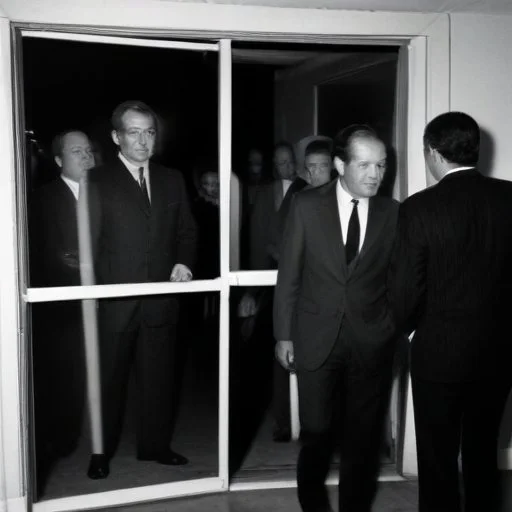
June 17, 1972: Five operatives, including Liddy, are arrested at the Watergate complex while attempting to install wiretaps and gather intelligence on the Democratic National Committee.
June-July 1972: Nixon's administration tries to cover up the scandal, denying any involvement and dismissing the incident as a "third-rate burglary."
September 1972: Bob Woodward and Carl Bernstein, two young reporters from The Washington Post, begin investigating the scandal, uncovering a trail of connections between the Nixon administration and the burglars.
January 1973: Liddy and fellow burglar James McCord are convicted of conspiracy, burglary, and wiretapping.
July 16, 1973: Alexander Butterfield, a Nixon aide, reveals the existence of secret tapes recording conversations between Nixon and his aides, which could implicate the president in the scandal.
August 9, 1974: Nixon resigns, becoming the first U.S. president to do so, as the House Judiciary Committee votes to impeach him on charges of obstruction of justice and abuse of power.
The Watergate scandal led to a complete overhaul of American politics, with far-reaching consequences that still resonate today:
The Watergate scandal marked a turning point in American history, with the public's trust in government and institutions significantly eroded:
The scandal inspired a wave of political activism, with many young people becoming involved in politics and social causes.
The scandal also led to a greater emphasis on accountability and transparency in government, with the media playing a crucial role in holding those in power accountable.
"I am not a crook." - Richard Nixon, November 17, 1973
"Follow the money." - Deep Throat (Mark Felt), advice to Bob Woodward and Carl Bernstein during their investigation
The Watergate scandal shares striking parallels with other notable political scandals, including the Teapot Dome Scandal of the 1920s and the Iran-Contra Affair of the 1980s. All three scandals involved abuse of power, corruption, and cover-ups, highlighting the need for accountability and transparency in government.
The Watergate scandal will forever be remembered as a dark chapter in American political history, a cautionary tale of the dangers of unchecked power and corruption. Yet, out of this crisis emerged a renewed commitment to transparency, accountability, and the rule of law, shaping the course of American politics for generations to come.
Liddy, a former FBI agent and Navy officer, was the brains behind the Watergate break-in and wiretapping operation. Born on August 30, 1930, in Hoboken, New Jersey, Liddy grew up in a middle-class family and developed a strong sense of patriotism from an early age.
Liddy's fascination with espionage and covert operations led him to join the FBI, where he worked closely with J. Edgar Hoover. However, his extremist views and militant approach often put him at odds with his superiors.
After being fired from the FBI, Liddy joined Nixon's re-election campaign and became involved in the Committee to Re-elect the President (CREEP). His experience in espionage and counter-intelligence made him the perfect candidate to lead the Watergate operation.

The Watergate scandal had a profound impact on popular culture, inspiring countless films, books, and documentaries. The scandal's intricate web of deceit and conspiracy captivated the American public, making it a staple of 1970s popular culture.
Films like All the President's Men (1976) and Watergate (1995) brought the scandal to life on the big screen, while books like Bob Woodward and Carl Bernstein's All the President's Men (1974) and Stanley Kutler's The Wars of Watergate (1990) provided in-depth analysis of the scandal.
The scandal also inspired numerous parodies and satires, including a famous Saturday Night Live skit featuring Dan Aykroyd as Nixon and John Belushi as H.R. Haldeman.
The Watergate scandal was not an isolated incident, but rather the culmination of a culture of corruption and abuse of power that permeated Nixon's administration.
Similarities can be drawn between Nixon's administration and that of President Warren G. Harding, who was embroiled in the Teapot Dome Scandal of the 1920s. Both scandals involved high-level officials engaging in illegal activities, abuse of power, and elaborate cover-ups.
Additionally, the Watergate scandal shares parallels with the Iran-Contra Affair of the 1980s, in which senior government officials secretly sold arms to Iran and diverted the proceeds to fund anti-Sandinista rebels in Nicaragua.

The historiography of Watergate has undergone significant revisions since the scandal broke in 1972. Initially, historians and journalists portrayed Watergate as a political aberration, a brief deviation from the norms of American democracy.
However, recent scholarship has challenged this view, arguing that Watergate was a symptom of deeper structural problems within American politics, including the rise of executive power and the decline of congressional oversight.
The Nixon tapes, recorded between 1971 and 1973, provide a unique window into the inner workings of the Nixon administration and the Watergate scandal.
The tapes, which include conversations between Nixon and his aides, reveal a culture of corruption and paranoia, with the president and his advisors discussing everything from political sabotage to hush money payments.
One of the most infamous recordings is the "smoking gun" tape, which captures Nixon ordering his aides to tell the CIA to stop the FBI's investigation into the Watergate break-in.