


The Watergate scandal, one of the most infamous political scandals in American history, is known for exposing the corrupt and clandestine actions of the Nixon administration, ultimately leading to the resignation of President Richard M. Nixon in 1974. At the heart of the scandal lies a secret recording of Nixon and his Chief of Staff, H.R. Haldeman, conspiring to use the Central Intelligence Agency (CIA) to obstruct the Federal Bureau of Investigation's (FBI) probe into the Watergate break-in.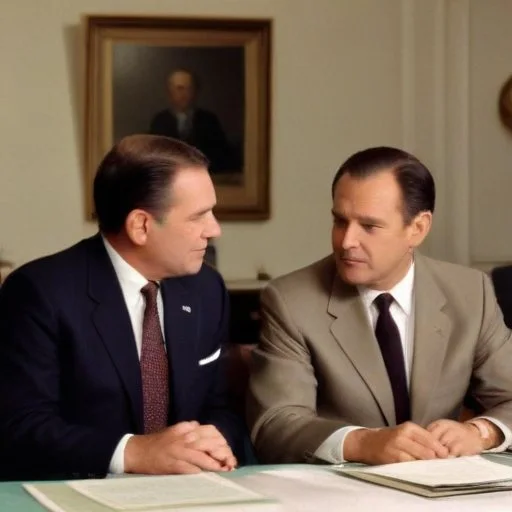
The roots of the Watergate scandal can be traced back to the tumultuous 1960s, a decade marked by widespread social unrest, political assassinations, and a growing distrust of government institutions. Nixon's presidency, which began in 1969, was characterized by a desire to consolidate power and suppress political opposition. The Democratic National Committee's headquarters, located in the Watergate complex in Washington D.C., became a focal point of Nixon's paranoia, as he believed the Democrats were plotting against him.
June 17, 1972: Five men, linked to the Nixon re-election campaign, are caught breaking into the Democratic National Committee's headquarters at the Watergate complex.
June 23, 1972: Nixon and Haldeman's fateful conversation, in which they discuss using the CIA to stifle the FBI's investigation, is secretly recorded.
July 1973: Alexander Butterfield, a former Nixon aide, reveals the existence of the Oval Office tapes, which include the incriminating conversation between Nixon and Haldeman.
August 1974: The House Judiciary Committee votes to impeach Nixon on charges of obstruction of justice, abuse of power, and contempt of Congress.
August 9, 1974: Nixon becomes the first U.S. President to resign from office.
The Watergate scandal led to a constitutional crisis, as the executive branch's abuse of power was challenged by the legislative and judicial branches. The scandal resulted in:
The Watergate scandal had a profound impact on American society, fueling a growing mistrust of government and institutions. The scandal:
One of the most enduring quotes of the Watergate era, Nixon's infamous declaration, "I am not a crook," has become a symbol of the President's defiant denial and eventual downfall.
The Watergate scandal serves as a cautionary tale about the dangers of unchecked power and the importance of a free press in holding those in power accountable. As a nation, we continue to grapple with the consequences of Nixon's actions, seeking to ensure that such abuses of power are never again tolerated.
H.R. Haldeman, Nixon's Chief of Staff, was a critical player in the Watergate scandal. Born on October 20, 1926, in Los Angeles, California, Haldeman was a decorated Navy veteran and a graduate of the University of Southern California.
Haldeman's rise to power began in the 1950s, when he worked as an advertising executive and later as a campaign aide for Nixon's 1960 presidential campaign. He eventually became Nixon's Chief of Staff in 1969, earning a reputation as a loyal and efficient administrator.
However, Haldeman's loyalty to Nixon would ultimately be his downfall. He was deeply involved in the Watergate cover-up, and his secret recordings of conversations with Nixon provided crucial evidence against the President.

The Watergate scandal has had a lasting impact on popular culture, inspiring countless films, books, and songs. From the iconic "All the President's Men" (1976) to the more recent "Mark Felt: The Man Who Brought Down the White House" (2017), the scandal has been reimagined and reinterpreted in various forms of media.
The scandal also inspired a wave of conspiracy-themed films, such as "The Parallax View" (1974) and "Three Days of the Condor" (1975), which reflected the public's growing paranoia and distrust of government institutions.
In music, the scandal inspired songs like "Watergate Blues" by Gil Scott-Heron and "Politics as Usual" by The J. Geils Band, which captured the mood of disillusionment and outrage that characterized the era.
The most damning piece of evidence against Nixon was the so-called "smoking gun" tape, a recording of a conversation between Nixon and Haldeman on June 23, 1972.
In this conversation, Nixon and Haldeman discuss using the CIA to stop the FBI's investigation into the Watergate break-in. This tape provided irrefutable evidence of Nixon's involvement in the cover-up and ultimately sealed his fate.
The tape was discovered in July 1973, and its contents were revealed to the public in August 1974, leading to Nixon's resignation.

The Watergate scandal precipitated a constitutional crisis, as the legislative and judicial branches clashed with the executive branch over issues of power and accountability.
The crisis began when Nixon refused to comply with congressional subpoenas, citing executive privilege. This led to a series of legal battles, including the landmark case of United States v. Nixon (1974), which ultimately forced Nixon to turn over the tapes.
The scandal highlighted the need for checks and balances on executive power, leading to reforms such as the Congressional Budget and Impoundment Control Act and the Freedom of Information Act.
While Nixon, Haldeman, and Ehrlichman dominate the narrative of the Watergate scandal, the five men who broke into the Democratic National Committee's headquarters on June 17, 1972, are often forgotten.
The burglars, including Bernard Barker, Virgilio Gonzalez, Eugenio Martinez, James W. McCord Jr., and Frank Sturgis, were all connected to the Nixon re-election campaign and had ties to the CIA and FBI.
Their botched break-in and subsequent arrests set off a chain of events that would eventually lead to Nixon's downfall, yet their own stories remain largely in the shadows of history.