


In 1983, the West German news magazine Stern made headlines around the world by publishing excerpts from what they claimed were the private diaries of Adolf Hitler, the infamous leader of Nazi Germany. However, the excitement was short-lived as it was soon discovered that the diaries were expertly crafted forgeries, leaving the public stunned and wondering how such a monumental hoax had gone undetected.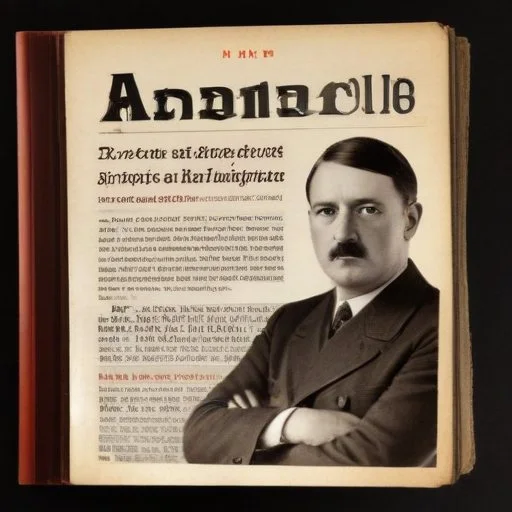
In the aftermath of World War II, the world was left grappling with the atrocities committed by the Nazi regime, and the fascination with Hitler's life and reign only continued to grow. As a result, there was a high demand for any material that could provide insight into the mind and actions of the dictator. It was in this context that Stern magazine thought they had stumbled upon a literary treasure trove.
The mastermind behind the forgery was Konrad Kujau, a petty thief and con artist with a talent for copying Hitler's handwriting. Kujau was able to create 60 volumes of diaries, complete with intricate details and convincing forgeries of Hitler's signature. The diaries were so convincing that even the most discerning experts were fooled, including the renowned historian and Hitler biographer, Hugh Trevor-Roper.
The revelation that the diaries were forgeries sent shockwaves through the historical community, with many experts left red-faced and reputation-damaged. The scandal also raised questions about the authenticity of historical documents and the trustworthiness of sources. Stern magazine was forced to issue a public apology and retract their story, while Kujau was arrested and charged with fraud.
The Hitler diary hoax had a significant impact on the field of historical scholarship, highlighting the importance of rigorous fact-checking and verification of sources. It also led to a re-evaluation of the way historical documents are authenticated and preserved. As a result, historians and researchers have become more cautious and meticulous in their approach, ensuring that such a scandal is never repeated.
The Hitler diary hoax serves as a stark reminder of the power of deception and the dangers of blindly accepting information as truth. It highlights the importance of critical thinking and skepticism, especially when dealing with sensitive and high-profile information. As Kujau's forgery demonstrated, even the most convincing and elaborate deceptions can be constructed with ease, and it is up to us to remain vigilant and critical.
The Hitler diary hoax serves as a cautionary tale about the dangers of deception and the importance of critical thinking. It highlights the need for rigorous verification and authentication of sources, especially when dealing with sensitive and high-profile information. As we reflect on this scandal, we are reminded that the pursuit of truth and accuracy is an ongoing battle, and one that requires constant vigilance and scrutiny.
The discovery of Hitler's diaries in 1983 sparked a frenzy of interest in the Nazi regime and its leaders. However, the forgery scandal that followed also led to a re-examination of the historical record and a renewed focus on the importance of verifying sources. This renewed scrutiny also shed light on the often-overlooked role of other key figures in the Nazi regime, including Heinrich Himmler, Hermann Göring, and Rudolf Hess, who played important roles in Hitler's inner circle.
These figures, often overshadowed by Hitler's dominant personality, were instrumental in shaping the Nazi party's ideology and policies. Himmler, as head of the SS, was responsible for overseeing the Holocaust, while Göring was a key strategist and diplomat. Hess, meanwhile, was a devoted follower who became increasingly disillusioned with Hitler's policies.
The Hitler diary forgery scandal led historians to re-examine the relationships between these figures and their roles in shaping the course of Nazi history. This re-examination has provided a more nuanced understanding of the complexities of the Nazi regime and the individuals who drove its policies.
Konrad Kujau, the mastermind behind the Hitler diary forgery, was a complex figure with a troubled past. Born in 1938 in Löbau, Saxony, Kujau grew up in a family of modest means and struggled in school. He turned to petty theft and forgery at an early age, eventually becoming a skilled art forger.
Kujau's talents as a forger were matched only by his bravado and confidence. He was able to convincingly recreate Hitler's handwriting and signature, even fooling experts who had studied the dictator's writing. However, Kujau's ego ultimately proved to be his downfall, as he became increasingly reckless and arrogant in his forgeries.
Despite his criminal past, Kujau's skills as a forger were so impressive that he was later hired by a German museum to create replicas of historical documents. This ironic twist of fate speaks to the enduring fascination with the Nazi regime and the importance of preserving historical artifacts.
The Hitler diary forgery scandal highlights the importance of historiographical rigor in the pursuit of historical truth. The scandal exposed the dangers of confirmation bias, as experts and journalists alike were eager to accept the diaries as authentic without subjecting them to rigorous scrutiny.
The scandal also underscores the importance of interdisciplinary collaboration in historical research. Historians, archivists, and forensic experts must work together to verify the authenticity of historical documents and artifacts.
Furthermore, the Hitler diary forgery serves as a reminder that historical scholarship is an ongoing process of discovery and revision. As new evidence emerges, historians must be willing to challenge and revise their existing narratives.
The Hitler diary forgery scandal took place against the backdrop of Cold War tensions and the ongoing struggle for German reunification. The scandal sparked a wave of anti-German sentiment, as many saw the forgery as a reflection of Germany's troubled past.
In the aftermath of the scandal, West Germany was forced to confront its own historical amnesia, as many Germans had deliberately ignored or downplayed the country's Nazi past. The scandal sparked a renewed effort to come to terms with this legacy, including the establishment of museums and memorials to the victims of the Holocaust.
The scandal also had implications for international relations, as it led to increased scrutiny of Germany's commitment to preserving historical records and artifacts.
The Hitler diary forgery scandal had a profound impact on popular culture, as it sparked a wave of satire and ridicule in the media. The scandal was seen as a symbol of the gullibility of the media and the public's insatiable appetite for sensationalism.
The scandal also inspired a range of artistic and literary works, including novels, plays, and films that explored the themes of deception, forgery, and historical fabrication.
Furthermore, the scandal led to increased scrutiny of the media's role in shaping public opinion, as many critics argued that the media had been too quick to accept the diaries as authentic without subjecting them to rigorous scrutiny.