


William's armada, comprising over 700 ships and an estimated 7,000 to 8,000 soldiers, knights, and archers, was a formidable force, honed by years of warfare in Normandy. The fleet, assembled at the mouth of the Somme, was a marvel of medieval naval engineering, with vessels ranging from sturdy transports to nimble warships.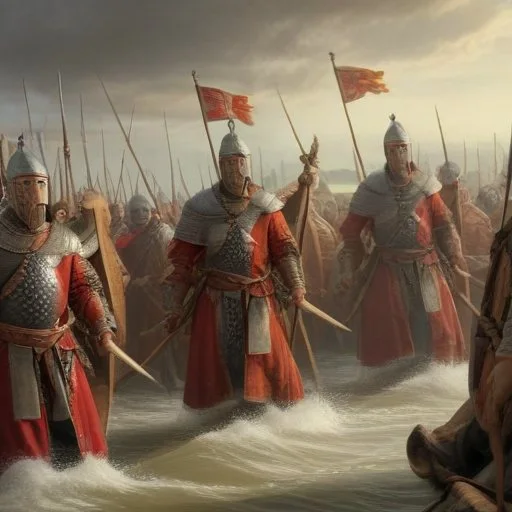
The Norman armada set sail on September 27, 1066, departing from the mouth of the Somme River, near the modern-day town of Saint-Valery-sur-Somme. The winds and tides were in their favor, allowing the fleet to make a remarkably swift crossing, landing at Pevensey Bay in Sussex, England, on September 28.

The Norman army swept across England, winning a decisive victory at the Battle of Hastings on October 14, 1066. King Harold II fell in the fray, and William, now the victorious Conqueror, claimed the throne of England. The subsequent years saw a wholesale transformation of English society, as William imposed Norman rule, language, and culture upon the land.
The Norman Conquest of England had far-reaching consequences, shaping the course of English history for centuries to come. The fusion of Norman and Anglo-Saxon cultures gave birth to a new English identity, influencing art, architecture, literature, and language. The legacy of William the Conqueror continues to reverberate through the ages, a testament to the power of courage, strategy, and ambition.
As we reflect on this pivotal moment, we are reminded that the winds of change can sweep across nations, reshaping the very fabric of history. The story of William the Conqueror's daring invasion serves as a potent reminder of the human spirit's capacity to shape the course of destiny.
William, also known as William the Bastard, was born circa 1028 to Robert I, Duke of Normandy, and Herleva, a tanner's daughter. Despite his illegitimate birth, William's strong leadership and military prowess earned him the respect of his nobles and the nickname "the Conqueror."
William's ambition and strategic thinking were key factors in the success of the Norman Conquest. He was a skilled diplomat, able to forge alliances and negotiate with neighboring kingdoms. Moreover, he was a just ruler, fair but firm, and his reputation as a strong leader inspired loyalty among his soldiers and nobles.
The Norman Conquest brought about a profound cultural shift in England. The fusion of Norman and Anglo-Saxon cultures resulted in a unique blend of language, architecture, and art. The Norman nobility introduced their own language, which eventually evolved into Middle English, while the Anglo-Saxon influence is still visible in the English language today.
The Norman Conquest also had a significant impact on English architecture. The construction of castles, such as the Tower of London, and the introduction of Romanesque architecture, characterized by the use of arches and vaults, transformed the English landscape. Furthermore, the Normans brought with them their own style of illuminated manuscripts and decorative arts, which enriched English art and literature.
The Norman Conquest of England took place in a complex web of alliances and rivalries between European kingdoms. The rivalry between the Duchy of Normandy and the Kingdom of England dated back to the Viking invasions of the 9th century. The Norman Conquest was, in part, a response to the threat posed by the English monarchy to Norman power and influence in Europe.
The Conquest also had far-reaching implications for the balance of power in Europe. The Norman victory weakened the Anglo-Saxon kingdom, creating a power vacuum that was exploited by other European kingdoms, such as the Kingdom of France and the Holy Roman Empire. The Norman Conquest, therefore, was a pivotal moment in the shaping of European geopolitics.
The Bayeux Tapestry is a 70-meter-long embroidered cloth that depicts the events leading up to the Norman Conquest of England. Commissioned by Bishop Odo of Bayeux, William's half-brother, the tapestry is a unique and valuable historical resource.
The tapestry provides a visual record of the Norman Conquest, showcasing the army's preparation, the Channel crossing, and the Battle of Hastings. It also offers insight into the daily life of the nobility and the common people of the time, as well as the architecture and warfare of the period.
The Bayeux Tapestry is not only an artistic masterpiece but also a historical treasure that has survived the test of time, offering a glimpse into the epic events of the Norman Conquest.
The Norman Conquest of England was a testament to the advancement of naval warfare in the 11th century. William's armada, comprising over 700 ships, was a marvel of medieval naval engineering. The fleet's ability to cross the English Channel, a feat considered impossible by many, was a demonstration of the Normans' mastery of shipbuilding, navigation, and maritime warfare.
The Norman Conquest also saw the introduction of new naval technologies, such as the use of the longship, a fast and maneuverable vessel, and the development of more sophisticated shipbuilding techniques. These advancements had a lasting impact on European naval warfare, paving the way for future maritime empires.