


On a fateful day in September 1066, William, Duke of Normandy, also known as William the Bastard, landed on the shores of Pevensey Beach in Sussex, England, marking the beginning of the Norman Conquest. This pivotal event would change the course of English history, bringing an end to Anglo-Saxon rule and ushering in a new era of Norman dominance.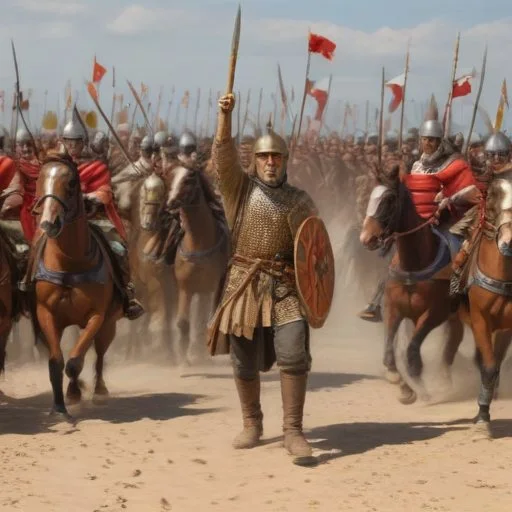
William's ambition to claim the English throne was rooted in his blood ties to the English monarchy. He was the great-nephew of King Edward the Confessor, who had died childless in January 1066. William believed that he was the rightful heir to the throne, and his claim was backed by Pope Alexander II, who saw the Norman Conquest as an opportunity to strengthen the Catholic Church's hold on England.
Meanwhile, the ruling Anglo-Saxon king, Harold II, was caught off guard by William's sudden invasion. Harold had just defeated an invading Norwegian army in the north, and his forces were weary and disorganized. The English army, largely made up of infantry and relying on traditional shield walls, was no match for the well-equipped and disciplined Norman army, which boasted skilled archers, knights, and men-at-arms.
The two armies clashed on October 14, 1066, at the Battle of Hastings. The Normans, led by William, employed a clever tactic of feigning retreat, which lured the English into a disorganized pursuit. The Norman cavalry then turned and attacked, decimating the English ranks. King Harold was killed in the battle, reportedly by an arrow to the eye, and William emerged victorious.
The Norman Conquest of England had far-reaching consequences. William was crowned King William I of England on Christmas Day 1066, and he began to impose Norman French as the language of the ruling class. The Anglo-Saxon aristocracy was largely replaced by Norman nobles, and the English language, culture, and politics were forever changed.
The Norman Conquest introduced feudalism to England, a system in which lords held power over vassals in exchange for military service and loyalty. This led to the development of a more centralized state, with a strong monarchy and administrative machinery. The Conquest also brought about significant cultural exchange, as Norman artisans, scholars, and clergy introduced their own traditions and customs to England.
The Norman Conquest of England had a profound impact on the development of the English language, culture, and politics. It brought about significant changes in the English monarchy, nobility, and administrative systems, and paved the way for the rise of a strong, centralized state. The Conquest also had far-reaching consequences for the English language, as French and Latin influences began to shape the language and literature of the British Isles.
William the Conqueror's landing in England marked the beginning of a new era in English history, one that would shape the course of the nation for centuries to come. The Norman Conquest remains one of the most significant events in English history, and its impact continues to be felt to this day.
William, Duke of Normandy, was a man of unyielding ambition and cunning strategy. Born out of wedlock to Robert I of Normandy and Herleva, a tanner's daughter, William's illegitimate birth did not hinder his rise to power. He was precocious and intelligent, understanding the importance of allegiances and strategic alliances from a young age.
William's claim to the English throne was not simply a matter of blood ties; it was a calculated move to expand his dominion and secure his legacy. His military prowess and tactical genius were instrumental in his victory at Hastings, and his subsequent reign as King William I of England.
Despite his ruthless determination, William was also a skilled politician and administrator, introducing reforms and policies that would shape the course of English history.

The Norman Conquest of England had a profound impact on the country's art and architecture. The influx of Norman craftsmen and architects introduced Romanesque styles, which replaced the Anglo-Saxon tradition of timber churches.
The construction of grand cathedrals, such as Canterbury and York Minster, showcased the Normans' mastery of stone carving, sculpture, and stained glass. The Bayeux Tapestry, a 70-meter long embroidery, is another example of Norman artistic excellence, depicting the events leading up to the Norman Conquest.
The fusion of Norman and Anglo-Saxon styles gave rise to a unique English aesthetic, characterized by the use of stone, arches, and vaults. This cultural exchange continued to influence English art and architecture for centuries to come.
The Norman Conquest of England took place amidst a tumultuous period in European history. The fragmentation of power, the rise of feudalism, and the struggle for dominance among noble families created an environment of instability and competition.
In this context, William's invasion of England was part of a larger pattern of territorial expansion and consolidation. The Normans had already established themselves as a dominant force in Northern France, and England was a prized addition to their empire.
The Norman Conquest also had significant implications for the broader European landscape, as it marked the beginning of a new era of Anglo-Norman relations that would shape the course of European politics and culture.

The Norman Conquest brought about a radical reorganization of the English government. William replaced the Anglo-Saxon system of earldoms with a feudal hierarchy, where power was concentrated in the hands of a few powerful nobles.
The introduction of a strong centralized monarchy, coupled with the establishment of a robust administrative system, enabled William to exert control over his new territory. The creation of the Curia Regis, a council of high-ranking officials, advised the king on matters of state and justice.
This reorganization of government laid the foundations for a more efficient and effective system of governance, which would characterize English politics for centuries to come.
Historians have long debated the significance and implications of the Norman Conquest. Some have viewed it as a catastrophic event that destroyed Anglo-Saxon culture and identity, while others have interpreted it as a necessary step towards the development of a more sophisticated and centralized state.
Despite these differing interpretations, the Norman Conquest remains a pivotal event in English history, continues to fascinate and inform historians, and shape our understanding of the medieval period.