


October 1915 marked a somber chapter in the annals of World War I, as the combined might of Austria-Hungary, Germany, and Bulgaria launched a crushing offensive against Serbia, under the seasoned command of August von Mackensen. This pivotal assault, known as the Serbian Campaign, would prove to be a decisive moment in the war, shaping the course of history and sealing the fate of a nation.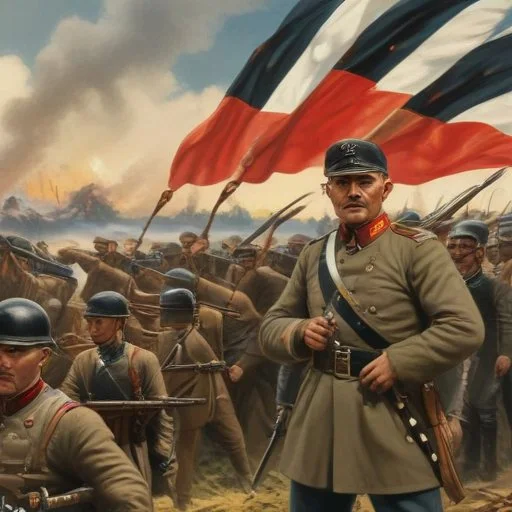
In the summer of 1914, the assassination of Archduke Franz Ferdinand of Austria-Hungary sparked a chain reaction of events that drew Europe into the abyss of war. As tensions escalated, Serbia, a small but fiercely independent nation, found itself at the crossroads of rival alliances. Despite its valiant efforts to maintain neutrality, Serbia soon became embroiled in the conflict, earning the wrath of the Central Powers.
At the helm of the Central Powers' forces stood General August von Mackensen, a battle-hardened commander with a reputation for strategic brilliance. With a storied military career spanning over three decades, Mackensen had earned the respect of his peers and the fear of his enemies. His meticulous planning and tactical prowess would prove instrumental in the Serbian Campaign.
The Serbian Campaign dealt a crippling blow to the country, forcing its government and military into exile. The human toll was staggering, with estimates suggesting that over 1 million Serbians lost their lives during the war. The campaign also marked a significant shift in the balance of power, as the Central Powers secured a crucial victory that would have far-reaching consequences for the war's outcome.
The Serbian Campaign had a profound impact on Serbian culture and identity, forging a sense of national resilience and determination. The struggle against overwhelming odds became a defining moment in Serbian history, shaping the nation's collective psyche and inspiring future generations to fight for their freedom and independence.
In the annals of military history, the Serbian Campaign stands as a testament to the strategic brilliance of August von Mackensen. While the campaign was marked by brutality and devastation, it remains a powerful reminder of the human spirit's capacity to persevere in the face of overwhelming adversity. As we reflect on this pivotal moment in World War I, we honor the memories of those who fought and suffered, and draw inspiration from their courage and sacrifice.
The Serbian Campaign was not only a military conflict but also a human tragedy that unfolded on multiple fronts. As the Austro-Hungarian and German forces advanced, they left a trail of destruction, pillage, and rape in their wake. Civilians, including women and children, were forced to flee their homes, leaving behind their belongings and livelihoods. The campaign also saw the introduction of new warfare tactics, including the use of artillery and poison gas, which further exacerbated the humanitarian crisis.
One of the most devastating aspects of the campaign was the deliberate targeting of civilian populations. The Central Powers' forces employed a scorched earth policy, burning villages and crops, and slaughtering livestock to prevent them from falling into Serbian hands. This strategy not only affected the civilian population but also had long-term consequences for the country's infrastructure and economy.
The Siege of Belgrade, a pivotal event in the campaign, lasted for over a month, with both sides suffering heavy losses. The siege was marked by intense artillery bombardments, which reduced much of the city to rubble. The fall of Belgrade on October 9, 1915, was a crushing blow to Serbian morale and marked a turning point in the campaign.
August von Mackensen, the mastermind behind the Serbian Campaign, was a highly decorated and respected military commander. Born on December 30, 1849, in Brandenburg, Prussia, Mackensen rose through the ranks of the German army, earning a reputation for his tactical genius and leadership skills. He saw action in several conflicts, including the Franco-Prussian War and the Boxer Rebellion, before being appointed as the commander of the German Eleventh Army in 1914.
Mackensen's personality was marked by his calm and reserved demeanor, which earned him the nickname "the Iron General." He was a meticulous planner, known for his attention to detail and ability to inspire loyalty among his troops. Despite his tough exterior, Mackensen was deeply concerned about the welfare of his soldiers and was often seen on the front lines, offering words of encouragement and support.
Under Mackensen's command, the German army won several decisive victories, including the Battle of Gorlice-Tarnow and the Battle of Lodz. His reputation as a military strategist and leader was cemented during the Serbian Campaign, which earned him the Pour le Mérite, Germany's highest military honor.
The Serbian Campaign had a profound impact on Serbian culture and identity, shaping the nation's collective psyche and inspiring future generations to fight for their freedom and independence. The struggle against overwhelming odds became a defining moment in Serbian history, fostering a sense of national resilience and determination.
The campaign also had a significant impact on Serbian art, literature, and music. Many Serbian writers, poets, and artists drew inspiration from the conflict, creating works that reflected the nation's suffering and sacrifice. The campaign became a symbol of Serbian resistance and courage, inspiring a new wave of nationalist sentiment and cultural expression.
The Serbian Campaign has been immortalized in popular culture, with numerous films, books, and songs dedicated to the conflict. The campaign's legacy continues to be felt today, with many Serbians regarding it as a source of national pride and a testament to the country's ability to persevere in the face of adversity.
The Serbian Campaign was not an isolated conflict but rather part of a broader struggle for dominance in the Balkans. The campaign was closely tied to the larger war effort, with the Central Powers seeking to crush Serbia as a means of securing a strategic advantage in the region.
In comparison to other military campaigns of World War I, the Serbian Campaign was marked by its brutal efficiency and speed. The combined might of Austria-Hungary, Germany, and Bulgaria overwhelmed the Serbian army, forcing it to retreat in disarray. The campaign's outcome was a decisive victory for the Central Powers, which secured a crucial strategic advantage in the Balkans.
The Serbian Campaign shares parallels with other military campaigns of the war, including the German invasion of Belgium and the Austro-Hungarian campaign in Galicia. Each of these campaigns involved a powerful military force seeking to crush a smaller opponent, often with devastating consequences for civilians and combatants alike.
The Serbian Campaign has been subject to varying interpretations and assessments by historians, with some viewing it as a crucial turning point in the war and others regarding it as a peripheral conflict. The campaign's significance has been debated by scholars, with some arguing that it was a decisive victory for the Central Powers and others contending that it was a pyrrhic victory that ultimately contributed to the Allied victory.
Historians have also grappled with the campaign's legacy, with some portraying it as a heroic struggle for Serbian independence and others viewing it as a brutal and devastating conflict that had catastrophic consequences for the country and its people.
The Serbian Campaign has been the subject of numerous historical accounts, including works by Serbian, Austrian, German, and British historians. Each of these accounts offers a unique perspective on the campaign, reflecting the biases and assumptions of the authors and the times in which they wrote.