


The Battle of Megiddo, fought from September 19 to 25, 1918, marked the climax of the British Army's Sinai and Palestine campaign under General Edmund Allenby. It was a decisive victory that would ultimately lead to the surrender of the Ottoman Empire, a pivotal moment in World War I.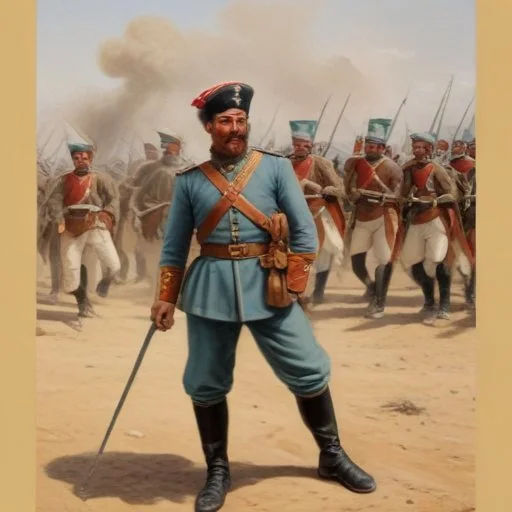
In the wake of the Russian Revolution, the Ottoman Empire, sensing an opportunity, launched a surprise attack on the Suez Canal in 1915. The British, determined to protect their vital trade route, responded with a series of military campaigns in the Sinai and Palestine regions.
By the summer of 1918, General Allenby's seasoned troops had been battling the Ottoman forces for years, pushing them back through the desert landscapes of Sinai and into Palestine. The stage was set for a final, decisive confrontation.
The Battle of Megiddo was a series of intense skirmishes fought over six days, as the British Army clashed with the Ottoman forces. Allenby's troops, bolstered by the arrival of fresh reinforcements, launched a surprise attack on the Ottoman lines, exploiting a weakness in their defenses.
The British cavalry charges, led by the Australian Mounted Division, proved decisive, shattering the Ottoman lines and sending their troops into a chaotic retreat. As the enemy faltered, Allenby's forces pressed their advantage, pushing forward and securing a crushing victory.
The Battle of Megiddo marked a turning point in the war, as the Ottoman Empire, realizing the futility of further resistance, began to negotiate surrender terms. The battle also paved the way for the capture of Damascus, Aleppo, and other key cities, ultimately leading to the defeat of the Ottoman Empire.
The Battle of Megiddo had far-reaching cultural and social implications, as the defeat of the Ottoman Empire marked the end of an era in Middle Eastern politics. The victory also bolstered British prestige and influence in the region, shaping the course of modern history.
General Allenby, in his dispatches, praised the bravery and tenacity of his troops, noting that "the Australian Mounted Division, in particular, had done magnificent work." The battle also saw the valiant efforts of the Indian Army, which played a crucial role in securing the victory.
The Battle of Megiddo had significant implications for the post-war settlement, as the defeat of the Ottoman Empire led to the redrawing of the Middle Eastern map. The victory paved the way for the creation of modern nation-states, including Iraq, Syria, and Jordan.
The Battle of Megiddo was a costly one, with over 1,500 British and Commonwealth soldiers killed or wounded. The legacy of their sacrifice is remembered to this day, as a testament to the bravery and sacrifice of those who fought for their countries.
"The Battle of Megiddo will go down in history as one of the most brilliant and decisive victories of the war." - General Edmund Allenby
The Battle of Megiddo shares similarities with other decisive battles of World War I, such as the Battle of Amiens and the Battle of Vittorio Veneto. All three battles marked significant turning points in the war, as the Allies began to gain the upper hand against their enemies.
The Battle of Megiddo serves as a reminder of the bravery and sacrifice of those who fought for their countries during World War I. It is a testament to the power of determination and perseverance in the face of adversity.
The Australian Mounted Division, led by General Henry W. Hodgson, played a crucial role in the Battle of Megiddo. Hodgson's leadership and tactical prowess were instrumental in breaking through the Ottoman lines, allowing the British cavalry to secure a decisive victory.
Hodgson's men, largely consisting of Australian and New Zealand soldiers, had been battle-hardened through years of fighting in the Sinai and Palestine campaign. Their bravery and tenacity were exemplified during the Battle of Megiddo, where they faced intense Ottoman resistance.
Hodgson's LegacyGeneral Hodgson's contribution to the Allied victory in the Battle of Megiddo earned him great acclaim. He was hailed as a hero in Australia and New Zealand, and his leadership was recognized by General Allenby himself.

The defeat of the Ottoman Empire at the Battle of Megiddo had far-reaching cultural implications for the Middle East. The collapse of Ottoman rule led to the rise of modern nation-states, including Iraq, Syria, and Jordan, which would go on to shape the region's politics and identity.
The Battle of Megiddo also marked the beginning of a new era in Arab nationalism, as the defeat of the Ottoman Empire created a power vacuum that would be filled by emerging nationalistic movements.
The End of an EraThe Battle of Megiddo signaled the end of Ottoman dominance in the Middle East, a development that would have lasting impacts on the region's cultural and political landscape.
The Battle of Megiddo took place against the backdrop of a rapidly changing geopolitical landscape. The Russian Revolution had pulled Russia out of the war, allowing the Ottoman Empire to focus its attention on the Middle East.
The British, determined to protect their interests in the region, responded with a series of military campaigns aimed at pushing the Ottomans out of Palestine and Sinai.
A Shift in PowerThe Battle of Megiddo marked a significant shift in power in the Middle East, as the British emerged as the dominant force in the region. This development would have lasting implications for the region's politics and international relations.

The Battle of Megiddo has left behind a rich legacy of artifacts and documents, providing valuable insights into the tactics, strategies, and experiences of those who fought in the battle.
The British Imperial War Museum holds a vast collection of artifacts from the Battle of Megiddo, including military uniforms, equipment, and personal belongings of soldiers who fought in the battle.
A Window into the PastThe artifacts and documents from the Battle of Megiddo serve as a window into the past, offering a unique perspective on one of the most pivotal battles of World War I.
The Battle of Megiddo was not the first time that the ancient city of Megiddo had witnessed a pivotal battle. In 1469 BCE, the Egyptian pharaoh Thutmose III had defeated a coalition of Canaanite cities at the same site, marking a significant milestone in ancient history.
The city of Megiddo had long been a strategic location, controlling the passage between the Mediterranean coast and the Jordan Valley.
A Site of Ancient SignificanceThe coincidence of two battles, one ancient and one modern, sharing the same name and location, serves as a testament to the enduring importance of Megiddo as a site of historical significance.