


In the midst of the Great War, as the world's attention was fixated on the blood-soaked battlefields of Verdun and the Somme, a daring maneuver was unfolding in the Balkans. On October 5, 1915, Entente forces, spearheaded by the French and British, landed in Thessaloniki, Greece, marking the inception of the Macedonian front against the Central Powers.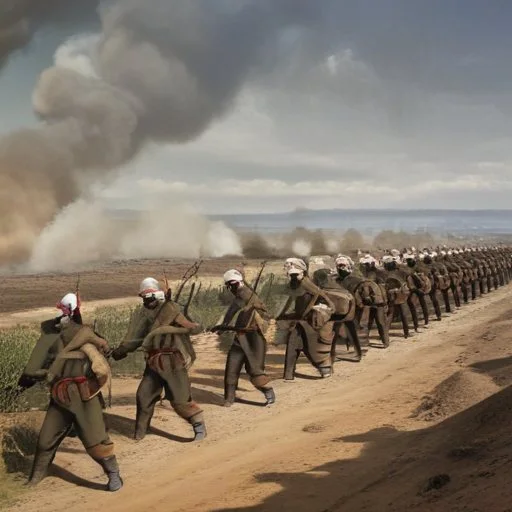
This bold move was designed to alleviate the crushing pressure on Serbia, which was buckling under the relentless onslaught of Bulgarian and Austro-Hungarian forces. By opening a new front, the Entente powers aimed to divide the enemy's attention, disrupt their supply lines, and create a fresh battleground that would ultimately tip the balance of the war.
Thessaloniki, a strategic port city in northern Greece, was chosen as the entry point for the Allied forces. The region's rugged terrain, crisscrossed by rivers and mountains, would prove a formidable challenge for both sides. The Macedonian front would stretch from the Adriatic coast to the shores of the Aegean, encompassing modern-day Greece, Albania, and Macedonia.
The multinational coalition that converged on Thessaloniki was a testament to the complexity of the war effort. The French, led by General Maurice Sarrail, formed the backbone of the expeditionary force, alongside British, Serbian, Italian, and Russian contingents. This diverse army of over 400,000 soldiers would face off against a formidable enemy, determined to hold its ground.
The Central Powers, comprised of Germany, Austria-Hungary, and Bulgaria, had been making gains in the region since the start of the war. Their stranglehold on Serbia was tightening, and their sights were set on Greece, a key prize in the Mediterranean. The arrival of the Entente forces threatened to upset the delicate balance of power, prompting a fierce reaction from the Central Powers.
The Macedonian front would become a grueling, three-year slog, marked by brutal fighting, disease, and trench warfare. The battle-scarred landscape of Dojran, Lake Prespa, and Salonica would witness some of the most intense combat of the war, with both sides suffering heavy losses. Despite the Entente's superior manpower and resources, the conflict would settle into a stalemate, with neither side able to gain a decisive advantage.
The Macedonian campaign would ultimately contribute to the defeat of the Central Powers, as the Allies capitalized on the diversion of resources and manpower to this new front. The war would claim the lives of over 100,000 soldiers, leaving deep scars on the region and its people. The significance of the Macedonian front, however, extends beyond the battlefields – it serves as a testament to the strategic ingenuity and sacrifice of those who fought to shape the course of history.
The landing of Entente forces in Thessaloniki marked a significant turning point in the war, as it forced the Central Powers to divert resources from the Western Front. This strategic decision was made possible by the efforts of Serbian diplomats, who had been secretly negotiating with the Entente powers for months. In April 1915, Serbia's Prime Minister Nikola Pašić had signed a secret agreement with the Entente, promising to allow the transportation of troops through Greek territory. This agreement paved the way for the eventual landing of Entente forces in Thessaloniki.
General Maurice Sarrail, the commander of the French Army of the Orient, played a crucial role in the Macedonian campaign. A career military officer with a reputation for bravery and tactical genius, Sarrail was tasked with leading the multinational force against the Central Powers. Despite facing numerous challenges, including supply chain disruptions and disease outbreaks, Sarrail's leadership helped to stabilize the front and ultimately contributed to the defeat of the Central Powers.
The Macedonian front was marked by stark contrasts between the two opposing armies. While the Entente forces boasted superior numbers and resources, the Central Powers had the advantage of familiarity with the terrain and a well-established supply chain. The Entente forces, on the other hand, had to navigate the treacherous terrain and contend with the harsh Balkan climate. This contrast would play out in the battlefield, as the two sides engaged in a series of brutal and bloody skirmishes.

The Macedonian campaign had a profound impact on the cultural landscape of the region. The influx of foreign troops and supplies led to a cultural exchange between the local population and the occupying forces. This exchange had lasting consequences, as local artists, musicians, and writers were exposed to new ideas and influences. The campaign also led to the destruction of cultural artifacts and historical sites, leaving a lasting scar on the region's cultural heritage.
The Macedonian front was situated at the crossroads of several empires, including the Ottoman, Austro-Hungarian, and Russian empires. This complex web of alliances and rivalries had been unfolding for centuries, and the outbreak of World War I only added to the complexity. The Entente powers' decision to open a new front in the Balkans was a direct challenge to the Central Powers' dominance in the region, and marked a significant shift in the global balance of power.