


Known as the battle that saved Paris from certain capture, the First Battle of the Marne marked a crucial turning point in World War I, halting the Imperial German Army's relentless advance into France. This pivotal clash would alter the course of the war, marking a significant shift in the balance of power between the Allies and the Central Powers.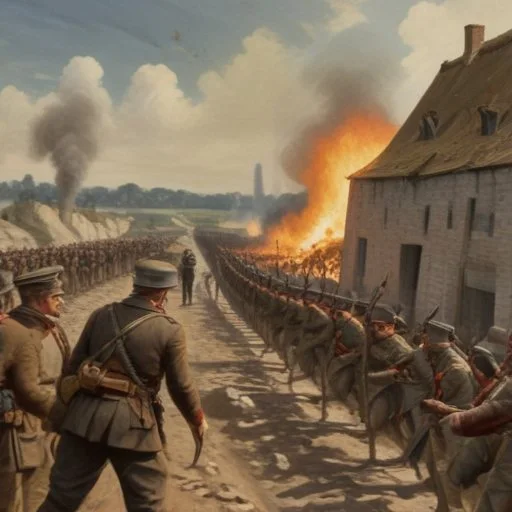
In the summer of 1914, Germany, led by the Schlieffen Plan, launched a surprise attack on France, hoping to quickly defeat the French Army and then focus on Russia. The plan seemed to be working, with the German Army making rapid gains, pushing deep into France. However, the Allies, led by French General Joseph Joffre and British General Lord Kitchener, were determined to stop the German advance.
The stage was set for a colossal clash on September 5, 1914, as the German Army, led by General Helmuth von Moltke, encountered the entrenched Allied forces along the Marne River. For two days, the armies clashed in a frenzy of artillery fire, cavalry charges, and brutal trench warfare. The Germans, caught off guard by the Allies' cunning tactics, were initially confident of victory, but their momentum began to falter.
As the battle raged on, the Allies' tactical superiority began to pay off. The French Army, bolstered by the arrival of troops from Paris, launched a series of decisive counterattacks, pushing the Germans back. Meanwhile, the British Expeditionary Force (BEF) played a crucial role, exploiting the Germans' exposed flank and further weakening their position.
The First Battle of the Marne ended on September 12, 1914, with the German Army in full retreat. The Allies had successfully halted the German advance, saving Paris from capture and altering the course of the war. Although the battle was far from decisive, it marked a significant shift in momentum, as the German Army began to dig in for a long and bloody war of attrition.
The First Battle of the Marne had far-reaching consequences, setting the tone for the rest of the war. The battle highlighted the importance of trench warfare, leading to the development of new tactics and technologies. It also marked a turning point in the war, as the Allies began to take the initiative, eventually pushing the Germans back and paving the way for the Allied victory in 1918.
General Helmuth von Moltke: The Architect of Germany's War Effort
General Helmuth von Moltke was a brilliant and experienced military strategist who played a crucial role in shaping Germany's war effort during World War I. As the Chief of the General Staff, Moltke was responsible for implementing the Schlieffen Plan, a bold and ambitious strategy designed to quickly defeat France and then focus on Russia. Despite his initial successes, Moltke's confidence and overreliance on the plan ultimately led to the German Army's defeat at the First Battle of the Marne.
Moltke's leadership style was marked by caution and hesitation, often prioritizing defensive strategies over bold offensive maneuvers. This approach ultimately proved disastrous, as the German Army became bogged down in a prolonged and bloody war of attrition.

The Geopolitical Context of the First Battle of the Marne
In the years leading up to World War I, the European continent was a complex web of alliances and rivalries. The Franco-Russian Alliance, formed in 1894, had created a sense of unease in Germany, which felt encircled by its powerful neighbors. The assassination of Archduke Franz Ferdinand in June 1914 sparked a chain reaction of events, as Austria-Hungary declared war on Serbia, followed by the declarations of war by Germany on Russia and France.
The First Battle of the Marne was fought against this backdrop of escalating tensions and competing alliances. The battle was a critical moment in the war, as the outcome would determine the fate of Europe and the balance of power for generations to come.
The Technological Impact of the First Battle of the Marne
The First Battle of the Marne was a bloody and brutal conflict that saw the widespread use of new and devastating technologies. The introduction of artillery, machine guns, and trench warfare marked a significant shift in the nature of modern warfare. The battle highlighted the importance of mobility and adaptability, as the Allies' superior use of rail networks and logistics allowed them to rapidly deploy troops and supplies.
The battle also saw the early use of airpower, with reconnaissance planes playing a critical role in gathering intelligence and directing artillery fire. The First Battle of the Marne set the tone for the rest of the war, highlighting the importance of technological innovation and superiority in modern warfare.

The Economic Impact of the First Battle of the Marne
The First Battle of the Marne had significant economic implications for all parties involved. The battle marked a critical turning point in the war, as the German Army's advance was halted and the Allies began to take the initiative. This shift in momentum had a profound impact on the global economy, as the war effort became increasingly industrialized and total.
The battle also led to a significant increase in government spending and mobilization, as countries redirected resources towards the war effort. The war would ultimately lead to widespread economic devastation, inflation, and widespread unemployment.
Historiographical Perspectives on the First Battle of the Marne
The First Battle of the Marne has been the subject of intense historical debate and analysis. Historians have long disagreed on the significance of the battle, with some viewing it as a decisive turning point in the war, while others argue that it was a mere pause in the German Army's relentless advance.
Recent scholarship has shed new light on the battle, highlighting the critical role played by Allied logistics and supply chains. The battle has also been reevaluated in the context of modern theories of warfare, with historians arguing that it marked a significant shift towards total war and the industrialization of warfare.