


The Dardanelles, a narrow strait in northwest Turkey, was the focal point of a critical Allied operation in World War I. On February 19, 1915, a powerful Anglo-French naval task force unleashed a barrage of heavy artillery fire on Ottoman defenses along the Gallipoli coast, marking the beginning of a brutal and costly campaign.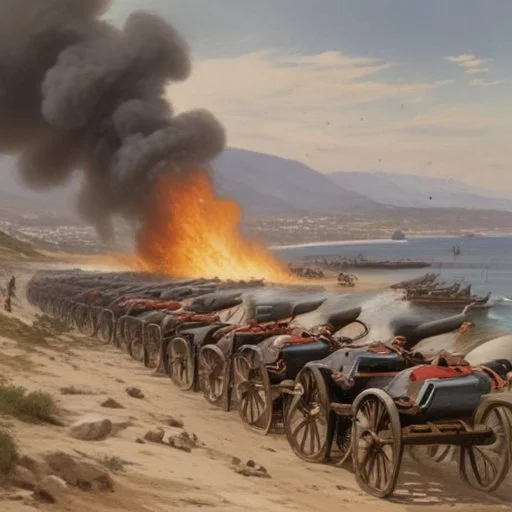
The Allies' ultimate goal was to capture the strategic Dardanelles, thereby securing control of the Bosphorus and gaining a vital supply route to Russia. This would enable the Allies to relieve pressure on the Eastern Front, where Russian forces were struggling against the German army.
The Anglo-French naval task force, comprising 16 battleships, was an imposing force. Led by British Admiral Sackville Carden, the fleet included some of the most modern and powerful warships of the time, such as the HMS Queen Elizabeth and the French battleship Bouvet. The Allies were confident that their superior firepower would swiftly dismantle the Ottoman defenses and pave the way for a swift victory.
The Ottoman Empire, however, was not about to yield without a fight. The defenders, led by German General Otto Liman von Sanders, had meticulously prepared their defenses, constructing a network of forts, trenches, and artillery emplacements along the Gallipoli coast. The Ottomans were determined to protect their territory and maintain control of the vital waterway.
At 10:00 AM on February 19, the Allied fleet opened fire on the Ottoman defenses. The initial barrage lasted for several hours, with the Allies firing over 1,000 shells at the Ottoman positions. Despite the intensity of the bombardment, the Ottoman defenses held firm, and the Allies were forced to regroup and reassess their strategy.
One of the most iconic accounts of the Gallipoli campaign comes from Australian journalist and soldier, Keith Murdoch, who wrote: "The whole place is a graveyard, and the stench is beyond description... The Turks are superb fighters, and they are fighting for their homes and their country."
The Gallipoli campaign shares similarities with other amphibious assaults in history, such as the Allied invasion of Normandy during World War II. Both operations involved complex planning, massive firepower, and significant losses on both sides.
The Gallipoli campaign remains one of the most significant and controversial events of World War I. The bravery and sacrifice of the soldiers on both sides are still commemorated today, and the campaign serves as a poignant reminder of the devastating consequences of war.
British Admiral Sackville Carden, a seasoned naval officer, was tasked with leading the Anglo-French task force in the Dardanelles campaign. Despite his reservations about the operation's feasibility, Carden was pressured by Winston Churchill, then First Lord of the Admiralty, to proceed with the attack. Carden's reluctance was justified, as the campaign ultimately proved disastrous for the Allies.
Carden's cautious nature and lack of enthusiasm for the operation would later be cited as contributing factors to the campaign's failure.
The Dardanelles campaign was not just a military operation, but also a reflection of the complex geopolitical landscape of World War I. The Ottoman Empire, once a dominant power in the region, was now fighting for its survival against the Allied forces. The campaign was also influenced by the rivalries between the great powers, with Russia seeking to gain control of the Bosphorus and Germany supporting the Ottoman Empire.
The campaign was a microcosm of the larger struggle for power and influence in the region.
The Dardanelles campaign had a profound impact on the cultural landscape of the nations involved. In Australia, the campaign marked the first major military engagement of the war, and the subsequent heavy losses suffered by Australian forces helped to shape the country's national identity. In Turkey, the campaign is still remembered as a symbol of national resistance against foreign invasion.
The campaign also inspired a range of literary and artistic works, including poems, novels, and films that continue to influence popular culture today.
The Dardanelles campaign saw the introduction of new technologies that would go on to shape the course of modern warfare. The campaign marked the first use of naval gunfire support, as well as the deployment of early submarines and mines. The failure of the campaign also led to the development of new tactics and strategies, including the use of combined arms and amphibious landings.
The campaign's legacy can be seen in the modern naval and amphibious forces of today.
Historians have long debated the significance and impact of the Dardanelles campaign. While some have portrayed the campaign as a doomed venture from the outset, others have argued that it was a bold and innovative attempt to break the stalemate on the Western Front. Recent scholarship has sought to reevaluate the campaign's significance, highlighting the importance of understanding the complex contextual factors that shaped the operation.
By reexamining the campaign through a historiographical lens, we can gain a deeper appreciation for the complexities and contradictions of World War I.