


The sinking of the RMS Lusitania on May 7, 1915, is one of the most notorious maritime disasters in history, claiming the lives of 1,199 people, including 128 Americans. This brutal act of aggression by the German U20 submarine not only shocked the world but also marked a critical turning point in World War I, drawing the United States closer to the conflict.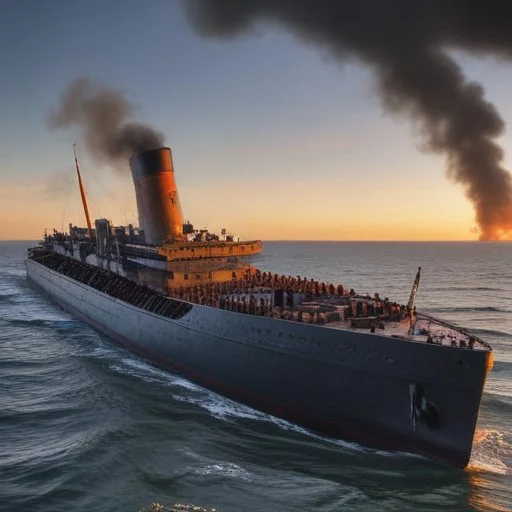
As World War I raged on, Germany's naval blockade of Britain had severely limited the island nation's ability to import essential supplies. In response, Britain implemented its own naval blockade, severely impeding Germany's ability to import goods. This led to a dramatic increase in the use of submarines, or U-boats, by the German navy to target British merchant vessels.
The Lusitania, a British-owned luxury passenger liner, set sail from New York on May 1, 1915, bound for Liverpool. On board were over 1,900 passengers, including many women and children. The ship was also carrying a cargo of explosives, rifle ammunition, and other war-related materials, making it a legitimate target for the German U-boats.
At 2:10 pm on May 7, 1915, the U20 submarine, under the command of Walther Schwieger, fired a single torpedo that struck the Lusitania on its starboard side. The ship sank just 18 minutes later, sending hundreds of passengers to their deaths in the freezing waters of the North Atlantic.
The sinking of the Lusitania sparked widespread outrage across the United States, with many Americans condemning Germany's actions as barbaric and inhumane. The tragedy turned many former pro-Germans against the German Empire, and public opinion shifted dramatically in favor of entering the war on the side of the Allies.
The sinking of the Lusitania remains a controversial topic, with many arguing that the ship was a legitimate target due to its cargo of war-related materials. Others have questioned the role of the British government in allowing the ship to sail despite knowing the risks, and the subsequent cover-up of the true nature of the cargo.
Survivor accounts of the tragedy paint a harrowing picture of panic and chaos as passengers scrambled to escape the sinking ship. Many stories of bravery and heroism have also emerged, including that of Second Officer Charles Lightoller, who helped hundreds of passengers to safety before the ship sank.
The sinking of the Lusitania played a significant role in shaping the course of World War I, and its impact can still be felt today. The tragedy highlighted the importance of protecting civilians in times of war and led to the development of international laws and conventions governing maritime warfare.
The sinking of the Lusitania serves as a poignant reminder of the devastating consequences of war and the importance of promoting peace and international cooperation. The tragedy also highlights the bravery and resilience of those who risked their lives to save others, inspiring generations to come.
Walther Schwieger, the commander of the U20 submarine, was a seasoned German naval officer who had already sunk several Allied ships before targeting the Lusitania. Born in 1885, Schwieger came from a military family and was trained at the German Naval Academy. He was known for his tactical skills and bravery, earning him the Iron Cross, a prestigious German military honor. Schwieger's decision to sink the Lusitania was seen as a calculated move to disrupt British supply lines and gain a strategic advantage for Germany.
The sinking of the Lusitania sparked widespread international outrage, with many countries condemning Germany's actions as barbaric and inhumane. The British government, in particular, was vocal in its criticism, calling the attack a "cold-blooded massacre." The United States, while initially cautious in its response, eventually issued a strong condemnation of Germany's actions, which contributed to a shift in public opinion in favor of entering the war. Other European countries, such as France and Russia, also condemned the attack, further isolating Germany diplomatically.
The sinking of the Lusitania took place against the backdrop of a rapidly changing geopolitical landscape. The war had already been raging for nearly a year, and the alliances formed by the major powers had created a complex web of tensions and rivalries. The sinking of the Lusitania was seen as a bold move by Germany to challenge British hegemony and assert its own dominance on the world stage. In this context, the tragedy can be seen as a turning point in the war, marking a shift towards more brutal and total warfare.
The sinking of the Lusitania highlighted the importance of submarine warfare in modern naval combat. The U20's attack demonstrated the vulnerability of surface ships to underwater attacks, leading to a significant shift in the development of naval technologies. The tragedy spurred the development of sonar, depth charges, and convoy systems, which would become crucial in future naval conflicts. The Lusitania's sinking also led to improvements in shipbuilding, including the use of armor plating and watertight compartments.
The sinking of the Lusitania has been the subject of intense historiographical debate, with historians arguing over the motivations behind the attack, the role of the British government, and the impact of the tragedy on the war. Some historians have portrayed the sinking as a ruthless act of terror, while others have seen it as a desperate attempt by Germany to gain a strategic advantage. The debate has also focused on the role of propaganda in shaping public opinion, with some arguing that the British government exploited the tragedy to sway American public opinion in favor of entering the war.