


In a daring display of bravery and strategic precision, the 11th Airborne Division, alongside Filipino guerrillas, executed a stunning rescue mission, freeing 2,147 Allied prisoners of war from the notorious Los Baños internment camp, 30 miles southeast of Manila, Philippines. This textbook airborne operation, hailed by General Colin Powell as an exemplar for all ages and armies, marked a pivotal moment in World War II history.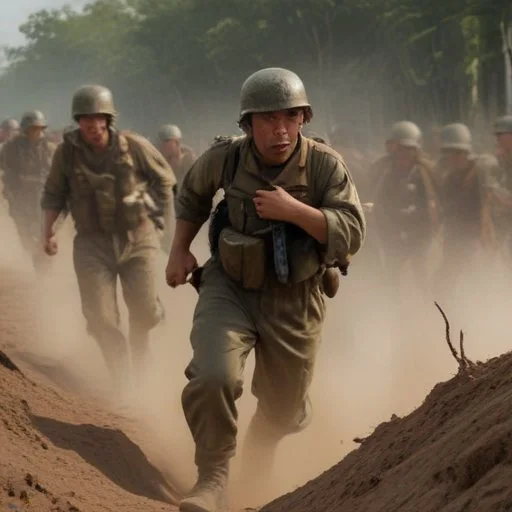
The success of the operation relied on meticulous planning, innovative tactics, and flawless execution. Led by General Robert L. Eichelberger, the 11th Airborne Division, comprising 550 paratroopers, and Filipino guerrillas, carefully orchestrated the dawn raid to catch the Japanese guards off guard.
The Filipino guerrillas played a crucial role in the mission's success, providing invaluable intelligence on the Japanese occupation and facilitating the Allied forces' advance. Their knowledge of the terrain and local networks enabled the paratroopers to navigate the complex landscape, ultimately ensuring the safe and rapid extraction of the prisoners.
At dawn on February 23, 1945, the paratroopers, supported by artillery and air support, descended upon the internment camp, securing the perimeter and neutralizing the Japanese guards. The prisoners, many of whom had been held captive for years, were whisked away to freedom in a matter of hours, with minimal casualties sustained by both the liberators and the liberated.
"We were awakened by the sound of planes, and then suddenly, parachutes were opening above us. The next thing we knew, American soldiers were rushing towards us, shouting 'Get out! Get out!' It was like a dream come true." – Private First Class, Los Baños prisoner of war
The Los Baños raid not only secured the freedom of 2,147 prisoners but also marked a turning point in the Pacific War. The operation's success bolstered morale, demonstrated the effectiveness of airborne operations, and showcased the power of collaboration between diverse forces.
The 11th Airborne Division's bravery and innovative tactics were recognized with numerous awards, including the Presidential Unit Citation, the Philippine Republic Presidential Unit Citation, and the Bronze Star Medal.
The Los Baños raid serves as a testament to the importance of adaptability, flexibility, and creative problem-solving in the face of uncertainty. The operation's success also underscores the significance of building alliances and fostering cooperation, ultimately paving the way for future collaborative efforts in combat and beyond.
As General Colin Powell so aptly put it, "The Los Baños raid will be remembered as the textbook airborne operation for all ages and all armies – a shining example of what can be accomplished when courage, ingenuity, and teamwork come together."
The Los Baños internment camp was originally built by the Philippine government in 1941 as a rural retreat for wealthy nationals. However, following the Japanese invasion, it was converted into a prison camp, holding over 2,000 Allied civilians and prisoners of war. The camp's location, surrounded by dense jungle and near the shores of Laguna de Bay, made it an ideal spot for the Japanese to keep their captives isolated and guarded.
Despite the harsh conditions, the prisoners managed to maintain a sense of community, with many organizing their own educational and entertainment programs. They also established a makeshift hospital, where prisoners with medical training tended to the sick and wounded.
The prison camp was notorious for its overcrowding, poor sanitation, and lack of food. Prisoners suffered from malnutrition, and diseases such as dysentery and malaria were rampant. The Japanese guards were cruel and brutal, often subjecting prisoners to physical punishment and humiliation.

General Robert L. Eichelberger, commander of the 11th Airborne Division, was a seasoned military leader with extensive experience in World War II. Born in 1886, Eichelberger graduated from the United States Military Academy in 1909 and went on to serve in various capacities, including as a staff officer in the American Expeditionary Forces during World War I.
Eichelberger's leadership during the Los Baños raid was instrumental in its success. He carefully planned and coordinated the operation, utilizing innovative tactics and clever deception to catch the Japanese off guard. His bravery and tactical genius earned him the Distinguished Service Medal and the Legion of Merit.
After the war, Eichelberger continued to serve in the military, eventually becoming the commander of the Eighth Army in the Pacific. He retired in 1948 with the rank of general, and passed away in 1961.
The liberation of Los Baños internment camp took place during a pivotal moment in World War II. The Allies were making steady gains in the Pacific, and the Japanese were increasingly on the defensive.
The Philippines, a strategic location in Southeast Asia, was a crucial battleground in the war. The country's geographic location made it an important stopping point for Allied forces pushing north towards Japan, and the Japanese occupation of the Philippines was a major obstacle to Allied progress.
The Los Baños raid demonstrated the Allies' ability to execute complex and daring operations behind enemy lines, and marked a significant shift in momentum in the war. The successful rescue of over 2,000 prisoners boosted morale and highlighted the importance of cooperation between different branches of the military and guerrilla forces.

The planning and execution of the Los Baños raid involved extensive use of maps, intelligence reports, and reconnaissance photographs. The 11th Airborne Division's operations team pored over detailed maps of the camp and surrounding terrain, identifying potential entry and exit points, as well as Japanese strongpoints.
One of the most critical documents used in the planning process was a hand-drawn map of the camp, created by a Filipino guerrilla named Captain Juan Pajota. Pajota, who had infiltrated the camp, provided crucial intelligence on the Japanese guard rotation, prisoner population, and camp layout.
The operation's success was also facilitated by innovative uses of technology, including the deployment of C-47 transport planes, which dropped the paratroopers behind enemy lines. The planes' ability to fly at low altitude and release troops quickly and accurately was instrumental in the mission's success.
Historians have long debated the significance of the Los Baños raid in the broader context of World War II. Some have argued that the operation was a key demonstration of the effectiveness of airborne warfare, while others have seen it as a testament to the power of guerrilla resistance.
Recent studies have shed new light on the role of Filipino guerrillas in the liberation of Los Baños. Historians such as James M. Scott and Ricardo Trota Jose have highlighted the crucial contributions of local forces, challenging traditional narratives that emphasize the dominance of American forces.
The Los Baños raid continues to fascinate historians, who see it as a unique example of cooperation between disparate forces, and a testament to the ingenuity and bravery of those involved.