


On September 17, 1944, the largest airborne operation in history unfolded as thousands of Allied troops parachuted into the Netherlands, while British XXX Corps advanced into the country, marking the beginning of Operation Market Garden. This audacious plan aimed to capture key bridges, disrupt German supply lines, and pave the way for a rapid advance into Germany, liberating the war-weary Dutch population and turning the tide of World War II.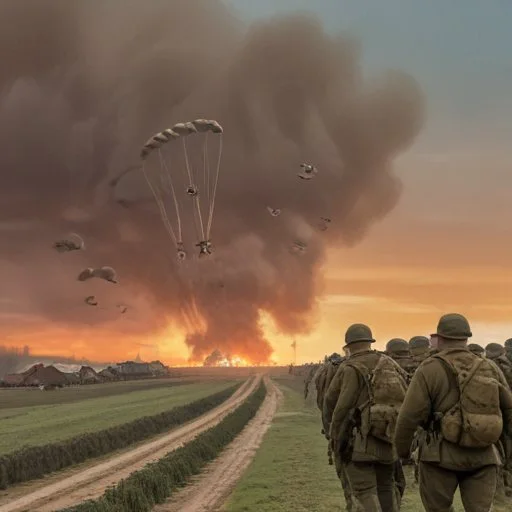
The brainchild of British Field Marshal Bernard Montgomery, Operation Market Garden was a complex and perilous operation that involved dropping over 40,000 airborne troops, including American, British, and Polish forces, behind enemy lines. The goal was to secure a narrow corridor of territory, dubbed the "airborne highway," stretching from the Dutch-Belgian border to Arnhem, where the British 1st Airborne Division would establish a bridgehead.
The airborne assault, code-named "Market," kicked off at dawn with a massive fleet of transport planes and gliders taking to the skies. Paratroopers and airborne infantry units, equipped with lightweight gear and bicycles, descended onto the Dutch countryside, securing key objectives such as bridges, road junctions, and towns.
Simultaneously, the British XXX Corps, led by Lieutenant General Brian Horrocks, launched the "Garden" phase, pushing north from the Belgian border towards the airborne troops. The corps consisted of armored divisions, infantry, and artillery units, which were tasked with linking up with the airborne forces and securing the corridor.
As the ground forces advanced, they faced stiff German resistance, which slowed their progress and put pressure on the airborne troops holding the bridges.
Among the thousands of paratroopers who took part in Operation Market Garden was Private First Class Joe E. Mann, an American from the 101st Airborne Division. Mann recalled the intense excitement and fear as he jumped out of the plane:
"I remember the sound of the engines, the rush of the wind, and the feeling of weightlessness. Then, suddenly, I was floating down, watching the ground rush up to meet me. It was a surreal experience, knowing that I was about to land in the middle of a war zone."
Despite the bravery and sacrifice of the Allied troops, Operation Market Garden was marred by controversies and challenges. Poor weather, Communication breakdowns, and inadequate intelligence hampered the operation, allowing German forces to regroup and counterattack.
The most critical failure was the inability to secure the Rhine bridge at Arnhem, which remained in German hands, isolating the British 1st Airborne Division and forcing them to fight a desperate battle for survival.
Although Operation Market Garden ultimately failed to achieve its objectives, the bravery and sacrifice of the Allied troops left a lasting impact on the war effort. The operation paved the way for future airborne assaults and demonstrated the importance of coordinated military strategy.
In the Netherlands, the operation marked the beginning of the end of German occupation, and the liberation of the Dutch people. The Market Garden veterans became heroes, and their story continues to inspire generations to come.
Operation Market Garden serves as a testament to the bravery and sacrifice of the Allied troops who fought for freedom and democracy. As we reflect on this pivotal moment in history, we are reminded of the power of courage, perseverance, and determination in the face of overwhelming odds.
In the words of General Dwight D. Eisenhower, "The airborne operation was a magnificent achievement, and the courage and determination of the troops will be remembered for all time."
One of the lesser-known aspects of Operation Market Garden was the role of the Dutch resistance movement. As the Allied forces advanced into the Netherlands, they were aided by a network of brave Dutch civilians who provided crucial intelligence and logistical support. These unsung heroes risked their lives to sabotage German communications, disrupt supply lines, and guide Allied troops through the treacherous Dutch countryside.
In fact, the Dutch resistance played a significant role in the success of the airborne operation. They provided vital information about German troop movements and helped to identify key targets for the Allied forces. The resistance also played a crucial role in evacuating wounded soldiers and civilians, often at great personal risk.
The bravery and sacrifice of the Dutch resistance movement are a testament to the power of ordinary people in extraordinary circumstances. Their contributions to the success of Operation Market Garden are a shining example of the importance of grassroots resistance in the face of tyranny.

Private First Class Joe E. Mann's experience during Operation Market Garden was just one example of the bravery and sacrifice of the thousands of airborne troops who participated in the operation. But what about the men who planned and executed the operation?
Field Marshal Bernard Montgomery, the architect of Operation Market Garden, was a complex and often controversial figure. A brilliant strategist and tactician, Montgomery was also known for his stubbornness and willingness to take risks. His leadership during the operation was marked by a series of bold decisions, including the decision to drop the airborne troops behind enemy lines.
Less well-known is the role of Lieutenant General Brian Horrocks, commander of the British XXX Corps. Horrocks was a skilled and experienced commander who played a crucial role in coordinating the ground forces during the operation. His leadership helped to ensure that the corps was able to advance rapidly through the Netherlands, despite fierce German resistance.
Operation Market Garden is often compared to other major airborne operations of World War II, such as the D-Day landings in Normandy. However, there are some key differences between the two operations that are worth noting.
One of the main differences was the scale of the operation. While the D-Day landings involved over 156,000 troops, Operation Market Garden involved around 40,000 airborne troops. This smaller scale meant that the operation required a greater degree of precision and coordination.
Another key difference was the terrain. The rolling hills and countryside of the Netherlands proved to be a much more challenging environment than the beaches of Normandy. The airborne troops had to navigate through dense forests, cross rivers, and avoid urban areas, all while facing fierce German resistance.

Operation Market Garden had a profound impact on Dutch culture and society. The operation marked the beginning of the end of German occupation, and the liberation of the Dutch people from years of tyranny and oppression.
The bravery and sacrifice of the Allied troops during the operation inspired a sense of national pride and gratitude among the Dutch people. The operation also marked a turning point in the war, as the Dutch began to take an active role in the fight against the Germans.
Today, the legacy of Operation Market Garden continues to be felt in the Netherlands. The operation is commemorated through a series of museums, memorials, and ceremonies, which serve as a reminder of the bravery and sacrifice of the Allied troops.
Operation Market Garden took place against the backdrop of a rapidly changing geopolitical landscape. As the Allies advanced through Europe, they were faced with the challenge of coordinating their military efforts with those of the Soviet Union.
The operation was seen as a key component of the Allied strategy to defeat Germany, and to prevent the Soviet Union from gaining a foothold in Western Europe. The success of the operation was seen as crucial to maintaining the balance of power in Europe.
In the aftermath of the operation, the Allies were forced to confront the reality of a post-war Europe, in which the Soviet Union would play a dominant role. The operation marked a turning point in the war, and set the stage for the Cold War that would follow.