


On July 10, 1943, the largest amphibious assault of World War II was set in motion as a massive Allied invasion fleet sailed for the sun-kissed shores of Sicily, marking a pivotal moment in the war's trajectory.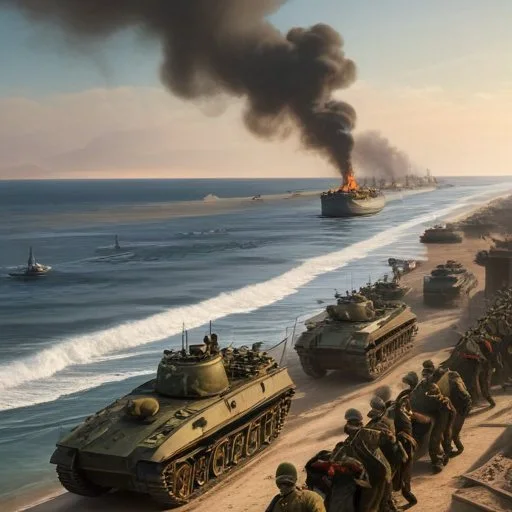
This audacious operation, code-named Husky, would see over 2,000 ships and landing craft, packed with 160,000 troops, clash with 300,000 Italian and German defenders in a battle that would rewrite the course of history.
In 1943, the Allies were determined to gain a foothold in the Mediterranean, aiming to drive the Axis powers out of North Africa and pave the way for an eventual invasion of Italy. With the North African Campaign behind them, attention turned to the island of Sicily, a strategic stronghold that would provide a vital stepping stone for the invasion of Italy.
The success of Operation Husky marked a significant shift in the balance of power, as the Allies gained a crucial foothold in the Mediterranean. The operation demonstrated the strength and coordination of the Allied forces, paving the way for future campaigns.
The fall of Sicily also led to the eventual surrender of Italy in September 1943, followed by the Allied invasion of Italy in September 1943.
Operation Husky played a significant role in shaping the course of World War II, but its impact extended beyond the battlefield. The operation marked a turning point in the war, boosting morale and cementing the Allies' reputation as a formidable force.
"The landing was a bloody mess. The Germans and Italians were dug in tight, and it took us a while to get a foothold. But once we did, there was no stopping us." – Private First Class John R. Higgins, 1st Infantry Division
"I remember the sounds of gunfire and explosions filling the air. It was like nothing I'd ever experienced before. But we pushed on, driven by our determination to secure the island." – Lieutenant James W. Jones, 82nd Airborne Division
The success of Operation Husky paved the way for the Allied invasion of Italy, and ultimately, the push into Western Europe. The operation demonstrated the feasibility of large-scale amphibious landings, setting the stage for future operations, including the D-Day landings in Normandy.
The legacy of Operation Husky continues to inspire military strategists and historians alike, serving as a testament to the bravery and ingenuity of the Allied forces who dared to take the fight to the enemy's doorstep.
The Allied invasion of Sicily was not the first time the island had been conquered. Throughout history, Sicily has been a prized possession for various empires and powers, including the Phoenicians, Greeks, Romans, Arabs, and Normans. Each of these conquerors left their mark on the island, shaping its culture, architecture, and people.
In the centuries leading up to World War II, Sicily was a vital strategic location, controlling access to the Mediterranean Sea and serving as a bridge between Europe and North Africa. The island's rich history and cultural heritage made it a coveted prize for the Allies, who sought to use it as a launching point for further military campaigns.
The Allies' success in Sicily was not solely due to their military prowess. The island's complex history and cultural dynamics played a significant role in the outcome of the campaign. For example, the presence of Mafia operatives on the island, who were fiercely anti-Fascist, aided the Allies in their efforts. This unlikely alliance would have far-reaching consequences, shaping the post-war reconstruction of Sicily and beyond.
General George S. Patton: The Maverick Commander
General George S. Patton was a larger-than-life figure, known for his bold leadership and unorthodox tactics. As commander of the 7th Army, Patton played a crucial role in the Allied invasion of Sicily, earning him the nickname "the blood and guts general."
Patton's flamboyant personality and tendency to speak his mind often put him at odds with his superiors. However, his bravery and military acumen earned him the respect of his troops, who affectionately referred to him as "Old Blood and Guts."
Patton's role in Operation Husky was instrumental in the Allied victory, as he successfully outmaneuvered German forces and secured key objectives. His leadership during the campaign solidified his reputation as one of the most capable and daring military commanders of World War II.
The Cultural Significance of Operation Husky
Operation Husky had a profound impact on the cultural landscape of Sicily and beyond. As the Allies poured onto the island, they brought with them new ideas, customs, and practices that would forever change the local culture.
The presence of American and British troops introduced Sicilians to new forms of music, film, and literature, which would have a lasting impact on the island's cultural identity. The Allies' influence can still be seen today, from the widespread adoption of American-style hamburgers to the popularity of British rock music.
Furthermore, the Allied occupation of Sicily led to a renewed interest in the island's rich cultural heritage. As the war drew to a close, the Allies worked to preserve Sicily's historic landmarks and cultural treasures, ensuring their protection for future generations.
The Geopolitical Ramifications of Operation Husky
The success of Operation Husky had far-reaching geopolitical implications, reshaping the balance of power in the Mediterranean and beyond.
The Allied victory in Sicily paved the way for the invasion of Italy, which would ultimately lead to the country's surrender and the demise of Fascist rule. This, in turn, would have a ripple effect throughout Europe, as the Allies continued to push into Western Europe.
The operation also marked a significant shift in the global balance of power, as the United States and Great Britain emerged as the dominant military powers. This newfound status would have lasting implications for international relations, shaping the course of global politics in the decades to come.
The Strategic Importance of Sicily
Sicily's unique geography made it a crucial location for military operations. The island's proximity to North Africa, Italy, and the European mainland made it an ideal staging ground for further military campaigns.
The island's rugged terrain, with its mountainous interior and coastal plains, presented a significant challenge to military planners. However, the Allies' success in securing key ports and airfields enabled them to establish a foothold on the island, paving the way for further military operations.
The control of Sicily provided the Allies with a vital strategic advantage, allowing them to dominate the Mediterranean Sea and control access to key shipping lanes. This, in turn, enabled them to supply their troops and materials, securing a vital logistical advantage over Axis forces.