


The Italian campaign had bogged down in a grueling stalemate, with both the Allies and Axis powers dug in along the Gustav Line. The Allies needed a decisive victory to break the deadlock and push into central Italy.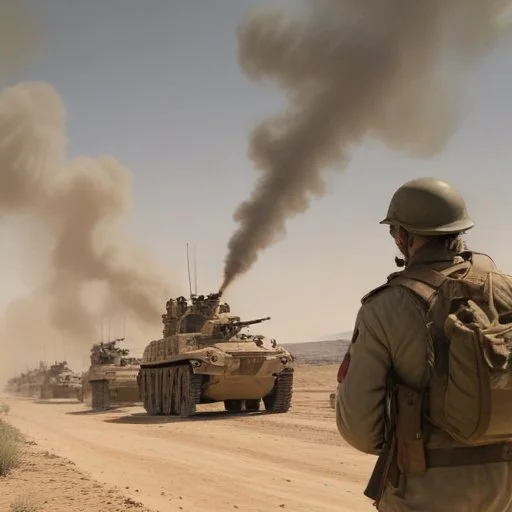
Under the command of American Major General John P. Lucas, Operation Shingle involved a daring surprise attack on the lightly defended coastal towns of Anzio and Nettuno. The plan called for 36,000 troops, supported by massive artillery and air power, to storm the beaches under the cover of darkness.
The attack began on the night of January 21, with waves of Allied troops landing on the beaches under the cover of naval gunfire and air support. The U.S. 3rd Infantry Division and the British 1st Infantry Division formed the spearhead of the assault.
Operation Shingle ultimately succeeded in breaking the stalemate in Italy, paving the way for the Allied advance on Rome.
The Battle of Anzio inspired a 1968 film, "Anzio," starring Robert Mitchum and Peter Falk.
The operation's bold and innovative tactics have influenced military strategy and doctrine, serving as a model for future amphibious assaults.
"The quickest way to win this war is to get to the other side of the Apennines and get into the valley of the Po." - General Harold Alexander
Operation Shingle shares similarities with other amphibious assaults, such as the Allied landings in Normandy and the Pacific theater.
The operation's emphasis on surprise, adaptability, and bold action has drawn comparisons with other notable battles, including the Battle of El Alamein.
"We were told to expect a walk-in, but it wasn't a walk-in. We got our tails shot off." - Private First Class Edward Andrews, U.S. 3rd Infantry Division
Operation Shingle paved the way for the Allied advance on Rome, which fell on June 4, 1944.
The operation's success demonstrated the importance of adaptability and innovation in modern warfare, influencing military strategy in the decades that followed.
The Allied decision to launch Operation Shingle was influenced by the broader strategic situation in the Mediterranean theater. The Italian campaign, which began with the invasion of Sicily in July 1943, had stalled in the face of fierce German resistance. The Allies' ultimate goal was to knock Italy out of the war and secure a foothold on the continent, but the rugged terrain and strong German defenses had slowed their advance to a crawl. In the weeks leading up to Anzio, the Allies had been probing the German defenses, searching for a weak point to exploit. The lightly defended coastal towns of Anzio and Nettuno presented an opportunity to outflank the enemy and break the stalemate.The Road to Anzio: The Italian Campaign's Strategic Context

General Harold Alexander, the commander of the Allied 15th Army Group, was the driving force behind Operation Shingle. A seasoned veteran of the North African and Italian campaigns, Alexander was known for his bold and innovative tactics. Alexander's plan for Anzio was to use surprise and deception to gain a foothold on the continent, before rapidly exploiting the weakness to rupture the German defenses. Despite the initial success of the operation, Alexander's leadership would come under scrutiny in the weeks that followed, as the Allies struggled to break out of the beachhead.General Harold Alexander: The Architect of Operation Shingle
Operation Shingle was one of several major amphibious assaults launched by the Allies during World War II. The operation shares similarities with other notable landings, including the Allied invasion of Normandy and the Pacific island-hopping campaign. Like Anzio, these operations relied on surprise, speed, and overwhelming firepower to secure a foothold on hostile shores. However, each operation presented unique challenges, from the rugged terrain of Italy to the intense tropical heat of the Pacific. A comparative analysis of these operations reveals the importance of adaptability and flexibility in modern warfare, as well as the crucial role of combined arms cooperation and coordinating air, land, and sea forces.Amphibious Assaults in World War II: A Comparative Analysis

The Battle of Anzio has left a lasting impact on popular culture, inspiring numerous films, books, and songs. The 1968 film Anzio, starring Robert Mitchum and Peter Falk, is one of the most well-known adaptations of the battle. In literature, the battle has been immortalized in works such as The Battle of Anzio by Lloyd Clark and Anzio: Italy and the Battle for Rome by Lloyd Clark. The battle's cultural significance extends beyond the military sphere, serving as a symbol of Allied determination and ingenuity in the face of adversity.The Battle of Anzio in Popular Culture
The launch of Operation Shingle occurred at a critical juncture in the war, as the Allies sought to exploit the weakness of the Axis powers and secure a strategic advantage. The operation was closely tied to the broader geopolitical context, as the Allies sought to knock Italy out of the war and create a second front in Europe. The success of Operation Shingle would have far-reaching implications, influencing the course of the war in Europe and paving the way for the Allied advance on Rome.The Geopolitical Context of Operation Shingle