


In a bold move to break the German grip on Italy, Allied forces launched a monumental amphibious assault on the sun-kissed beaches of Salerno and Taranto, marking a pivotal moment in World War II's Italian campaign. As the Allies sought to disrupt German supply lines and pave the way for Rome's capture, they clashed with entrenched enemy troops in a fierce battle that would decide the fate of Italy.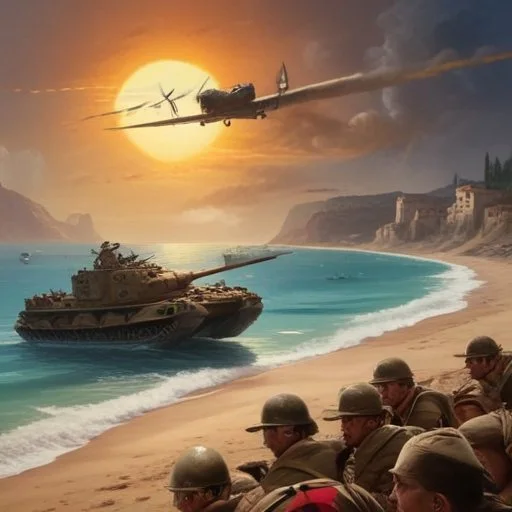
By 1943, Italy had become a key battleground in the war, with German and Italian forces dug in along the southern coast. The Allies, determined to drive the Axis powers out of Italy, devised a plan to launch a simultaneous assault on Salerno and Taranto, catching the enemy off guard and splitting their forces.
On September 9, 1943, a massive armada of warships, transport vessels, and landing craft converged on the beaches of Salerno and Taranto, supported by a barrage of naval gunfire and air support. As Allied troops stormed ashore, they faced a hail of machine gun fire, artillery shells, and determined German resistance.
General Mark Clark, commander of the U.S. Fifth Army, led the Allied forces in the assault, while General Heinrich von Vietinghoff, commander of the German 10th Army, directed the German defense.
The Allied victory at Salerno and Taranto marked a significant turning point in the Italian campaign, paving the way for the eventual capture of Rome and the surrender of German forces in Italy.
The battle also highlighted the importance of combined arms warfare, demonstrating the effectiveness of coordinated naval, air, and ground forces in overcoming entrenched enemy defenses.
The battle of Salerno and Taranto left an indelible mark on the local population, with many Italian civilians caught in the crossfire or forced to flee their homes. The Allied victory, however, brought hope and relief to a war-weary nation, paving the way for Italy's post-war reconstruction.
In the years that followed, the bravery and sacrifice of the Allied forces who fought at Salerno and Taranto would be remembered and honored, serving as a testament to the enduring spirit of liberation and freedom.
The Allies' decision to launch a simultaneous attack on Salerno and Taranto was influenced by the lessons learned from previous amphibious landings in North Africa and Sicily. The planners of the operation, led by General Dwight D. Eisenhower, recognized the importance of surprise and deception in achieving a successful landing. To this end, they implemented a series of diversionary tactics, including fake radio transmissions and double agents, to mislead the Germans about the actual location and timing of the attack.
Another key factor in the planning of the operation was the use of advanced intelligence gathering techniques. The Allies had broken several German and Italian cryptic codes, providing them with valuable insights into enemy troop movements and defensive strategies. This intelligence was used to identify the most vulnerable points in the German defenses and to plan the assault accordingly.

General Heinrich von Vietinghoff, the commander of the German 10th Army, was a seasoned veteran of the Eastern Front. He had risen through the ranks of the German army, earning a reputation as a skilled and relentless commander. Despite being outnumbered and outgunned, Vietinghoff was determined to hold his ground against the Allied invasion.
Vietinghoff's defense strategy was centered around the use of fortified strongpoints and mobile reserves. He had carefully positioned his troops to take advantage of the rugged terrain and to funnel the Allied forces into kill zones. The German commander was confident that his troops could hold out against the Allied onslaught, at least long enough for reinforcements to arrive from the north.
The Allied invasion of Salerno and Taranto shared many similarities with the German invasion of Normandy on D-Day. Both operations involved massive amphibious landings, with thousands of troops and tons of equipment being transported across the Mediterranean and English Channel, respectively.
Despite these similarities, there were also significant differences between the two operations. The Allies had the advantage of surprise in Italy, whereas the Germans had been expecting an invasion of France for months. The terrain in Italy was also much more challenging, with steep cliffs and rugged mountains making it difficult for the Allies to establish a foothold.

The battle of Salerno and Taranto had a profound impact on the local Italian population. Many civilians were caught in the crossfire or forced to flee their homes, leading to a significant humanitarian crisis.
Despite the challenges, the Allied victory brought hope and relief to the Italian people. The liberation of Italy marked the beginning of a new era of cooperation and friendship between the Italian people and the Allied powers.
The Allied invasion of Salerno and Taranto was part of a broader strategy to defeat the Axis powers in World War II. The battle was seen as a key stepping stone in the campaign to liberate Italy and ultimately to defeat Germany.
The landing was also closely tied to the broader geopolitical context of the war. The Allies were eager to establish a foothold in Southern Europe, which would provide a strategic base for further operations against Germany and the Balkans.