


In the frigid waters off Norway's coast, a monumental clash of underwater titans took place, etching its mark in history as one of the rarest instances of submarine-to-submarine combat. On February 9, 1945, HMS Venturer, a British submarine, engaged and sank U864, a German U-boat, in a thrilling display of naval prowess.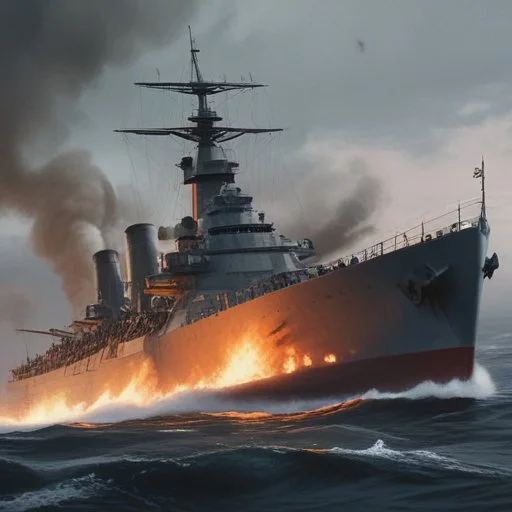
The Battle of the Atlantic was a pivotal campaign during World War II, where Allied forces sought to disrupt Germany's supply lines and cripple its war machine. As the war raged on, the Allies continued to develop new tactics and technologies to counter the German U-boat threat. In response, the German Navy, the Kriegsmarine, adapted and evolved its U-boat fleet to remain a formidable force.
HMS Venturer, commanded by Lieutenant Jimmy Launders, was a British V-class submarine, specifically designed for anti-submarine warfare. U864, under the command of Kapitänleutnant Ralf-Reimar Wolfram, was a German Type IXD2 U-boat, tasked with intercepting Allied convoys and disrupting supply lines.
In the early hours of February 9, 1945, HMS Venturer lay in wait off the coast of Fedje, Norway, its sonar operators tracking the faint sounds of U864's approach. As the U-boat drew closer, Launders made a daring decision: he would launch a spread of torpedoes, knowing that a direct hit would be impossible to achieve. The Venturer's crew held their breath as the torpedoes whirred towards their target.
The torpedoes struck U864 with devastating effect, crippling the U-boat and sending it to the ocean floor. The Venturer's crew watched in awe as the U-boat's stern rose into the air, its propellers spinning wildly before slipping beneath the surface. In a rare instance of submarine-to-submarine combat, HMS Venturer had emerged victorious.
The HMS Venturer's victory resonated deeply with the British public, boosting morale and underscoring the importance of the Royal Navy's role in the war effort. The incident also solidified the reputation of Lieutenant Jimmy Launders as a skilled and daring commander.
In his memoirs, Launders recalled the tense moments preceding the ambush, stating, "I knew that if we could get close enough, we could get him. It was a gamble, but it was one I was willing to take."
The sinking of U864 contributed to the decline of the German U-boat fleet and paved the way for the Allied victory in the Battle of the Atlantic. The incident also influenced the development of post-war submarine design and operation, with a renewed focus on stealth, speed, and agility.
The HMS Venturer's daring ambush and subsequent sinking of U864 off the coast of Fedje, Norway, remains one of the most remarkable instances of submarine-to-submarine combat in history. This thrilling episode in the Battle of the Atlantic serves as a testament to the bravery, skill, and strategic vision of the Allied forces, and a poignant reminder of the enduring importance of naval power in modern warfare.
As the HMS Venturer lay in wait off the coast of Fedje, Norway, its sonar operators tracked the faint sounds of U864's approach. The Venturer's crew had received critical intelligence from Norwegian resistance agents, who had intercepted German communications indicating the U-boat's presence in the area. This intelligence, combined with British cryptography experts' work, allowed the Venturer's crew to prepare for the ambush.
The Venturer's commander, Lieutenant Jimmy Launders, made a daring decision to launch a spread of torpedoes at U864, knowing that a direct hit would be impossible to achieve. The torpedoes struck U864 with devastating effect, crippling the U-boat and sending it to the ocean floor.
Lieutenant Jimmy Launders, commander of HMS Venturer, was a seasoned naval officer with a reputation for bravery and strategic vision. Born in 1917, Launders had joined the Royal Navy in 1935 and quickly rose through the ranks, earning a reputation as a skilled and daring commander.
Launders' leadership during the sinking of U864 earned him the Distinguished Service Order, a prestigious honor awarded for exceptional bravery and leadership in the face of enemy action. His success in the Battle of the Atlantic solidified his reputation as one of the most skilled submarine commanders of World War II.
The sinking of U864 by HMS Venturer was a rare instance of submarine-to-submarine combat in World War II. In fact, only three British submarines sank U-boats during the entire war. The Venturer's success was all the more remarkable given the challenges of engaging an enemy submarine in the depths of the ocean.
In contrast, the German U-boat fleet was highly effective in sinking Allied convoys, with over 2,700 Allied ships sunk during the war. However, the Venturer's victory marked a turning point in the Battle of the Atlantic, as the Allies continued to develop new tactics and technologies to counter the U-boat threat.
The sinking of U864 had significant implications for the development of submarine design and operation. The success of HMS Venturer's ambush demonstrated the importance of stealth, speed, and agility in submarine warfare.
In the post-war period, the Allies continued to develop new submarine technologies, including nuclear-powered submarines and advanced sonar systems. These advancements enabled submarines to operate with greater ease and effectiveness, revolutionizing the conduct of naval warfare.
The sinking of U864 resonated deeply with the British public, boosting morale and underscoring the importance of the Royal Navy's role in the war effort. The incident was widely reported in the British press, with Launders and his crew hailed as heroes.
The incident also had significant cultural implications, as the British public began to see the Royal Navy as a vital component of the war effort. The sinking of U864 helped to shift public opinion in favor of increased naval spending and investment in new technologies.