


The Battle of Cherbourg, fought from June 18 to June 30, 1944, marks a significant milestone in World War II, as American forces seized control of the strategically vital port city of Cherbourg, France, from the German army. This pivotal victory secured a crucial supply line for the Allied forces, enabling them to push deeper into Europe and ultimately contributing to the liberation of Western Europe from German occupation.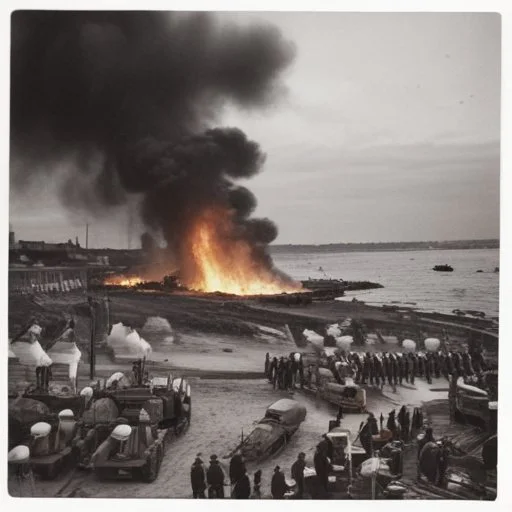
In 1940, German forces had captured Cherbourg, a key port city on the Normandy coast, as part of their rapid advance into France. The city remained under German occupation for four years, with Colonel General Friedrich Dollmann's Seventh Army firmly entrenched in the region. The Allies, determined to regain control of the port, recognized the significance of Cherbourg as a vital gateway for supplies and troops.
The Battle of Cherbourg was led by American General Omar Bradley, commander of the First Army, who devised a meticulous plan to liberate the city. Meanwhile, Colonel General Friedrich Dollmann's Seventh Army, comprised of seasoned German soldiers, put up a fierce resistance against the Allied forces.
The Battle of Cherbourg's outcome was multifaceted, yielding significant strategic, logistical, and psychological benefits for the Allies. The capture of Cherbourg's port enabled the Allies to establish a secure supply line, facilitating the rapid buildup of troops and equipment in Europe. This, in turn, paved the way for the liberation of Western Europe and ultimately contributed to the Allied victory in World War II.
The Battle of Cherbourg had a profound impact on the local population, who had endured four years of German occupation. The liberation of Cherbourg brought hope and relief to the French people, rekindling their faith in the Allied forces and their ability to bring about a swift end to the war.
"The capture of Cherbourg is a momentous event, marking a significant step forward in the liberation of Western Europe." – General Dwight D. Eisenhower
Private First Class William E. Horton, a soldier with the 9th Infantry Division, recalled the ferocity of the battle: "The artillery fire was so intense that it shook the ground beneath our feet. We knew we had to push forward, no matter what." Horton's unit played a crucial role in breaching the German defenses, paving the way for the ultimate capture of Cherbourg.
The Battle of Cherbourg set the stage for the Allied forces' subsequent advances in Europe, including the liberation of Paris and the ultimate defeat of Germany. The capture of Cherbourg's port also facilitated the buildup of troops and supplies for the eventual invasion of Germany, culminating in the Allied victory in May 1945.
The Battle of Cherbourg has been subject to various historiographical interpretations, with some historians emphasizing its strategic significance in the Allied victory, while others have highlighted its impact on the French Resistance and the liberation of Western Europe. American historians, such as Stephen Ambrose, have emphasized the role of General Omar Bradley in the battle, while British historians, like Max Hastings, have highlighted the contributions of the Royal Navy in securing the port.
More recent studies have examined the battle's cultural impact on the French people, with some arguing that it marked a turning point in their perception of the Allied forces as liberators. The varied perspectives on the Battle of Cherbourg underscore the complexity of historical events and the ongoing debates among historians.
The liberation of Cherbourg had a profound impact on French culture, as it marked a significant step towards the country's liberation from German occupation. The city's liberation was celebrated through music, art, and literature, with many French artists and intellectuals hailing the Allied victory as a symbol of freedom and resistance.
The battle also had a lasting impact on the city's cultural heritage, with the Allies' efforts to preserve Cherbourg's historic landmarks and cultural institutions. The United States Army's Monuments, Fine Arts, and Archives section, led by James J. Rorimer, played a crucial role in protecting and restoring Cherbourg's cultural treasures, including the city's medieval castle and the Notre-Dame de la Trinité church.
Colonel General Friedrich Dollmann was the commander of the German Seventh Army during the Battle of Cherbourg. A seasoned military officer, Dollmann had served in the German Army since World War I and had risen through the ranks to become one of the most respected German commanders.
Despite being outgunned and outmanned, Dollmann's forces put up a fierce resistance against the Allied forces, earning him the respect of his adversaries. After the fall of Cherbourg, Dollmann committed suicide, reportedly due to the shame of defeat and the fear of being held accountable for the atrocities committed by his troops.
The Battle of Cherbourg was fought against the backdrop of a rapidly changing geopolitical landscape. The Allied invasion of Normandy had marked a significant shift in the balance of power in Europe, with the Soviet Union's advance on the Eastern Front and the Allied forces' push into Western Europe.
The capture of Cherbourg's port was critical in securing a foothold in Europe, as it provided the Allies with a vital supply line and enabled them to build up their forces for further advances. The battle's outcome had far-reaching implications, influencing the course of the war and paving the way for the eventual defeat of Germany.
The Battle of Cherbourg had significant economic implications for the Allied war effort. The capture of the port enabled the Allies to establish a secure supply line, facilitating the rapid buildup of troops and equipment in Europe.
The liberation of Cherbourg also paved the way for the reconstruction of France's economy, which had been devastated by four years of German occupation. The Allied victory enabled the French government to regain control of its economy and begin the process of rebuilding and recovery.