


The Battle of Guadalcanal, a brutal and pivotal six-month campaign, marked the first American offensive in the Pacific during World War II. This daring operation, where 11,000 United States Marines stormed the Japanese-occupied Solomon Islands, would rewrite the course of the war.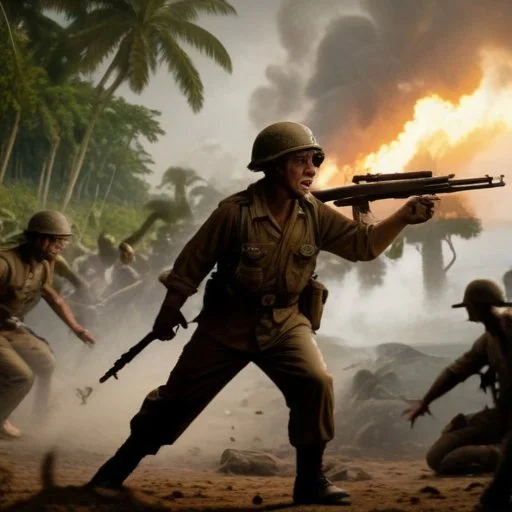
In the summer of 1942, the Japanese Empire, seeking to expand its territory and secure strategic locations, occupied the Solomon Islands. The Allies, aware of the islands' crucial position in the Pacific, knew they had to act swiftly to prevent the enemy from establishing a stronghold.
Under the cover of darkness on August 7, 1942, Lieutenant General Alexander Vandegrift's 1st Marine Division launched a surprise attack on the Japanese strongholds of Guadalcanal and Tulagi. The Marines, battle-hardened and determined, caught the enemy off guard, securing a crucial foothold on the islands.
The Battle of Guadalcanal was a crucial turning point in the Pacific War, marking the first major land victory for the Allies. The battle halted the Japanese advance, secured a crucial foothold in the Solomon Islands, and paved the way for future Allied offensives.
The Battle of Guadalcanal had a profound impact on the home front, boosting American morale and demonstrating the nation's resolve to reclaim the Pacific. The battle also marked a shift in the Allies' strategy, with a greater emphasis placed on amphibious warfare and the importance of securing strategic islands.
"The Guadalcanal Campaign was a series of bitter, bloody, and brutal battles..." - Lieutenant General Alexander Vandegrift
"We were green as grass, but we learned fast...We had to." - Sergeant Mitchell Paige, 1st Marine Division
The Battle of Guadalcanal set the stage for future Allied offensives, including the Battle of Tarawa and the Philippines Campaign. The battle's success also led to the development of new military tactics and strategies, influencing the outcome of the war.
The Battle of Guadalcanal, a testament to the bravery and determination of the United States Marines, remains an integral part of American history and a turning point in the Pacific War.
The Battle of Guadalcanal also had a profound impact on the cultural identity of the Solomon Islands. The war brought about significant changes to the local population, including the displacement of native communities and the destruction of their traditional way of life. In the aftermath of the battle, the Solomon Islands became a hub for Allied forces, leading to an influx of foreign influences and cultures. The blend of traditional and modern cultures continues to shape the nation's identity to this day.
Furthermore, the battle has been commemorated through various cultural events and memorials, including the Guadalcanal American Memorial, which honors the sacrifices of American and Solomon Islands forces. The memorial has become a symbol of friendship and cooperation between the two nations.

Lieutenant General Alexander Vandegrift: A Profile of Leadership
Lieutenant General Alexander Vandegrift was a decorated Marine Corps officer who played a pivotal role in the Battle of Guadalcanal. Born on March 13, 1887, in Virginia, Vandegrift graduated from the Virginia Military Institute and later received his commission in the Marine Corps.
During his illustrious career, Vandegrift demonstrated exceptional leadership skills, earning the respect of his men and the admiration of his superiors. His bravery and tactical genius during the Battle of Guadalcanal earned him the Medal of Honor, the Navy Cross, and the Army Distinguished Service Medal.
The Road to Guadalcanal: A Prelude to Battle
In the months leading up to the Battle of Guadalcanal, the United States and Japan engaged in a series of secret diplomatic negotiations, known as the Konoe Proposals. The proposals aimed to prevent further conflict between the two nations, but ultimately failed to yield a peaceful resolution.
Meanwhile, the United States military was busy preparing for a potential showdown with Japan. In July 1942, Admiral Ernest King, the Chief of Naval Operations, devised a plan to capture the Solomon Islands, including Guadalcanal, in order to secure a strategic foothold in the Pacific.
The Geopolitical Significance of Guadalcanal
The Battle of Guadalcanal was fought on a small island in the Solomon Islands, but its strategic importance extended far beyond the Pacific. The battle marked a crucial turning point in the war, as it thwarted Japan's expansionist ambitions and secured a vital foothold for the Allies in the region.
The battle also highlighted the importance of amphibious warfare, demonstrating that control of the seas could be leveraged to project power ashore. This realization would shape the course of modern warfare, influencing military strategies and doctrines for decades to come.
Deciphering Japanese Radio Communications
During the Battle of Guadalcanal, Allied forces relied heavily on signals intelligence to decipher Japanese radio communications. The cryptanalysis unit, led by Lieutenant Commander Joseph Rochefort, successfully cracked Japanese naval codes, providing crucial insights into enemy plans and operations.
The intercepted messages revealed Japanese intentions to reinforced their troops on Guadalcanal, allowing the Allies to prepare accordingly. This strategic advantage contributed significantly to the ultimate Allied victory in the battle.