


The Battle of Guam, a lesser-known yet pivotal episode in the Pacific Theater of World War II, witnessed American troops clashing with Japanese forces in a 20-day campaign that would leave an indelible mark on the island's history. From July 21 to August 10, 1944, the sounds of gunfire, artillery, and desperation echoed through the once-peaceful shores of Guam, as the United States sought to reclaim this strategic territory from Japanese occupation.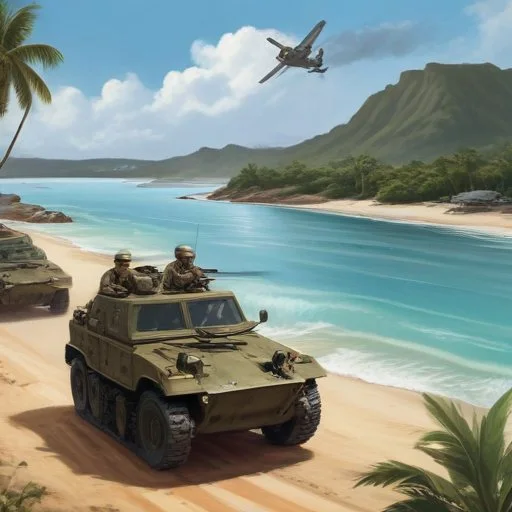
Guam, the largest island in the Mariana Islands, had been under American control since 1898. However, following the Japanese surprise attack on Pearl Harbor in December 1941, Guam fell to the Japanese on December 10, 1941, leaving the island's native Chamorros and American expatriates at the mercy of their occupiers.
In the months leading up to the battle, General Roy Geiger's III Amphibious Corps underwent rigorous training, preparing for a grueling campaign to retake the island. Meanwhile, Japanese forces, under the command of Lieutenant General Takeshi Takashina, fortified their defenses, constructing a complex network of bunkers, tunnels, and pillboxes to repel the impending American assault.
On July 21, 1944, the III Amphibious Corps launched a combined air and naval assault on Guam's beaches, with the 3rd Marine Division leading the charge. The initial landings were met with fierce resistance, as Japanese forces unleashed a maelstrom of artillery fire, attempting to push the Americans back into the sea.
As the battle intensified, the Americans adapted their tactics, employing innovative strategies such as "island-hopping" and "leapfrogging" to outmaneuver their foes. The U.S. military also leveraged its air superiority, conducting relentless bombing raids on Japanese strongholds and supply lines.
After 20 days of brutal fighting, the Japanese defense lines finally cracked. The 3rd Marine Division, bolstered by the 1st Provisional Marine Brigade, breached the enemy's stronghold at Mount Santa Rosa, securing a decisive victory for the Americans.
The Battle of Guam exacted a heavy toll on both sides, with the Japanese suffering an estimated 18,000 casualties, while the Americans lost over 1,700 men. The recapture of Guam marked a crucial turning point in the Pacific War, paving the way for the Allied forces' ultimately triumphant march towards Japan.
In the aftermath of the battle, the U.S. military established a significant presence on the island, which would serve as a vital staging ground for future operations. The Battle of Guam also left an indelible mark on the island's cultural heritage, as the native Chamorros and American veterans forged an unbreakable bond, forged in the fire of war.
The Battle of Guam remains an often-overlooked yet pivotal chapter in the narrative of World War II. As we reflect on this heroic struggle, we honor the bravery and sacrifice of the soldiers, sailors, and airmen who fought for freedom and liberty on the island's sun-scorched beaches.
Today, the Battle of Guam serves as a testament to the resilience of the human spirit, a beacon of hope in the face of adversity, and a reminder of the enduring bonds forged in the crucible of war.
The 3rd Marine Division's campaign on Guam was not without its challenges. One of the significant hurdles was the island's treacherous terrain, characterized by dense jungles, steep cliffs, and rugged hills. The Marines had to navigate through this unforgiving landscape, often under heavy fire, to reach the Japanese strongholds. The division's commander, Major General Allen Turnage, later recalled that the terrain was so difficult that it "made the Marines' job seem like an impossible task."
Another crucial factor was the intensity of the Japanese defenses. The Japanese forces had constructed an intricate network of bunkers, tunnels, and pillboxes, which made them nearly impervious to American artillery and aerial bombardment. The Marines had to use innovative tactics, such as flamethrower-equipped tanks and demolitions experts, to breach these fortifications and dislodge the Japanese defenders.

Lieutenant General Takeshi Takashina, the Japanese commander on Guam, was a seasoned veteran of the Imperial Japanese Army. Born in 1891, Takashina had seen action in the Russo-Japanese War and later served as a military attaché in China and the United States. Despite being vastly outnumbered and outgunned, Takashina's leadership and strategic thinking allowed the Japanese forces to hold out for 20 days against the American onslaught.
Takashina's defense of Guam was marked by a series of bold and unorthodox tactics. He employed dummy positions and decoy units to deceive the Americans, and launched several daring counterattacks to disrupt the Marines' advance. Although ultimately unsuccessful, Takashina's bravery and tactical genius earned him a reputation as one of the most skilled Japanese commanders of the Pacific War.
The Battle of Guam had a profound impact on the island's cultural heritage. The war effort brought together Chamorros and Americans in a shared struggle against a common enemy, fostering a sense of unity and cooperation that would last long after the conflict. The Chamorros, who had suffered heavily under Japanese occupation, welcomed the Americans as liberators and played a crucial role in supporting the US military effort.
The war also led to a significant influx of American influence on the island, shaping the Chamorros' language, customs, and way of life. Today, the island's unique cultural blend – a fusion of indigenous Chamorro, Spanish, Japanese, and American influences – is a testament to the enduring legacy of the Battle of Guam.

The Battle of Guam was fought against the backdrop of a broader strategic landscape. The island's capture was a crucial step in the Allied forces' "island-hopping" campaign, which aimed to bypass heavily fortified Japanese strongholds and secure key strategic locations in the Pacific.
The battle was also closely tied to the larger war effort. The capture of Guam provided a vital staging ground for future operations, including the eventual invasion of Japan. The island's airfields and harbors enabled the Allies to launch a series of devastating bombing raids on Japanese cities, ultimately contributing to the enemy's surrender.
The Battle of Guam has left behind a rich trove of artifacts and historical relics. The war-ravaged landscape is still dotted with remnants of Japanese bunkers, tunnels, and fortifications, many of which have been preserved as historical sites.
One of the most poignant artifacts of the battle is the "Libugon Hill" memorial, which commemorates the site where the 3rd Marine Division breached the Japanese defenses. The memorial features a bronze plaque inscribed with the names of the fallen Marines, as well as a quote from General Douglas MacArthur: "The struggle for Guam was fierce, but in the end, the courage and sacrifice of the Marines prevailed."