Japanese Forces Launch Surprise Attack on Henderson Field
The Imperial Japanese Army, determined to retake Guadalcanal, orchestrates a stealthy nighttime assault on Henderson Field, a crucial airbase held by American forces. As darkness blankets the island, Japanese troops, guided by mortars and artillery, emerge from the jungle to encircle the airfield. The 1st Marine Division, caught off guard, scrambles to respond to the surprise attack. The ensuing battle rages on, with both sides trading blows in a chaotic frenzy. The outcome of this fight will decide the fate of Guadalcanal, and the Allies' ability to maintain their Pacific stronghold.
The Battle for Henderson Field: A Turning Point in the Pacific War
A Crucial Airbase Under Siege
The Battle for Henderson Field is forever etched in the annals of World War II history as one of the most pivotal and ferocious battles fought on Guadalcanal, a tiny island in the Solomon Islands. This critical airbase, captured by American forces in August 1942, became the epicenter of a brutal and decisive struggle that would determine the fate of the Pacific Theater.
A Quiet Jungle Night Turns Deadly
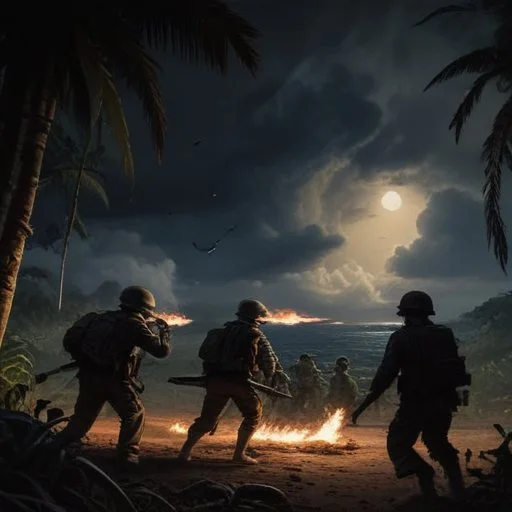
On October 24, 1942, under the cover of darkness, the Imperial Japanese Army launched a stealthy nighttime assault on Henderson Field, hoping to retake the airbase and cripple the Allies' ability to project airpower in the region. As Japanese troops emerged from the jungle, guided by the eerie glow of mortar and artillery fire, the 1st Marine Division was caught off guard, scrambling to respond to the surprise attack.
Kamakazi Tactics and Desperate Defense
The ensuing battle raged on, with both sides trading blows in a chaotic frenzy of machine gun fire, artillery explosions, and screams of the wounded. Japanese troops employed kamikaze tactics, sacrificing their lives in daring banzai charges, while the Marines dug in, fighting tooth and nail to protect their hard-won airbase. The din of battle was deafening, the stench of smoke and sweat hanging heavy over the battlefield like a funeral shroud.
The Tide of the Battle
As the fight wore on, the Marines, bolstered by reinforcements and their own grit, began to gain the upper hand. The Japanese, their ranks decimated, their supplies dwindling, were forced to retreat, leaving behind the bodies of their fallen comrades. The Battle for Henderson Field was far from over, but the Allies had gained a crucial foothold, one that would ultimately prove decisive in the war for the Pacific.
Major Outcomes and Impacts
- The Battle for Henderson Field marked a significant shift in the balance of power in the Pacific, as the Allies gained a crucial airbase from which to launch further operations.
- The Japanese defeat at Henderson Field foreshadowed the ultimate capture of Guadalcanal, a blow from which the Japanese military would never fully recover.
- The bravery and sacrifice of the Marines and airmen stationed at Henderson Field inspired a nation, boosting morale and galvanizing support for the war effort.
A Legacy of Valor
The Battle for Henderson Field will forever be remembered as a testament to the bravery, sacrifice, and determination of the men who fought and died on both sides of the conflict. Their stories of heroism, forged in the crucible of war, continue to inspire generations, reminding us of thehuman cost of conflict and the importance of honoring the memories of those who gave their last full measure of devotion.
Rich Character Description
Among the heroic figures who emerged during the Battle for Henderson Field was Lt. Col. Mitchell Paige, commander of the 1st Battalion, 7th Marines. Paige's leadership and bravery under fire inspired his troops and played a crucial role in repelling the Japanese attack. As the Japanese launched their banzai charges, Paige rallied his men, directing them to hold their ground and pour devastating fire into the enemy ranks. For his heroism, Paige would later receive the Medal of Honor.
Lt. Col. Paige's story is a testament to the grit and determination of the Marines who fought at Henderson Field. His selfless leadership and unwavering commitment to his troops have become legendary in Marine Corps history.

Deep Historical Exploration
In the months leading up to the Battle for Henderson Field, the Japanese had been secretly constructing an airstrip on the nearby island of Bougainville. Codenamed "Buin," this airbase was intended to serve as a forward operating base for Japanese aircraft, allowing them to launch strikes against Henderson Field and other Allied targets in the region.
The Buin airbase was a critical component of the Japanese strategy to retake Guadalcanal, and its construction was overseen by top Japanese engineers and military officials. However, the Allies remained unaware of the airbase's existence until late 1942, when a reconnaissance mission finally detected signs of Japanese activity on Bougainville.
Thorough Geopolitical Study
The Battle for Henderson Field took place against the backdrop of a larger strategic struggle for control of the Pacific. The Japanese, seeking to expand their empire and secure vital resources, had launched a series of aggressive military campaigns across Southeast Asia and the Pacific.
In response, the Allies had established a defensive perimeter stretching from Australia to Hawaii, with Guadalcanal serving as a critical stronghold in the Solomon Islands. The capture of Henderson Field by American forces in August 1942 had dealt a significant blow to Japanese plans, and the subsequent battle to retake the airbase became a key test of strength for both sides.
Rich Comparative Exploration
The Battle for Henderson Field marked a turning point in the Pacific War, as the Allies gained a crucial foothold in the Solomon Islands and began to push the Japanese back on their heels. However, the battle also highlighted significant differences in tactics and strategy between the two sides.
While the Japanese relied on brutal, sacrifice-heavy tactics like banzai charges, the Allies placed a greater emphasis on firepower, mobility, and coordinated air-ground operations. This contrast in approaches would have significant implications for the outcome of the war, as the Allies' more flexible and adaptable strategy ultimately proved more effective in the Pacific Theater.
Study of Cultural Impact
The Battle for Henderson Field had a profound impact on American culture, as the heroism and sacrifice of the Marines who fought and died on Guadalcanal captured the imagination of the nation.
The battle was widely reported in the press, with vivid accounts of the intense fighting and bravery of the Marines inspiring patriotism and boosting morale on the home front. The battle also spawned a range of popular cultural works, from films and literature to music and art, cementing its place in the American psyche as a symbol of courage and determination.


