


The Battle of Prokhorovka stands as a testament to the unbridled fury of war, a clash of titans that shook the very foundations of the Eastern Front. This pivotal engagement, fought on July 12, 1943, is renowned as one of the largest armored battles in the annals of military history, with over 1,000 tanks from both the German and Soviet armies locked in a frenzy of steel and fire.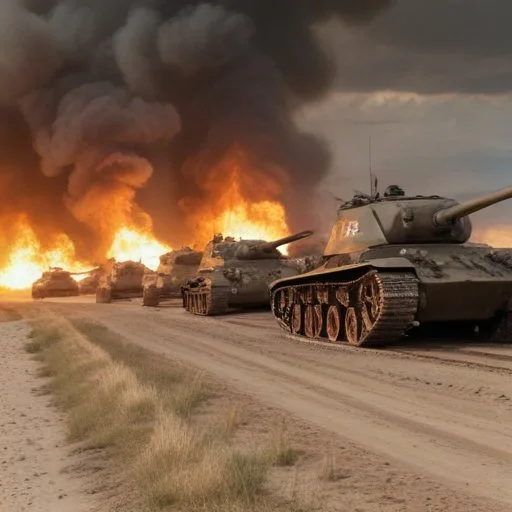
In the scorching summer of 1943, the German Wehrmacht and the Soviet Red Army were engaged in a brutal struggle for control of the Kursk salient, a strategic region in western Russia. The Germans, determined to capture the city of Kursk and crush the Soviet defenders, had launched Operation Citadel, a massive offensive that aimed to encircle and annihilate the Soviet forces. The Soviets, however, were well-prepared and determined to hold their ground, setting the stage for the epic confrontation at Prokhorovka.
As the sun rose over the rolling hills and sun-baked steppes of Prokhorovka, the German and Soviet tank formations faced off in a chaotic melee. The elite II SS Panzer Corps, spearheaded by the feared 1st SS Panzer Division Leibstandarte SS Adolf Hitler, charged forward with reckless abandon, their Panzer tanks belching flames and smoke as they clashed with the Soviet armor. The Red Army, led by General Pavel Rotmistrov's 5th Guards Tank Army, stood firm, its T-34 tanks and artillery batteries pounding the German lines with unrelenting ferocity.
The battle raged on for hours, the two armies trading blows in a maelstrom of steel and fire. The air was thick with the acrid smell of burning rubber and oil, the earth shaking beneath the treads of the tanks as they churned across the battlefield. The cries of the wounded and the dying echoed through the carnage, a haunting reminder of the horrific cost of war.
As the battle raged on, the Soviet forces began to gain the upper hand. The German tanks, despite their superior firepower, were being slowly but surely ground down by the relentless Soviet onslaught. The II SS Panzer Corps, which had borne the brunt of the fighting, was being steadily depleted, its armor pierced and its men cut down by the hail of Soviet artillery fire.
In a last-ditch effort to stem the tide of defeat, the Germans launched a series of desperate counterattacks, but these were swiftly repelled by the Soviet defenders. As the sun began to set on Prokhorovka, the German forces were in full retreat, their armor shattered and their morale broken. The Soviet Union had emerged victorious, but at a terrible cost in blood and steel.
The Battle of Prokhorovka was a crushing defeat for the German Wehrmacht, marking a decisive shift in the balance of power on the Eastern Front. The Soviet Union had proven its mettle, demonstrating its ability to withstand and ultimately defeat the mighty German war machine. The battle would go down in history as one of the largest armored engagements of all time, a testament to the unyielding ferocity and sacrifice of the soldiers who fought and died on that fateful day.
In the years that followed, the Battle of Prokhorovka would be remembered as a turning point in the war, a moment when the tide of history swung irrevocably in favor of the Allies. It would also serve as a poignant reminder of the devastating consequences of war, a testament to the bravery and sacrifice of the soldiers who fought and died on the battlefields of World War II.
General Pavel Rotmistrov was the commander of the 5th Guards Tank Army, the Soviet force that clashed with the German II SS Panzer Corps at Prokhorovka. Born in 1901, Rotmistrov was a seasoned military officer who had fought in the Russian Civil War and the Finnish Winter War. He was known for his bravery, tactical genius, and unwavering commitment to the Soviet cause.
Rotmistrov's leadership during the Battle of Prokhorovka was instrumental in the Soviet victory. He expertly deployed his tank formations, using terrain to his advantage and exploiting the weaknesses of the German armor. His ability to adapt to changing circumstances and make swift decisions under pressure was crucial in repelling the German onslaught.
The Battle of Prokhorovka took place against the backdrop of a rapidly shifting geopolitical landscape. The German invasion of the Soviet Union in 1941 had led to a bitter and brutal conflict, with both sides suffering heavy losses. The Soviet Union, determined to defend its territory and ideology, had mobilized its vast resources and manpower to repel the German attack.
The Battle of Kursk, of which Prokhorovka was a part, was a pivotal moment in the war, as it marked a decisive shift in the balance of power on the Eastern Front. The Soviet victory at Prokhorovka not only halted the German advance but also paved the way for the eventual defeat of Nazi Germany.
Beneath the scorched earth and burning tanks of Prokhorovka lay the untold stories of the ordinary soldiers who fought and died on that fateful day. Soviet tank crews, many of whom were conscripted from rural villages, bravely charged into battle against overwhelming odds. German soldiers, exhausted and demoralized, fought on despite being vastly outnumbered.
One such unsung hero was Soviet tanker Ivan Chernysh, who single-handedly destroyed several German tanks before being killed in action. His bravery was posthumously recognized with the title of Hero of the Soviet Union. Similarly, German Lieutenant Hans von Schroif, who led a desperate counterattack against the Soviet forces, was later commended for his bravery.
The Battle of Prokhorovka was a clash of titans, with both sides fielding some of the most advanced tanks of the time. The German Panzer III and IV tanks, with their lethal 88mm guns, were pitted against the Soviet T-34, a revolutionary design that would go on to become one of the most produced tanks in history.
The battle highlighted the importance of tank design and production in modern warfare. The Soviet Union's ability to mass-produce the T-34, with its sloping armor and powerful gun, gave it a decisive edge over the German forces. Meanwhile, the German failure to develop a more advanced tank design would ultimately prove disastrous.
The Battle of Prokhorovka and the Battle of El Alamein are often cited as two of the greatest tank battles in history. While both battles involved massive armored formations and decisive outcomes, they differed significantly in terms of terrain, tactics, and technology.
Prokhorovka was fought on the rolling hills and open steppes of western Russia, allowing for rapid tank movements and fluid battlelines. In contrast, El Alamein was fought in the deserts of North Africa, where the rugged terrain and limited visibility forced both sides to adopt more cautious tactics.