


The Battle of Leyte Gulf, fought from October 23 to 26, 1944, is renowned as the largest naval battle in history, with over 280 ships involved, and marked a decisive American victory that crippled Japan's naval power.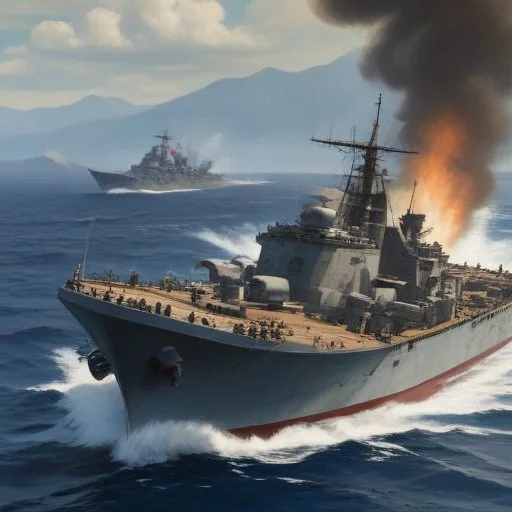
The battle was a culmination of the Allied forces' campaign to retake the Philippines, and it would prove to be a crucial turning point in the war, paving the way for the eventual defeat of Japan.
In the fall of 1944, the Allies had been making steady gains in the Pacific, and the Philippines, a strategic location, was the next target. The Japanese, determined to defend their territory, planned a bold counterattack to disrupt the Allied invasion.
On October 23, 1944, the Japanese launched a surprise attack on the Allied forces, but American Admiral Halsey's Task Force 38 responded swiftly, engaging the Japanese in a series of intense battles.
The Battle of Leyte Gulf resulted in a crushing defeat for the Japanese, with estimates suggesting that up to 10,000 Japanese sailors and airmen were killed, and four aircraft carriers, three battleships, and numerous smaller vessels sunk or severely damaged.
The American victory had far-reaching consequences, securing the Philippines as a key Allied stronghold, and paving the way for the eventual invasion of Japan.
The Battle of Leyte Gulf has been immortalized in films, literature, and art, serving as a testament to the bravery and sacrifice of those who fought.
In the years following the battle, the Philippines would become a key U.S. ally in the region, and the battle would be remembered as a symbol of American determination and naval prowess.
The battle has been the subject of controversy, with some historians questioning the strategic decisions made by Admiral Halsey, and the potential risks and consequences of his actions.
Despite these debates, the Battle of Leyte Gulf remains a celebrated American victory, and a testament to the strength and resilience of the Allied forces during World War II.
"There will be no dunking, there will be no surrender." - Admiral William F. Halsey Jr.
"The fate of the Empire rests upon this one battle." - Admiral Takeo Kurita
The Battle of Leyte Gulf marked a significant shift in the balance of power in the Pacific, mirroring the Battle of Midway, which had crippled the Japanese naval force two years earlier.
Both battles highlighted the importance of air power and the role of aircraft carriers in modern naval warfare, and would shape the course of naval strategy for decades to come.
Sailors on board the USS Enterprise, an American aircraft carrier, recalled the intense air battles, and the sight of Japanese planes crashing into the sea.
Survivors of the Japanese forces spoke of the chaos and devastation on board their ships, as the U.S. Navy launched wave after wave of attacks.
The Battle of Leyte Gulf has been the subject of extensive historical research and analysis, offering valuable insights into naval warfare, strategic decision-making, and the importance of air power.
The battle has also inspired generations of military leaders, strategists, and historians, shaping our understanding of modern warfare and the importance of alliances and cooperation.
The Medal of Honor was awarded to 12 American sailors and airmen for their heroism during the battle.
The USS Enterprise, which played a crucial role in the battle, was awarded the Presidential Unit Citation, and its crew received numerous decorations for their bravery.
In conclusion, the Battle of Leyte Gulf was a pivotal moment in World War II, marking a decisive American victory and a crushing defeat for the Japanese. The battle's legacy continues to inspire and educate, serving as a testament to the courage and sacrifice of those who fought.
The Battle of Leyte Gulf was a complex operation that involved multiple naval forces, including the U.S. Third Fleet, the U.S. Seventh Fleet, and the Japanese Combined Fleet. The Japanese had planned a bold counterattack, dubbed Operation Sho-1, to disrupt the Allied invasion of the Philippines. This operation involved a three-pronged attack, with a surface force, an air force, and a decoy force. The surface force, led by Admiral Takeo Kurita, consisted of four battleships, including the massive Musashi, as well as cruisers, destroyers, and smaller vessels. The air force, led by Vice Admiral Takijirō Ōnishi, was responsible for launching air attacks on the Allied forces.
The Japanese plan was to attack the Allied forces from multiple directions, hoping to catch them off guard and sink a significant number of ships. However, the plan was flawed from the start, as the Japanese forces were heavily outnumbered and outgunned by the Allies. Additionally, the Japanese were hampered by poor communication, inadequate intelligence, and a lack of coordination between their forces.

Admiral William F. Halsey Jr. was a seasoned naval officer who played a crucial role in the Battle of Leyte Gulf. Born in 1882, Halsey graduated from the U.S. Naval Academy in 1904 and went on to serve in both World War I and World War II. He was known for his bold and aggressive tactics, earning him the nickname "Bull" Halsey.
Halsey's leadership during the Battle of Leyte Gulf was instrumental in the Allied victory. He was able to outmaneuver and outgun the Japanese forces, sinking numerous ships and planes. His decision to pursue the Japanese fleet north of Luzon, rather than staying to protect the Allied invasion forces, was a gamble that paid off, as it led to the destruction of the Japanese carriers.
The Battle of Leyte Gulf had a profound impact on the cultural psyche of the United States and the Philippines. The battle marked a turning point in the war, as it marked the beginning of the end of Japanese occupation in the Philippines. For the Filipinos, the battle was a symbol of liberation and freedom from Japanese rule.
In the United States, the battle was hailed as a great victory, and it marked a significant shift in public opinion. The battle was seen as a testament to American power and determination, and it boosted morale on the home front.
The Battle of Leyte Gulf and the Battle of Midway: A Comparative Analysis
The Battle of Leyte Gulf and the Battle of Midway are two of the most significant naval battles in history. Both battles marked a turning point in the war, and both resulted in a decisive victory for the Allies.
One of the key similarities between the two battles is the importance of air power. In both battles, aircraft carriers played a crucial role, as they provided the necessary firepower to attack and sink enemy ships.
The Battle of Leyte Gulf marked a significant shift in naval warfare, as it highlighted the importance of air power and aircraft carriers. The battle demonstrated the devastating effect of aerial attacks on enemy ships, and it marked a turning point in the development of naval strategy.
The battle also led to significant advancements in aircraft carrier design and technology. The U.S. Navy learned valuable lessons from the battle, and it used these lessons to develop more advanced aircraft carriers, such as the USS Enterprise, which played a crucial role in the battle.