


The Battle of Midway, fought from June 4 to 7, 1942, is renowned for being a decisive naval battle in World War II, where the United States Navy thwarted the Japanese Empire's attempt to capture the Midway Atoll, inflicting devastating damage on the Japanese fleet and altering the course of the war in the Pacific.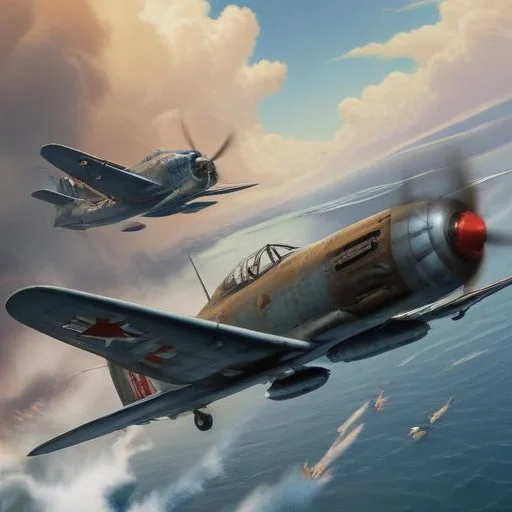
The Battle of Midway is often regarded as a crucial turning point in World War II, as it halted the Japanese Empire's seemingly unstoppable expansion in the Pacific. The Japanese Navy, led by Admiral Isoroku Yamamoto, had been on a winning streak, having captured Hong Kong, Singapore, and the Dutch East Indies, and launching a surprise attack on Pearl Harbor just six months prior.
The US Navy's victory at Midway was attributed to a combination of cryptic intelligence, clever tactics, and a dash of good fortune. American cryptanalysts had cracked the Japanese Navy's communication codes, providing the US Pacific Fleet with valuable insights into Japanese plans. This intelligence, coupled with the US Navy's adoption of a more aggressive and proactive approach, allowed them to prepare a decisive ambush.
On June 4, 1942, Japanese aircraft launched a surprise attack on Midway Island, but the US Navy was ready. As Japanese bombers and fighters roamed the skies, US aircraft, including the Grumman F4F Wildcat and Douglas SBD Dauntless, swooped in for the attack. The US Navy's aircraft, led by Lieutenant Commander Clarence W. McClusky, successfully targeted and sank all four Japanese aircraft carriers, Akagi, Kaga, Soryu, and Hiryu, dealing a crushing blow to the Japanese Navy.
The Battle of Midway's impact was profound, as it marked a shift in momentum in favor of the Allies. The loss of four aircraft carriers, along with hundreds of experienced pilots and crew, severely weakened the Japanese Navy's ability to project power. This defeat, combined with the Japanese Army's stalled advance on the Asian continent, created an opportunity for the Allies to regroup and launch a counterattack.
| Date | Event |
|---|---|
| June 4, 1942 | Japanese aircraft launch a surprise attack on Midway Island. |
| June 4, 1942 | US aircraft, led by Lieutenant Commander Clarence W. McClusky, launch a counterattack, sinking three Japanese carriers. |
| June 7, 1942 | The fourth Japanese carrier, Hiryu, is sunk, marking the end of the battle. |
The Battle of Midway serves as a testament to the bravery and determination of the sailors, airmen, and soldiers who fought on both sides of the conflict. Today, the USS Midway Museum in San Diego, California, stands as a memorial to this pivotal battle and the men who fought in it.
The Battle of Midway highlights the importance of adaptability, strategic thinking, and the role of intelligence in modern warfare. Its legacy continues to influence military strategy and tactics to this day, serving as a reminder of the power of combined air and naval forces in shaping the course of conflict.
The Japanese Navy's plan to capture Midway Island was devised by Admiral Isoroku Yamamoto, who aimed to draw out the US Pacific Fleet and destroy it in a decisive battle. The plan involved a complex sequence of events, including a diversionary attack on the Aleutian Islands, a naval bombardment of Midway Island, and a combined air and naval assault on the US fleet. However, the plan was flawed from the start, as it underestimated the strength and preparedness of the US Navy.
Despite their impressive naval victories in the early months of the war, the Japanese Navy was beginning to show signs of overextension and fatigue. Their forces were scattered across the Pacific, and their supply lines were stretched thin. Moreover, the Japanese Navy's communications codes had been compromised by American cryptanalysts, who had broken the Japanese Navy's secret codes.
Admiral Chester Nimitz was the Commander-in-Chief of the US Pacific Fleet during the Battle of Midway. Despite being overshadowed by more flamboyant personalities, Nimitz was a highly effective leader who played a crucial role in the battle's planning and execution. A quiet and unassuming man, Nimitz was known for his calm and composed demeanor, which inspired confidence in his subordinates.
Nimitz's leadership style was characterized by his emphasis on teamwork, adaptability, and flexibility. He encouraged his officers to think creatively and take initiative, which helped to overcome the Japanese Navy's surprise attack.
The Battle of Midway is often compared to the Japanese attack on Pearl Harbor, which occurred just six months earlier. While both battles involved surprise attacks by the Japanese Navy, there were significant differences between the two events.
Unlike Pearl Harbor, where the Japanese achieved complete surprise, the US Navy was forewarned of the Japanese attack on Midway Island. American cryptanalysts had broken Japanese codes, providing the US Pacific Fleet with valuable insights into Japanese plans. This allowed the US Navy to prepare an ambush, which ultimately led to the Japanese defeat.
The Battle of Midway took place against the backdrop of a rapidly changing geopolitical landscape. The Japanese Empire was expanding its territories across Asia and the Pacific, while the United States was struggling to respond to the surprise attack on Pearl Harbor.
The battle was also influenced by the complex web of alliances and rivalries between nations. The United States and the United Kingdom were allies, while Japan was aligned with Germany and Italy. The Soviet Union, which was fighting a desperate battle against Nazi Germany, was a wildcard in the Pacific Theater.
The Battle of Midway was won as much by codebreakers as it was by sailors and pilots. American cryptanalysts had been working tirelessly to break the Japanese Navy's secret codes, and their efforts paid off in the days leading up to the battle.
The cryptanalysts, led by Commander Joseph Rochefort, worked around the clock to decipher Japanese messages, providing the US Pacific Fleet with vital intelligence on Japanese plans and movements. This intelligence allowed the US Navy to prepare an ambush, which ultimately led to the Japanese defeat.