


The Fourth Battle of Monte Cassino, a brutal and intense conflict, finally came to an end after seven days of relentless fighting, marking a crucial turning point in the Italian campaign of World War II. This epic battle, which took place from May 11 to May 18, 1944, will be etched in history as one of the bloodiest and most decisive battles of the war.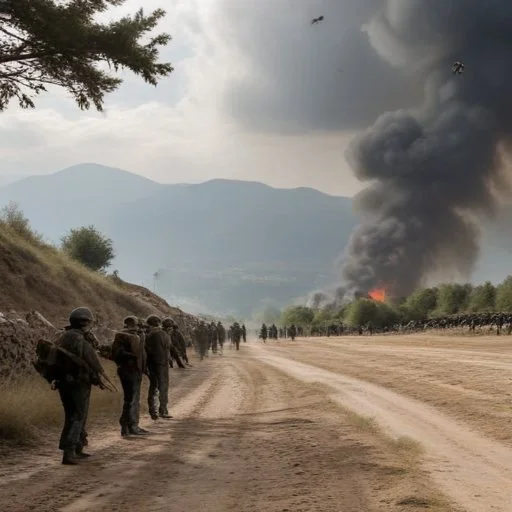
The Allies had been attempting to break through the German defenses in Italy for months, but the strategic hilltop of Monte Cassino, situated 80 miles southeast of Rome, remained a formidable obstacle. The Germans, led by General Albert Kesselring, had fortified the monastery and surrounding hills, making it a seemingly impregnable stronghold.
The fall of Monte Cassino marked a crucial turning point in the Italian campaign, allowing the Allies to advance up the Italian peninsula and eventually capture Rome on June 5, 1944. The victory also paved the way for the Allied advance into Central Europe.
The Battle of Monte Cassino holds a special significance for the Polish people, as it was a testament to their bravery and sacrifice in the fight against Nazi Germany. The battle is still celebrated as a national heroism day in Poland.
" Monte Cassino, a holy place, has been converted into a stronghold of war." - General Władysław Anders
The Fourth Battle of Monte Cassino is often compared to the Battle of Stalingrad, as both battles were brutal and intense, with heavy casualties on both sides. However, while Stalingrad marked a turning point on the Eastern Front, Monte Cassino marked a crucial victory in the Italian campaign.
The combination of the Allied forces' determination, the Polish Corps' bravery, and the Germans' exhaustion created a perfect storm of circumstances that led to the eventual defeat of the German forces.
The Battle of Monte Cassino will be remembered as one of the bloodiest and most intense battles of World War II, a testament to the bravery and sacrifice of the soldiers who fought on both sides. The battle's legacy continues to inspire and motivate people to this day, serving as a reminder of the importance of perseverance and determination in the face of adversity.
General Władysław Anders was a Polish general and commander of the Polish II Corps during the Fourth Battle of Monte Cassino. Born on August 11, 1892, in Krośniewice, Poland, Anders was a decorated veteran of World War I and the Polish-Soviet War. He played a crucial role in the battle, leading his troops in a series of intense battles against the German forces. Anders' bravery and leadership were instrumental in the eventual defeat of the Germans, and he became a national hero in Poland.

The Italian campaign, which began in 1943, was a series of battles fought between the Allies and the Axis powers in Italy during World War II. The campaign was marked by a series of grueling battles, including the Battle of Salerno, the Battle of Anzio, and the Battle of Monte Cassino. The Allies, led by General Harold Alexander, faced stiff resistance from the German forces, led by General Albert Kesselring, who had fortified the Italian peninsula with a series of defensive lines. The campaign was a key turning point in the war, as it marked the beginning of the end of Germany's dominance in Europe.
The Battle of Monte Cassino holds a special place in Polish culture, symbolizing the bravery and sacrifice of Polish soldiers during World War II. The battle is still celebrated as a national heroism day in Poland, with ceremonies and parades held annually on May 18th. The battle has also been immortalized in Polish literature and art, with numerous books, films, and paintings dedicated to the heroic deeds of the Polish soldiers. The battle's legacy continues to inspire and motivate the Polish people, serving as a reminder of the importance of defending one's country and fighting for freedom.

The Battles of Monte Cassino and Stalingrad were two of the most intense and brutal battles of World War II. While both battles were marked by heavy casualties and destruction, there are some key differences between them. The Battle of Stalingrad, fought from August 1942 to February 1943, was a major turning point on the Eastern Front, marking the beginning of the end of Germany's dominance in Europe. The Battle of Monte Cassino, on the other hand, was a crucial victory in the Italian campaign, paving the way for the Allied advance into Central Europe. While both battles were brutal and decisive, the Battle of Monte Cassino was marked by a greater degree of tactical innovation and flexibility, with the Allies employing a range of innovative strategies to outflank and outmaneuver the German forces.
Historians have long debated the significance of the Fourth Battle of Monte Cassino, with some viewing it as a turning point in the Italian campaign and others seeing it as a costly and avoidable battle. Some historians, such as John Ellis, have argued that the battle was a necessary evil, as it marked the beginning of the end of Germany's dominance in Italy. Others, such as Carlo D'Este, have been more critical, viewing the battle as a unnecessary slaughter that exacted a heavy toll on both sides. Regardless of one's perspective, the Battle of Monte Cassino remains an important and fascinating topic of study for historians and military strategists alike.