


The HMS Jervis Bay, a British armed merchant cruiser, etched its name in history on November 5, 1940, when it dared to confront the formidable German pocket battleship Admiral Scheer, buying time for its convoy to escape in the process. This valiant act of sacrifice would go down as one of the most courageous naval battles of World War II.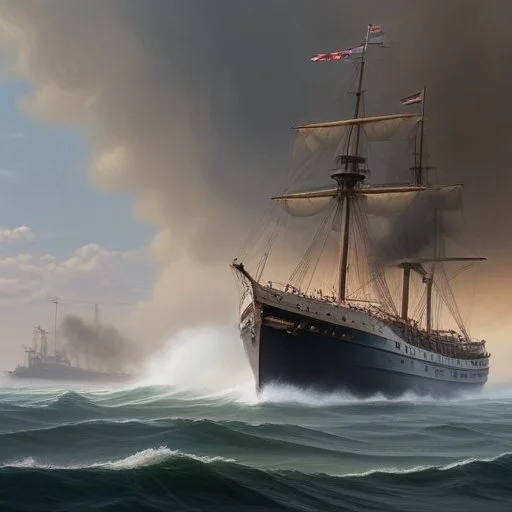
The odds were heavily stacked against the HMS Jervis Bay. Weighing in at around 6,000 tons, it was no match for the Admiral Scheer's 12,000 tons of steel and firepower. But Captain Edward Fegen, a seasoned veteran of the Royal Navy, refused to back down, even when faced with the daunting prospect of engaging a superior enemy.
The HMS Jervis Bay's determination was not merely a product of bravado; it was a calculated move to protect its convoy of 37 ships, carrying vital supplies to Britain. As the Admiral Scheer emerged from the misty North Atlantic, the Jervis Bay charged forward, firing its guns to distract the enemy and give the convoy time to escape.
The one-sided battle raged on for hours, with the Jervis Bay taking a merciless pounding. Despite being hopelessly outgunned, Captain Fegen fought on, buying time for his convoy to flee. The Jervis Bay's guns blazed away, firing 550 rounds in total, but it was only a matter of time before the superior German firepower would prevail.
As the Jervis Bay's defenses began to crumble, Captain Fegen gave the order to abandon ship. However, it was too late; the ship was already listing severely, and chaos had erupted on deck. In the end, 189 of the Jervis Bay's 254 crew members would lose their lives, including Captain Fegen, who went down with his ship.
Captain Fegen's bravery that day earned him a posthumous Victoria Cross, the highest British award for gallantry in the face of the enemy. The HMS Jervis Bay's heroic last stand would serve as a testament to the bravery and sacrifice of the Royal Navy during World War II.
In the annals of naval history, the HMS Jervis Bay's story serves as a powerful reminder of the importance of courage, duty, and sacrifice. Though the ship itself was lost, its legacy lives on, inspiring generations to come.
Captain Edward Fegen, the commander of the HMS Jervis Bay, was a seasoned veteran of the Royal Navy. Born in 1892, Fegen had a long and distinguished career, serving in both World War I and World War II. He was known for his bravery and leadership, earning several decorations, including the Distinguished Service Cross and the Order of the British Empire. Fegen's ultimate sacrifice on November 5, 1940, capped a life of service and dedication to his country. Despite the tragic loss, his legacy continues to inspire generations of naval officers.
In the fall of 1940, the British Admiralty had been tracking the movements of the Admiral Scheer, a German pocket battleship that had been wreaking havoc on Allied shipping lanes. The Scheer, under the command of Admiral Wilhelm Marschall, had evaded capture for months, leaving a trail of destruction in its wake. As the HMS Jervis Bay and its convoy approached the danger zone, the British Navy was on high alert, knowing that the Scheer was lurking in the vicinity. The stage was set for a dramatic confrontation.
The North Atlantic, where the HMS Jervis Bay and the Admiral Scheer clashed, played a critical role in the Allied war effort. The convoy route from North America to Britain was a vital lifeline, supplying the British Isles with essential goods and materials. The Germans, aware of this strategic importance, had deployed U-boats and surface raiders like the Scheer to disrupt and sink Allied shipping. The Battle of the HMS Jervis Bay was, in essence, a battle for control of the North Atlantic.
The Battle of the HMS Jervis Bay was, in many ways, a clash of two captain's philosophies. Captain Edward Fegen, commanding the Jervis Bay, embodied the British tradition of bravery and sacrifice. In contrast, Admiral Wilhelm Marschall, commanding the Admiral Scheer, represented the German naval doctrine of aggressive power projection. While Fegen's actions were guided by a sense of duty and loyalty, Marschall's decisions were driven by a desire for military victory and prestige. The battle was, in essence, a microcosm of the broader conflict between two competing ideologies.
The logbook of the HMS Jervis Bay, recovered after the battle, provides a unique glimpse into the events of November 5, 1940. The logbook, now housed at the UK National Archives, contains handwritten entries detailing the ship's movements, weather conditions, and notable events. The final entries, written in the midst of the battle, are a poignant testament to the bravery and sacrifice of the Jervis Bay's crew. The logbook serves as a tangible connection to the past, offering an unfiltered account of one of World War II's most heroic episodes.