


On September 10, 1943, the Eternal City of Rome fell under the iron grip of the German army, marking a pivotal moment in World War II. As the Allies advanced up the Italian peninsula, German forces swiftly moved to consolidate their control, pouring troops into Rome in a bid to counter the Italian surrender, which had occurred just days earlier.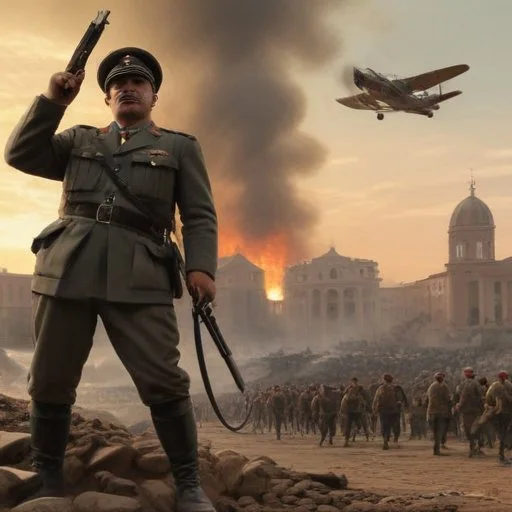
The roots of Operation Achse can be traced back to the struggling alliance between Germany and Italy. As the war turned against the Axis powers, Italian dictator Benito Mussolini's grip on power began to slip. The Allied invasion of Sicily in July 1943 added to the pressure, and on September 3, 1943, Italy surrendered to the Allies.
However, German high command suspected that Italy might switch sides, and Hitler ordered Operation Achse to secure key Italian cities, including Rome. The operation aimed to prevent the Italian military from joining the Allies and to secure vital infrastructure, such as airfields and ports.
The occupation of Rome marked a significant shift in the war's balance of power, foreshadowing a lengthy and bloody battle for the Italian capital. The German occupation led to widespread persecution of Jews, resistance fighters, and civilians, earning Rome the nickname "the city of suffering."
The occupation also had far-reaching implications for the war's outcome. The Allies were forced to divert valuable resources to liberate Rome, slowing their advance on other fronts. Meanwhile, the German occupation of Rome allowed the Nazis to maintain control over parts of Italy, prolonging the conflict.
The occupation of Rome had a profound impact on the city's cultural and social fabric. The presence of German troops led to widespread destruction, looting, and human suffering, leaving deep scars on the Roman people. The city's rich cultural heritage, including its historic landmarks and artistic treasures, was also threatened by the war.
However, the occupation also sparked a sense of unity and resistance among the Roman people. As the war dragged on, ordinary citizens, clergy, and resistance fighters joined forces to form a united front against the Nazi occupiers.
"Rome will be defended at all costs, and the city will be maintained as a fortress." - Field Marshal Albert Kesselring, September 1943
The occupation of Rome played a significant role in shaping the final stages of World War II. The brutal fight for control of the city influenced the Allies' strategy, leading to a prolonged and costly campaign to liberate Italy. The experience also informed post-war reconstruction efforts, as the international community sought to rebuild and restore the devastated city.
Today, the legacy of Operation Achse serves as a poignant reminder of the devastating consequences of war and the importance of preserving cultural heritage in the face of conflict.
As the Allies advanced up the Italian peninsula, Mussolini's grip on power began to slip. His once-unwavering confidence was eroded by a series of military defeats and economic crises. The Italian people, who had once hailed him as a hero, grew increasingly disillusioned with his authoritarian rule and the country's disastrous involvement in World War II.
Mussolini's relationships with his Axis allies also began to fray. Hitler, who had once seen Mussolini as a valuable partner, grew increasingly skeptical of the Italian dictator's ability to maintain control. The German Führer's decision to launch Operation Achse was, in part, a response to Mussolini's weakening grip on power.
Despite his declining fortunes, Mussolini remained defiant, vowing to resist the Allied advance and maintain Italy's sovereignty. However, his leadership was crippled by internal divisions and external pressures, ultimately paving the way for the German occupation of Rome.
The German occupation of Rome posed a unique challenge to the Vatican, which was determined to maintain its neutrality in the conflict. Pope Pius XII, who had previously been accused of being too soft on the Nazi regime, walked a delicate tightrope as he sought to protect the city's Catholic population and cultural heritage.
The Pope's decision to remain in Rome during the occupation was seen as a symbol of solidarity with the Italian people. However, his silence on the topic of Nazi atrocities has been the subject of controversy and debate among historians.
Despite these challenges, the Vatican played a crucial role in providing humanitarian aid to Rome's civilian population, particularly during the darkest days of the occupation. The city's Catholic institutions, including the Pontifical Villas, served as safe havens for persecuted Jews and resistance fighters.
The speed and efficiency of the German army's advance on Rome caught the Allies off guard. In the days following Italy's surrender, German troops poured into the city, securing key infrastructure and strategic locations with remarkable rapidity.
The German commander, Field Marshal Albert Kesselring, had meticulously planned the operation, using his knowledge of Italian terrain and infrastructure to outmaneuver the Allies. His troops were aided by the country's vast network of roads and railways, which allowed them to move quickly and efficiently.
The Germans' rapid advance was also facilitated by the Italian military's confusion and disarray. Many Italian soldiers, unsure of their role in the conflict, failed to resist the German occupation, allowing the Nazis to consolidate their control with relative ease.

The German occupation of Rome had significant implications for the broader geopolitical landscape of World War II. The Allies, who had been counting on Italy's surrender to open up a new front against Germany, were forced to reassess their strategy.
The occupation also altered the balance of power in the Mediterranean, allowing Germany to maintain control over key ports and airfields. This, in turn, threatened Allied supply lines and communication networks.
The occupation of Rome also had significant implications for the post-war world order. The Allies' prolonged campaign to liberate Italy delayed their advance on other fronts, ultimately contributing to the Soviet Union's dominance in Eastern Europe.
Rome's strategic location made it a crucial prize in the Allies' campaign to liberate Italy. The city's proximity to the Mediterranean coast and its status as a major transportation hub made it an essential hub for military supply lines and communication networks.
The city's occupation also gave Germany control over key airfields, allowing the Luftwaffe to launch attacks on Allied positions in North Africa and the Middle East.
Rome's cultural and historical significance also made it a symbolic prize in the war. The city's occupation was seen as a blow to Italian national pride, and its liberation became a key goal for the Allies as they pushed northwards up the Italian peninsula.