


In the midst of World War II, a remarkable act of humanity unfolded in southern Bavaria, Germany. A segregated, all-Nisei unit of the U.S. Army, the 522nd Field Artillery Battalion, stumbled upon a harrowing scene: a death march of gaunt, exhausted prisoners from Dachau, forced to trudge towards the Austrian border. 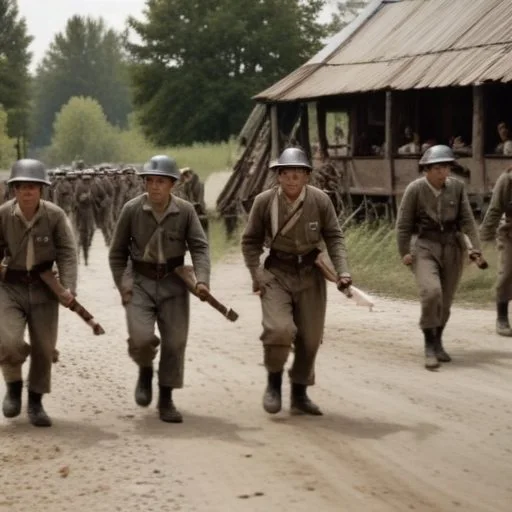
As Allied forces closed in on Germany, the Nazi regime grew increasingly desperate. One of their final, brutal acts was to force prisoners from concentration camps, like Dachau, to march towards the Austrian border. This inhumane ordeal, later known as a "death march," would claim countless lives.
On April 29, 1945, the 522nd Field Artillery Battalion, comprising Japanese-American soldiers, was advancing through southern Bavaria. As they navigated the war-ravaged countryside, they chanced upon the Dachau prisoners, stumbling through the roads in a state of utter despair.
Without hesitation, the Nisei soldiers intervened, liberating the prisoners from their Nazi captors. In a remarkable display of compassion, they provided the desperate prisoners with food, water, and medical care. This selfless act not only saved hundreds of lives but also offered a glimmer of hope amidst the devastation of war.
The 522nd Field Artillery Battalion, comprising approximately 650 soldiers, was a segregated unit of Japanese-American Nisei. Despite facing discrimination and skepticism from their own country, they proved themselves to be fiercely loyal and brave. Their actions on that fateful day would go down in history as one of the most remarkable acts of humanity during World War II.
The liberation of the Dachau prisoners by the 522nd Field Artillery Battalion served as a beacon of hope, highlighting the capacity for compassion and humanity even in the darkest of times. This remarkable event has inspired generations, reminding us that even in the face of adversity, ordinary people can become extraordinary heroes.
"We were just trying to do our job, and our job was to liberate those people." - Sgt. Takeshi Nakayama, 522nd Field Artillery Battalion
The actions of the 522nd Field Artillery Battalion have been immortalized in various forms, including documentaries, films, and literary works. Their bravery and compassion serve as a testament to the power of humanity, inspiring generations to come.
The 522nd Field Artillery Battalion's encounter with the Dachau prisoners is well-documented through various primary sources, including military reports, diaries, and photographs. One of the most significant documents is the Unit Journal of the 522nd Field Artillery Battalion, which provides a detailed account of the events leading up to the liberation.
A reproduction of the Unit Journal's entry on April 29, 1945, reads: "At 1400 hours, the battalion encountered a group of approximately 300 prisoners from Dachau, marching towards the Austrian border. The prisoners were in a state of utter despair, with many showing signs of starvation and exhaustion. The battalion immediately intervened, liberating the prisoners from their Nazi captors and providing them with food, water, and medical care."

Sergeant Takeshi Nakayama, a Japanese-American soldier from Hawaii, was among the first to encounter the Dachau prisoners. Nakayama's humility and compassion in the face of adversity epitomized the spirit of the 522nd Field Artillery Battalion.
Nakayama's Story: Born in 1923, Nakayama grew up on a sugar plantation in Hawaii. Despite facing racial discrimination and prejudice, he enlisted in the U.S. Army, determined to prove his loyalty and bravery. Nakayama's selflessness on that fateful day in April 1945 earned him a Bronze Star and a place in history as one of the unsung heroes of World War II.
The Dachau prisoners encountered by the 522nd Field Artillery Battalion were part of a larger group of thousands of prisoners forcibly marched from concentration camps across Germany. As Allied forces advanced, the Nazi regime resorted to these brutal death marches, hoping to evacuate prisoners from the camps and maintain the illusion of control.
The death marches were a deliberate attempt to erase evidence of the Nazi atrocities, and the prisoners were subjected to unimaginable cruelty, with many perishing along the way. The liberation of the Dachau prisoners by the 522nd Field Artillery Battalion was a rare instance of humanity amidst this brutal backdrop.
The liberation of the Dachau prisoners by the 522nd Field Artillery Battalion had far-reaching geopolitical implications. The event marked a turning point in the war, as it highlighted the atrocities committed by the Nazi regime and galvanized international opinion against them.
The liberation also underscored the importance of the Allied forces' advance into southern Germany, which ultimately led to the surrender of German forces and the end of World War II. The bravery and compassion displayed by the 522nd Field Artillery Battalion served as a beacon of hope, inspiring other units to continue the fight for freedom and humanity.
The liberation of the Dachau prisoners by the 522nd Field Artillery Battalion has had a profound cultural impact, inspiring numerous works of literature, film, and art. The event has become a symbol of hope, humanity, and redemption, resonating with people across generations and cultures.
The story has been immortalized in films such as The Liberation of Dachau (1945) and Only the Brave (2006), as well as in literary works like The 442nd Infantry: A History by Lyn Crost (1949). These artistic expressions have helped to keep the memory of the liberation alive, ensuring that the sacrifices and bravery of the 522nd Field Artillery Battalion are never forgotten.