


On May 13, 1940, the German army crossed the Meuse River, marking the beginning of the end for France's defenses. Meanwhile, in London, Winston Churchill stood before the House of Commons, delivering his iconic "blood, toil, tears, and sweat" speech, rallying Britain for the trials ahead.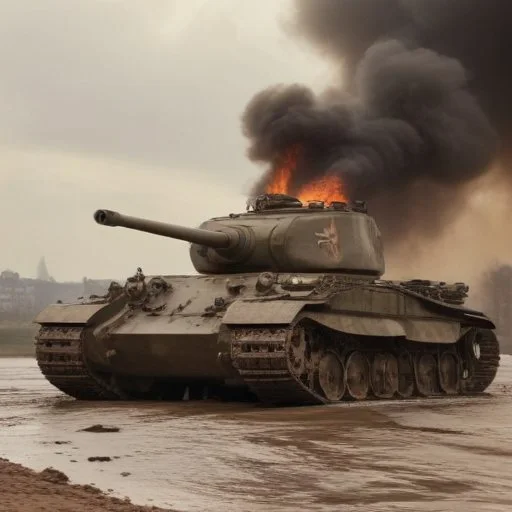
Following Germany's invasion of Poland in September 1939, France and the United Kingdom declared war on Germany, initiating the conflict that would become World War II. The Phoney War, a period of relative inactivity, persisted until May 1940, when Germany launched a surprise attack on France, Luxembourg, Belgium, and the Netherlands.
The German army's swift and decisive assault, known as the Blitzkrieg, caught the French military off guard. The Germans employed advanced tactics, including armored divisions, air support, and rapid mobilization, which allowed them to bypass French fortifications and push deep into French territory.
The Meuse River, a natural barrier between Germany and France, was breached by the German army on May 13, 1940. The crossing, facilitated by a combination of pontoon bridges and shallow fording points, enabled the Germans to establish a foothold on the western bank, paving the way for their advance into France.
As the German army surged forward, Winston Churchill, the newly appointed Prime Minister of the United Kingdom, stood before the House of Commons to deliver a speech that would become synonymous with British resolve during World War II. On May 13, 1940, Churchill declared:
"I have nothing to offer but blood, toil, tears, and sweat. We have before us an ordeal of the most grievous kind. We have before us many, many long months of struggle and of suffering."
The German conquest of France led to the fall of the French government, the establishment of the Vichy regime, and the occupation of France by German forces. The United Kingdom, now standing alone against the Nazi threat, would assume a crucial role in the Allied effort, with Churchill's defiant spirit inspiring a nation to persevere.
Churchill's "blood, toil, tears, and sweat" speech has become an iconic phrase, symbolizing British resolve and determination in the face of adversity. The speech has been referenced and parodied in popular culture, cementing its place in the collective consciousness.
The German conquest of France marked a pivotal moment in World War II, as the Nazi regime expanded its territorial control and solidified its grip on Europe. The event would have far-reaching consequences, shaping the course of the war and the future of the world.
Following Germany's invasion of Poland in September 1939, France and the United Kingdom declared war on Germany, but the ensuing months were marked by a strange calm. The period, known as the Phoney War, saw little military action, as both sides dug in along the Maginot Line and waited for the other to make a move.
Despite the lack of fighting, the Phoney War was a period of great anxiety for the French and British populations. Fear of air raids and gas attacks led to the evacuation of cities, and people lived in constant fear of the unknown.
The Phoney War also saw a significant buildup of troops and military equipment on both sides, setting the stage for the swift and decisive German attack in May 1940.

Winston Churchill, appointed Prime Minister of the United Kingdom in May 1940, was a seasoned politician and statesman with a reputation for unwavering determination and unshakeable resolve.
Churchill's leadership style was characterized by his unrelenting optimism and his ability to rally the British people in times of crisis. His famous "blood, toil, tears, and sweat" speech, delivered on May 13, 1940, galvanized the British people and set the tone for the country's response to the Nazi threat.
Throughout the war, Churchill's unwavering commitment to the Allied cause and his unshakeable belief in the ultimate defeat of the Nazis inspired hope and resilience in the British people.
The German army's swift and decisive victory over France in May 1940 was a result of vastly different military strategies employed by the two nations.
The French military, still wedded to the tactics of World War I, relied heavily on fortifications and static defenses, while the German army had developed a new and innovative approach to warfare, centered on rapid mobilization, armored divisions, and air support.
This mismatch in military doctrine and technology gave the Germans a significant advantage, allowing them to outmaneuver and outflank the French army with ease.

The German army's crossing of the Meuse River on May 13, 1940, marked a turning point in the war, but it also had a profound cultural impact on the French people.
The fall of France, symbolic of the demise of the old European order, led to a crisis of identity and purpose for the French people, who struggled to come to terms with their new reality under German occupation.
The event also inspired a surge of creative output, as writers, artists, and musicians responded to the trauma and upheaval of the war with works of great beauty and power.
The German army's operational maps, used during the 1940 campaign in France, provide a fascinating glimpse into the military strategy and planning that underpinned the Blitzkrieg.
These maps, recently declassified and made available to historians, reveal the complexity and sophistication of German military planning, as well as the attention to detail and rigor that characterized the German army's approach to warfare.
Study of these maps has shed new light on the German army's decision-making processes and has provided valuable insights into the military tactics and strategies employed during the campaign.