


Heinrich Himmler, the notorious head of the Schutzstaffel (SS) and one of the most powerful men in the Nazi regime, committed suicide on May 23, 1945, while in Allied custody, taking his secrets to the grave. This dramatic event marked the end of an era of terror and brutality, but not before Himmler's dark legacy would leave an indelible mark on human history.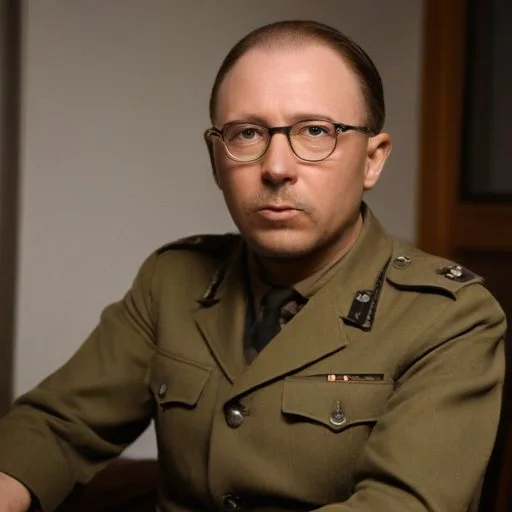
Heinrich Himmler was born on October 7, 1900, in Munich, Germany. From a young age, he was drawn to the extremist ideologies of the Nazi Party, eventually rising through the ranks to become one of Adolf Hitler's most trusted confidants. As the head of the SS, Himmler oversaw the creation of the Einsatzgruppen, mobile killing units responsible for the systematic murder of millions of Jews, Romani people, homosexuals, disabled individuals, and political opponents.
In the final months of World War II, as the Allies closed in on Berlin, Himmler's grip on reality began to slip. He became increasingly isolated and paranoid, ordering the execution of perceived traitors and rivals within the SS. On May 6, 1945, Himmler fled Berlin, attempting to escape capture by posing as a regular soldier in a German army deserters' camp.
On May 23, 1945, British soldiers arrested Himmler at a makeshift POW camp in Lüneburg, Germany. Initially, he denied his true identity, but a search of his person revealed a hidden cyanide capsule in his mouth. Before he could be interrogated, Himmler bit down on the capsule, killing himself instantly.
Himmler's suicide marked the end of an era of terror, but the atrocities committed under his watch would haunt the world for generations to come. The SS, under his leadership, had perpetrated some of the most heinous crimes in human history, including the systematic extermination of six million Jews during the Holocaust. His actions would forever be etched in the collective consciousness, serving as a stark reminder of the dangers of extremism and hatred.
During his lifetime, Himmler was awarded numerous honors and decorations, including the Blood Order, the highest Nazi Party award. However, these accolades were built on a foundation of blood, sweat, and tears, and today, they serve as a grim reminder of the horrors he unleashed upon the world.
Despite his monstrous deeds, Himmler was a complex and multifaceted individual. He was a devoted husband and father, who doted on his wife and children. He was also a prolific writer, keeping detailed diaries and journals that have since been used to chronicle the inner workings of the Nazi regime. These contradictions serve as a stark reminder that even the most heinous individuals are capable of contradictory emotions and behaviors.
Heinrich Himmler's suicide in Allied custody marked a turning point in human history, serving as a stark reminder of the dangers of unchecked power and extremism. His actions would influence generations to come, informing policies and laws aimed at preventing similar atrocities from occurring in the future.
In conclusion, Heinrich Himmler's suicide in Allied custody marked the end of an era of terror and brutality, but his dark legacy continues to haunt us to this day. As we reflect on the atrocities committed during World War II, we are reminded of the importance of standing against extremism and hatred, and working towards a more just and equitable world for all.
The suicide of Heinrich Himmler has been the subject of much historical debate and analysis. Historians have interpreted his actions as a desperate attempt to avoid accountability for his crimes, as well as a symbol of the collapse of the Nazi regime. Some have argued that Himmler's suicide was a deliberate attempt to erase his own culpability in the atrocities committed by the SS, while others have seen it as a testament to the chaos and disintegration of the Nazi leadership in the final days of World War II.
The event has also been studied in the context of the broader historiography of the Nazi regime, with some historians arguing that Himmler's suicide marked a turning point in the regime's collapse. Others have examined the suicide as part of a larger pattern of Nazi leaders taking their own lives, including Adolf Hitler and Joseph Goebbels.

The atrocities committed by Heinrich Himmler and the SS have had a profound impact on Western culture. The Holocaust, in particular, has become a symbol of the dangers of hatred, intolerance, and extremism. The event has inspired countless works of literature, art, and film, from Elie Wiesel's Night to Steven Spielberg's Schindler's List.
The cultural impact of Himmler's atrocities can also be seen in the countless memorials and museums dedicated to the victims of the Holocaust. These institutions serve as a testament to the horrors of the past and a warning for the future.
Heinrich Himmler was a complex and enigmatic figure, driven by a unique blend of ideological fervor and personal ambition. Behind the mask of the ruthless SS leader, Himmler was a devoted husband and father, who doted on his family and was known for his sentimental letters to his wife.
Despite his monstrous deeds, Himmler was also a romantic, who idealized the medieval German past and dreamed of rebuilding the SS as a modern-day Ordenstaat. This contradiction between his public persona and private life has fascinated historians and biographers, who continue to study Himmler's motivations and psyche.
The final months of World War II were marked by a dramatic shift in the balance of power in Europe. As the Allies closed in on Berlin, the Nazi leadership was increasingly isolated and desperate. Himmler's attempts to negotiate with the Allies, including his secret meetings with Count Bernadotte, were a testament to the regime's desperation.
The geopolitical context of Himmler's downfall was marked by a complex web of alliances and rivalries, including the Soviet Union's advance on Berlin and the Western Allies' push into Germany. The collapse of the Nazi regime was a result of this shifting landscape, which ultimately led to Himmler's capture and suicide.
Heinrich Himmler's SS uniform, with its distinctive silver runes and oak leaves, was more than just a symbol of power and authority. It was a carefully crafted artifact, designed to evoke the mystical and pagan ideologies that Himmler was fascinated by.
The uniform's intricate design, including the Totenkopf (Death's Head) insignia, was meant to inspire fear and reverence in those who saw it. It was a testament to the SS's self-image as an elite, warrior-priesthood, dedicated to the service of the Nazi regime.