Japan formally surrenders to Allied Powers on USS Missouri
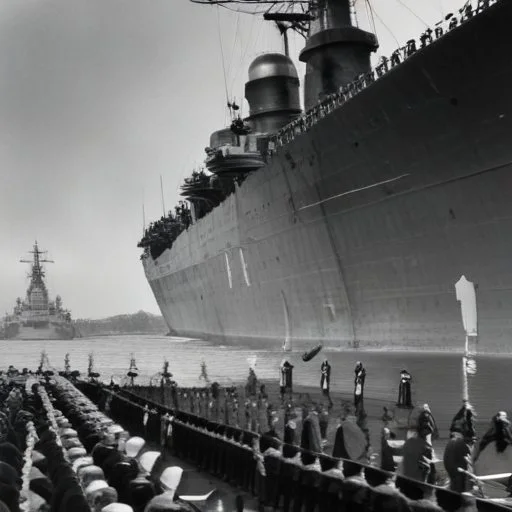
In the shadow of Tokyo Bay, a monumental ceremony unfolded on the decks of the USS Missouri, as Japanese officials, led by Foreign Minister Shigemitsu, and Allied leaders, including General Douglas MacArthur, converged to script a new chapter in history. With the stroke of a pen, Japan's Instrument of Surrender was signed, effectively ending World War II. The echoes of war gave way to an uneasy silence, as the world watched, holding its collective breath, as the once-mighty empire surrendered to the Allied Powers.
A New Chapter in History: The Japanese Instrument of Surrender
September 2, 1945: A Day of Surrender and New Beginnings
The Japanese Instrument of Surrender, signed on September 2, 1945, marked the official end of World War II, bringing an end to the devastating conflict that had ravaged the world for six years. This historic event took place on the deck of the USS Missouri in Tokyo Bay, Japan, as Japanese officials and Allied leaders gathered to pen a new chapter in history.
Historical Background: The Road to Surrender
The Japanese Instrument of Surrender was the culmination of a long and brutal war that had witnessed some of the most devastating battles in human history. The war in the Pacific had raged on since 1941, with the United States, Great Britain, and the Soviet Union forming the Allied Powers to counter the Axis powers of Germany, Italy, and Japan. As the Allies gained the upper hand, Japan found itself increasingly isolated, its economy in shambles, and its military depleted.
The Key Players: Shaping the Course of History
- General Douglas MacArthur: Supreme Commander for the Allied Powers, MacArthur played a crucial role in guiding the Allies to victory and overseeing the surrender process.
- Foreign Minister Shigemitsu: Representing Japan, Shigemitsu was instrumental in negotiating the terms of surrender and signing the Instrument of Surrender.
- General Yoshijiro Umezu: As Chief of the Army General Staff, Umezu was a key figure in Japan's military high command and played a significant role in the surrender negotiations.
The Ceremony: A Moment of Surrender and Reflection
The surrender ceremony was a dignified and somber affair, with the Japanese delegation arriving on board the USS Missouri at 8:56 am on September 2, 1945. The Instrument of Surrender was signed at 9:04 am, marking the formal end of World War II. As the pen was laid to paper, a sense of relief and uncertainty gripped the world.
Major Outcomes and Impacts: Shaping the Post-War World
The Japanese Instrument of Surrender had far-reaching consequences, shaping the course of world history in the decades that followed.
- The Occupation of Japan: The Allied Powers occupied Japan from 1945 to 1952, leading to significant reforms and rebuilding efforts.
- The Cold War: The surrender marked the beginning of the Cold War, as the United States and the Soviet Union emerged as superpowers.
- The Rise of the United Nations: The surrender paved the way for the establishment of the United Nations, aimed at promoting global peace and security.
Personal Accounts: A Glimpse into History
For those who witnessed the surrender, it was a moment etched in memory forever. General MacArthur's words, "These proceedings are now concluded," still resonate through history.
Inspirational Stories and Motivations: A New Era of Cooperation
The Japanese Instrument of Surrender serves as a powerful reminder of the devastating consequences of war and the importance of cooperation in maintaining world peace. As we reflect on this pivotal moment in history, we are reminded of the importance of diplomacy, understanding, and mutual respect in shaping a better future for all.
A New Era of Peace and Cooperation: The Legacy of the Japanese Instrument of Surrender
The Japanese Instrument of Surrender is a testament to the power of diplomacy and cooperation in shaping a better future. As we look back on this pivotal moment in history, we are reminded of the importance of promoting peace, understanding, and mutual respect in our ever-changing world.
Detailed Historical Story
The Road to Tokyo Bay: The Allied Advance
The Japanese Instrument of Surrender was the culmination of a long and arduous campaign by the Allied Powers to breach Japan's defenses. The Allies, led by General Douglas MacArthur, launched a series of amphibious assaults on Japanese-held islands, gradually encircling the Japanese mainland. The capture of Okinawa in June 1945 marked a significant turning point, providing a strategic foothold for the final push into Japan.
The Allies' military strategy was complemented by a devastating campaign of firebombing and atomic bombings, which weakened Japan's ability to wage war. The Soviet Union's declaration of war on Japan on August 8, 1945, further hastened Japan's surrender.
The Final Push
In the days leading up to the surrender, Allied forces were poised to launch a massive invasion of Japan, codenamed Operation Downfall. The invasion would have been the largest amphibious assault in history, involving over 5 million troops. However, Japan's surrender on September 2 rendered the invasion unnecessary, sparing countless lives on both sides.

Character Overview
General Yoshijiro Umezu: The Reluctant Signatory
General Yoshijiro Umezu, Chief of the Army General Staff, was a key figure in Japan's military high command. Despite his initial resistance to surrender, Umezu played a crucial role in negotiating the Instrument of Surrender.
A seasoned military leader, Umezu had served in various capacities, including as a military attaché in Germany. His experiences in Europe had instilled in him a deep respect for the German military, which he attempted to emulate in Japan.
A Divided Mind
Umezu's reluctance to surrender was rooted in a deep sense of duty and honor. However, as Japan's military fortunes dwindled, he came to realize the futility of continued resistance. His eventual signature on the Instrument of Surrender marked a painful acceptance of defeat.
Geopolitical Analysis
The Post-War Geopolitical Landscape
The Japanese Instrument of Surrender marked a significant shift in the global balance of power. With the defeat of Japan, the United States and the Soviet Union emerged as the dominant world powers.
The surrender also led to a reconfiguration of alliances and spheres of influence. The United States solidified its position as a Pacific power, while the Soviet Union expanded its territory and influence in Eastern Europe and Asia.
The Emergence of the Cold War
The rivalry between the United States and the Soviet Union, which began to take shape in the aftermath of World War II, would come to define the geopolitics of the second half of the 20th century.

Economic Influence Report
The Economic Consequences of Surrender
The Japanese Instrument of Surrender had far-reaching economic consequences. Japan's defeat led to a period of occupation and reconstruction, during which the country's economy was radically transformed.
The Allies implemented a range of reforms, including the dissolution of zaibatsu (large conglomerates), the promotion of labor unions, and the establishment of a new constitution.
From Ashes to Economic Miracle
The occupation laid the groundwork for Japan's post-war economic miracle, which transformed the country into one of the world's leading economies.
Political Examination
The Politics of Surrender: A Delicate Balance
The Japanese Instrument of Surrender was the result of a complex and delicate diplomatic process. The Allies, led by the United States, had to balance the need for a swift and unconditional surrender with the risk of provoking a military coup or prolonged resistance in Japan.
The Soviet Union's entry into the war against Japan on August 8, 1945, added a new layer of complexity, as the Allies sought to prevent a Soviet-dominated post-war settlement in Japan.
A New Era of International Cooperation
The successful negotiation of the Instrument of Surrender marked a significant milestone in international cooperation, paving the way for the establishment of the United Nations and a new era of collective security.


