


The occupation took a devastating toll on the people of Hong Kong. An estimated 10,000 civilians were killed, and many more were forced to flee their homes. The city's infrastructure was severely damaged, and its economy was in shambles.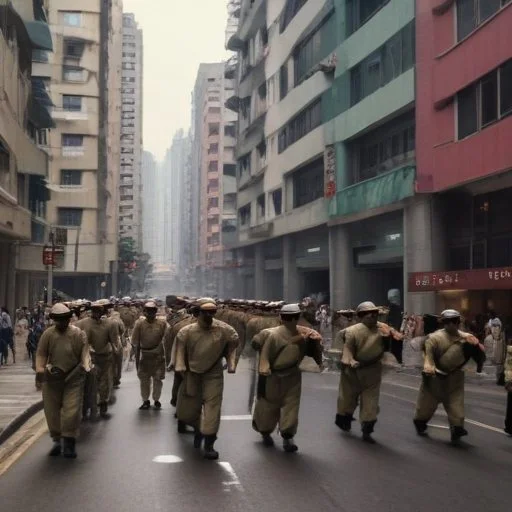
One of the most infamous atrocities committed during the occupation was the Tsim Sha Tsui Massacre, in which Japanese soldiers killed over 100 civilians and prisoners of war in a single day.
With the Japanese surrender, Hong Kong began the long and arduous process of rebuilding and recovery. The city's infrastructure was slowly rebuilt, and its economy began to flourish once more.
The people of Hong Kong, once again free to live their lives without fear of oppression, began to rebuild their communities and their lives.
The liberation of Hong Kong on September 16, 1945, will always be remembered as a turning point in the city's history, a testament to the indomitable spirit of its people, and a reminder of the devastating consequences of war.
Today, Hong Kong stands as a thriving metropolis, a beacon of freedom and prosperity, a testament to the power of human resilience in the face of adversity.
The Japanese occupation of Hong Kong was part of a larger campaign to dominate Asia during World War II. While Hong Kong's experience was unique in many ways, it shares similarities with other Asian cities that suffered under Japanese rule. For example, Singapore, another British colony, was also occupied by Japan from 1942 to 1945, and its people faced similar brutal treatment and economic hardship. Similarly, Shanghai, a major city in China, was occupied by Japan from 1937 to 1945, and its people suffered from military brutality, forced labor, and economic exploitation.
However, Hong Kong's experience differed from these cities in some significant ways. Unlike Singapore, Hong Kong was not a major military base, and its occupation was more focused on exploitation of its resources and people. Unlike Shanghai, Hong Kong was a British colony, and its people had a different cultural and political identity that shaped their response to the occupation.

Sir Mark Young was the Governor of Hong Kong during the Japanese occupation, from 1941 to 1947. Despite being a prisoner of war, Young continued to coordinate resistance efforts and provide leadership to the people of Hong Kong. His bravery and determination inspired many Hong Kong residents to resist the Japanese occupation and fight for their freedom.
Young was instrumental in maintaining British resistance in Hong Kong, even after the British garrison surrendered in 1941. He worked closely with Colonel Lindsay Ride, the leader of the Hong Kong Resistance, to disrupt Japanese operations and gather intelligence. His efforts helped to pave the way for the eventual liberation of Hong Kong in 1945.
The Japanese occupation of Hong Kong had a devastating impact on the city's environment. The war destroyed much of Hong Kong's infrastructure, including buildings, roads, and public facilities. The city's water supply system was severely damaged, leaving many residents without access to clean drinking water.
The war also led to the destruction of Hong Kong's natural habitats, including forests and wetlands. The Japanese military's extensive use of artillery and explosives resulted in widespread deforestation and habitat destruction, leading to a loss of biodiversity and ecological balance.

Hong Kong was a strategically important location during World War II, as it controlled the entrance to the Pearl River Delta and was a major hub for trade and commerce. The city's geographical location made it a crucial point for the Allies to defend against Japanese expansion in Asia.
The Japanese occupation of Hong Kong was part of a larger campaign to dominate Asia and secure vital resources, including oil and raw materials. The city's capture gave Japan control over a major port and access to the South China Sea, allowing them to expand their military presence in the region.
Historians have debated the significance of the liberation of Hong Kong in 1945, with some arguing that it marked a turning point in the war against Japan, while others see it as a symbol of British colonialism's decline.
Some historians have criticized the British for their slow response to the Japanese occupation of Hong Kong, and for their failure to adequately prepare the city's defenses. Others have argued that the liberation of Hong Kong was a testament to the bravery and resilience of the Hong Kong people, who suffered greatly during the occupation.