


The USS Indianapolis, a U.S. Navy cruiser, suffered a devastating fate in the final weeks of World War II, when it was torpedoed and sunk by the Japanese submarine I58 in the Philippine Sea. The attack, which resulted in the loss of 883 lives, remains one of the most horrific maritime disasters in U.S. naval history.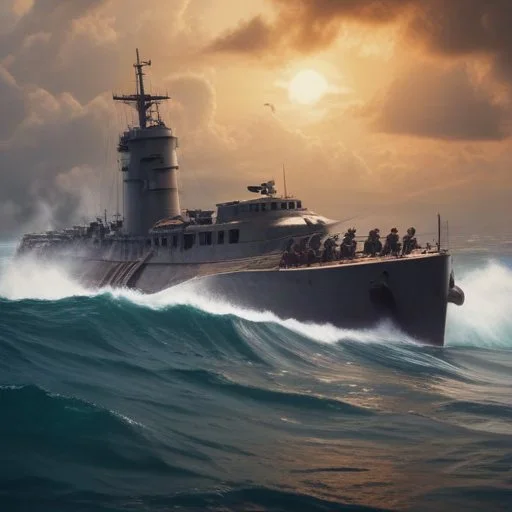
In July 1945, the USS Indianapolis was tasked with delivering a top-secret cargo of atomic bomb components to Tinian Island, a crucial staging area for the Allied forces. The cruiser, commanded by Captain Charles B. McVay III, set out from San Francisco, California, on a journey that would take it across the Pacific Ocean.
On July 30, 1945, at around 12:14 a.m., the USS Indianapolis was torpedoed by the Japanese submarine I58, commanded by Mochitsura Hashimoto. The attack occurred in the Philippine Sea, approximately 550 miles east of the Philippines. The cruiser sank in just 12 minutes, leaving over 1,000 crew members struggling to survive in the shark-infested waters.
For four agonizing days, the survivors of the USS Indianapolis clung to debris, fighting against exposure, dehydration, and the constant threat of predator attacks. The crew members were left to fend for themselves, with no rescue in sight, as the U.S. Navy was unaware of their fate.
On August 2, 1945, a U.S. aircraft patrol plane, piloted by Lieutenant Wilbur G. Taylor, spotted the survivors of the USS Indianapolis. The plane dropped emergency supplies, including life rafts, food, and water, before radioing for help. Shortly after, a rescue operation was launched, and the survivors were finally plucked from the ocean, exhausted and traumatized.
The sinking of the USS Indianapolis resulted in the loss of 883 lives, with only 316 survivors rescued from the ocean. The tragedy sent shockwaves throughout the U.S. Navy and the American public, prompting a re-evaluation of naval operations and emergency response procedures.
The sinking of the USS Indianapolis sparked controversy over the Navy's handling of the incident, particularly with regard to the lack of rescue efforts and the court-martial of Captain McVay III for his role in the tragedy. The incident also raised questions about the secrecy surrounding the mission and the risks taken by the crew.
The heroism and sacrifice of the USS Indianapolis crew members have been recognized and honored through various awards and memorials. The USS Indianapolis Memorial Museum, located in Indianapolis, Indiana, is dedicated to preserving the history and legacy of the cruiser and its crew.
The story of the USS Indianapolis serves as a powerful reminder of the bravery and resilience of those who serve in the armed forces. The tragedy also highlights the importance of accountability, transparency, and preparedness in the face of crisis.
The sinking of the USS Indianapolis occurred during a tumultuous period in global politics, with World War II entering its final stages. The Allies were making significant gains in the Pacific, and the Japanese Empire was fighting a desperate battle to maintain its territorial gains.
In this geopolitical context, the secrecy surrounding the USS Indianapolis' mission was critical. The atomic bomb components on board were intended for use in the impending invasion of Japan, and the Allies were keen to maintain the element of surprise.
The sinking of the USS Indianapolis also highlights the complexity of naval warfare in the Pacific during World War II. The Japanese Navy was still a formidable force, and the Allies were forced to navigate treacherous waters to establish a foothold in the region.

Captain Charles B. McVay III, the commander of the USS Indianapolis, was a seasoned naval officer with a distinguished career. Born in 1898, McVay graduated from the U.S. Naval Academy in 1920 and served in various capacities throughout his career, including as a naval attaché in Tokyo.
Despite his experience, McVay was court-martialed for his role in the sinking of the USS Indianapolis. The controversy surrounding the incident has persisted, with many arguing that McVay was unfairly scapegoated for a tragedy that was the result of a series of unfortunate events.
Mochitsura Hashimoto, the commander of the Japanese submarine I58, was a skilled and resourceful naval officer who played a crucial role in the sinking of the USS Indianapolis. Born in 1909, Hashimoto was a veteran of numerous naval battles and went on to become a successful businessman after the war.
The USS Indianapolis was equipped with advanced technology for its time, including radar and sonar systems designed to detect enemy submarines. However, these systems were not foolproof, and the Japanese submarine I58 was able to evade detection and launch a surprise attack.
The sinking of the USS Indianapolis highlights the importance of technological innovation in modern warfare. The development of more advanced sonar and radar systems, as well as improved communication networks, has significantly reduced the risk of such tragedies occurring in the future.
The incident also underscores the importance of adapting to changing circumstances. The U.S. Navy was forced to re-evaluate its tactics and strategies in response to the sinking of the USS Indianapolis, leading to significant improvements in naval warfare.

The USS Indianapolis carried a range of documents and artifacts, including top-secret plans for the Allied invasion of Japan. These documents were sensitive in nature and were intended for the eyes of senior military commanders only.
The ship's logs and navigational charts provide valuable insights into the circumstances surrounding the sinking. These artifacts have been carefully preserved and are now on display at the USS Indianapolis Memorial Museum.
The crew's personal belongings, including photographs and letters, offer a poignant glimpse into the lives of those who served on the USS Indianapolis. These artifacts serve as a testament to the human cost of war and the bravery of those who served.
Historians have debated the significance of the USS Indianapolis in the broader context of World War II. Some have argued that the sinking of the ship was a tragic anomaly, while others have seen it as a symbol of the risks and sacrifices made by those who served in the war.
The controversy surrounding Captain McVay's court-martial has been the subject of extensive historical analysis. Many historians have questioned the fairness of the trial, arguing that McVay was unfairly scapegoated for a tragedy that was the result of a series of unfortunate events.
The USS Indianapolis has also been the subject of numerous historical accounts and memoirs, offering a range of perspectives on the tragedy. These accounts provide valuable insights into the human experience of war and the importance of preserving historical memory.