


The Naval Battle of Guadalcanal, fought from November 13 to 15, 1942, was a brutal and decisive clash between American and Japanese naval forces during the Guadalcanal Campaign. This confrontation, marked by intense and chaotic close-quarters combat, would ultimately prove to be a crucial turning point in the war, showcasing the strategic importance of naval power in the Pacific Theater.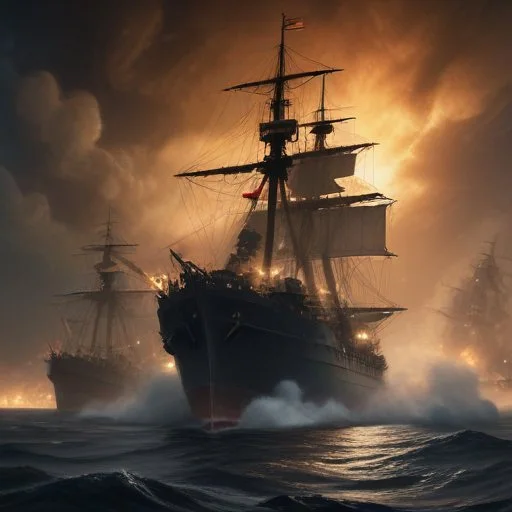
In the summer of 1942, Japanese forces had established a stronghold on the island of Guadalcanal, threatening Allied supply lines and control of the Solomon Islands. In response, the United States launched a campaign to retake the island, led by the 1st Marine Division. The Japanese, determined to hold their ground, dispatched a naval task force to reinforce their troops and resupply their garrison.
On the night of November 13, 1942, American and Japanese warships stumbled upon each other in the dark waters surrounding Guadalcanal. The ensuing battle was a frenetic and devastating melee, with ships on both sides trading blows in a desperate bid for supremacy. The U.S. Navy, led by Rear Admiral Daniel Callaghan, had prepared an ambush for the Japanese force, but the chaos of the battle soon made it difficult to distinguish friend from foe.
The Japanese force, under the command of Vice Admiral Hiroaki Abe, was comprised of two battleships, a cruiser, and several destroyers. The American fleet, consisting of five cruisers, two destroyers, and a battleship, was heavily outnumbered but determined to protect the Marine Corps' beachhead on Guadalcanal.
The Naval Battle of Guadalcanal was a costly but ultimately decisive victory for the United States. The Japanese suffered heavy losses, including two battleships and a destroyer sunk, while the Americans lost two cruisers and four destroyers. The battle prevented the Japanese from reinforcing their troops on the island, ultimately leading to their withdrawal and the secured Allied control of Guadalcanal.
This pivotal battle marked a significant shift in the balance of power in the Pacific Theater, as the U.S. Navy demonstrated its ability to engage and defeat the Imperial Japanese Navy in a close-quarters surface engagement. The Guadalcanal Campaign, of which the naval battle was a part, would prove to be a crucial turning point in the war, paving the way for the Allied advance towards Japan.
"It was like a nightmare, the noise, the smoke, the chaos. I saw ships on fire, men screaming, and death all around me." - Unknown U.S. sailor, recalling the battle.
"The darkness was complete, and it was impossible to distinguish our own ships from the enemy's... it was a miracle that we came out on top." - Rear Admiral Daniel Callaghan, in a post-battle report.
The Naval Battle of Guadalcanal served as a strategic lesson for both the Allies and the Axis powers. It highlighted the importance of naval power in the Pacific Theater and demonstrated the U.S. Navy's capability to engage and defeat the Imperial Japanese Navy in intense surface combat. The battle's outcome influenced the development of future naval tactics and strategies, as well as the eventual Allied victory in World War II.
Rear Admiral Daniel Callaghan was posthumously awarded the Medal of Honor for his heroic leadership during the battle. Many other sailors and officers on both sides were also recognized for their bravery and sacrifice, including the crew of the USS San Francisco, which was awarded the Presidential Unit Citation for its actions during the battle.
The Naval Battle of Guadalcanal remains an important and fascinating chapter in the history of World War II, a testament to the bravery and sacrifice of the sailors and officers who fought on both sides of the conflict.
The Naval Battle of Guadalcanal was not an isolated incident, but rather a culmination of a series of events that began months prior. In August 1942, the Japanese had established a stronghold on the island, and the Allies had been planning a counterattack ever since. The battle was the result of a complex series of maneuvers, including amphibious landings, aerial bombardments, and naval gunfire support. The outcome of the battle would have far-reaching consequences, shaping the course of the war in the Pacific.
The weeks leading up to the battle saw a flurry of activity, as both sides jockeyed for position. The Japanese had been transporting troops and supplies to the island, while the Allies had been building up their forces in preparation for a counterattack. The stage was set for a epic confrontation, one that would decide the fate of Guadalcanal and the balance of power in the Pacific.
The battle itself was a chaotic and intense affair, with ships on both sides trading blows in the dark waters surrounding the island. The Americans had prepared an ambush, but the Japanese had also laid a trap of their own. The result was a confusing and bloody melee, with ships on both sides suffering heavy losses.
Rear Admiral Daniel Callaghan was a complex and multifaceted individual, whose personality and leadership style played a crucial role in the outcome of the battle. A seasoned naval officer with a no-nonsense attitude, Callaghan was known for his bravery and tactical genius. Despite being outnumbered and outgunned, he led his fleet into battle with confidence and determination, inspiring his sailors to fight against overwhelming odds.
Vice Admiral Hiroaki Abe, on the other hand, was a more enigmatic figure, whose motivations and actions during the battle remain shrouded in mystery. A veteran of the Japanese navy, Abe was a skilled commander who had fought in numerous battles throughout the war. Despite his best efforts, however, he was ultimately unable to reverse the tide of the battle, and his force was defeated.
The Naval Battle of Guadalcanal had a profound impact on the cultural psyche of both the Americans and the Japanese. For the Americans, the battle marked a turning point in the war, a moment when the tide of battle began to shift in their favor. It was a symbol of American determination and resilience, a testament to the bravery and sacrifice of the sailors and soldiers who fought on Guadalcanal.
For the Japanese, the battle was a crushing defeat, one that marked the beginning of the end of their empire. It was a harsh reminder of the limits of Japanese power, and the vulnerability of their military machine. The battle would have far-reaching consequences, influencing Japanese strategy and tactics for the remainder of the war.
The Naval Battle of Guadalcanal has left behind a rich legacy of artifacts and documents, which provide a unique window into the battle and its participants. The war diaries and logs of the ships involved offer a detailed and intimate account of the battle, while the personal letters and diaries of the sailors and soldiers provide a poignant and humanizing perspective.
The USS San Francisco, one of the American cruisers involved in the battle, has been preserved as a museum ship, with many of its original features and artifacts still intact. The ship's bridge, where Rear Admiral Callaghan directed the battle, is particularly evocative, offering a tangible connection to the events of that fateful night.
The Naval Battle of Guadalcanal was a critical moment in the Pacific War, one that had far-reaching political implications. The battle marked a significant shift in the balance of power, as the Allies gained the initiative and began to push the Japanese back. It was a major victory for the United States, one that would have a profound impact on the course of the war.
The battle also had significant political implications for the Japanese, who were forced to re-evaluate their strategy and tactics in the wake of their defeat. The loss of the battle was a major blow to Japanese morale, and led to a reappraisal of their military leadership and planning.