


On a fateful morning in February 1945, a squadron of United States Army Air Forces (USAAF) B17 Flying Fortresses took to the skies, tasked with supporting the Soviet Red Army's Vistula-Oder Offensive. However, a catastrophic navigational mistake would lead to one of the most devastating friendly fire incidents in World War II history, as the bombers mistakenly rained down over 150 tons of explosives on the unsuspecting city of Prague, Czechoslovakia.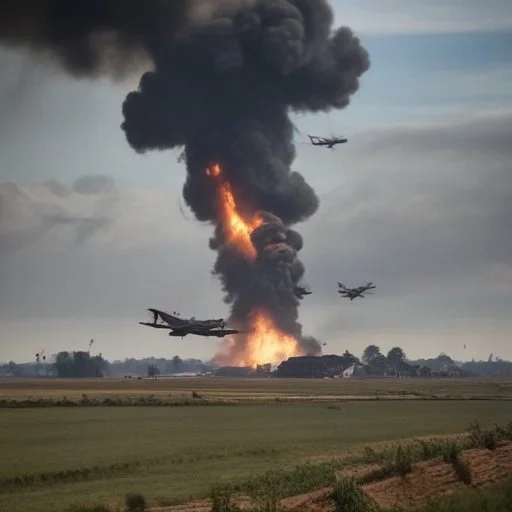
Operation Clarion, a massive Allied air campaign, was designed to soften German defenses in preparation for the Soviet Red Army's push into Eastern Europe. The USAAF's 8th Air Force, comprising B17 and B24 bombers, played a crucial role in the operation. On the morning of February 14, 1945, a group of B17s took off from their British airbase, bound for the German city of Dresden. But fate had other plans.
Foul weather and poor visibility plagued the skies that morning. The B17s, relying on navigational systems still in their infancy, struggled to pinpoint their target. As the fog refused to lift, the bomber crews grew anxious, fearful of missing their mark or, worse still, being caught in the crossfire of German anti-aircraft artillery. It was amidst this confusion that disaster struck.
In a heart-stopping moment of misidentification, the B17s mistook the Czechoslovakian city of Prague for their intended target, Dresden. The consequences were immediate and devastating. With bombs already loaded, the American airmen released their deadly cargo upon the unsuspecting citizens of Prague, unleashing a torrent of destruction upon the city.
The bombing of Prague resulted in an estimated 700 civilian casualties, with many more injured and left homeless. The city's infrastructure, including historic landmarks and residential areas, lay in ruins. The people of Prague, already suffering under the yoke of German occupation, were left to pick up the pieces of their shattered lives.
In the wake of the tragedy, the USAAF launched a thorough investigation into the navigational error. While the incident was attributed to a combination of factors, including poor weather and inadequate training, the fallout was undeniable. The bombing of Prague remains one of the most regrettable incidents of friendly fire in World War II history, serving as a poignant reminder of the devastating consequences of human error in the fog of war.
The tragic events of that fateful morning would go on to inform the development of navigational systems and procedures in the years to come. The mistake would also serve as a stark warning of the importance of precision and clarity in military operations, a lesson that would be etched into the annals of military history.
In Prague, a solemn memorial stands as a testament to the lives lost on that fateful day. The inscription, "To the victims of the American bombing on February 14, 1945," serves as a poignant reminder of the devastating consequences of human error and the enduring power of remembrance.
Operation Clarion, the Allied air campaign that led to the tragic bombing of Prague, was initially conceived as a response to the Soviet Union's Vistula-Oder Offensive. However, the operation's roots date back to 1944, when Allied forces began to prioritize the destruction of Germany's transportation infrastructure. The campaign's scope was later expanded to include attacks on German cities, with the goal of weakening the enemy's morale and hastening the end of the war.
The 8th Air Force, comprised of B17 and B24 bombers, played a crucial role in Operation Clarion. Based in Britain, the air force was tasked with conducting precision bombing raids on German targets, including Dresden, a key industrial center. The success of these raids depended on accurate navigation and communication, but as the events of February 14, 1945, would demonstrate, even the most advanced technology could be fallible.
Major General James H. Doolittle, a decorated veteran of World War I and pioneer of aerial warfare, played a crucial role in the development of the USAAF's strategic bombing campaign. As the commanding general of the 8th Air Force, Doolittle oversaw the planning and execution of Operation Clarion, including the fateful mission that resulted in the bombing of Prague.
Doolittle's leadership and tactical prowess had earned him the respect of his peers and the admiration of his subordinates. However, the catastrophic mistake that led to the bombing of Prague would also raise questions about the general's command decisions and the preparedness of his aircrews.
The bombing of Prague had a profound impact on the city's cultural fabric, as historic landmarks and cultural institutions lay in ruins. The Czech Philharmonic, one of Europe's oldest and most revered orchestras, lost its home and many of its musicians in the bombing. The city's ancient architecture, a testament to centuries of cultural and artistic heritage, was irrevocably scarred.
The tragedy also sparked an outpouring of artistic expression, as poets, writers, and musicians responded to the senseless destruction. The bombing of Prague became a powerful symbol of the devastating consequences of war, inspiring a generation of artists to create works that reflected the angst and despair of a nation.
The bombing of Prague resulted in an estimated 1.5 billion Czech koruna in damages, a staggering sum that threatened to cripple the city's already war-weakened economy. The destruction of infrastructure, including roads, bridges, and public buildings, added to the financial burden, as the city struggled to rebuild and recover.
The bombing also disrupted the flow of goods and services, exacerbating the shortage of food, medicine, and other essential supplies. The economic toll of the bombing would be felt for years to come, as Prague struggled to rebuild and restore its pre-war prosperity.
Located at the crossroads of Eastern and Central Europe, Prague had long been a strategic hub, coveted by empires and nations for its unique geography. The city's proximity to the Soviet Union made it an important staging ground for Allied operations, including the Vistula-Oder Offensive.
The bombing of Prague also underscored the complexities of wartime alliances, as the Soviet Union, despite its ideological differences with the Western powers, became a reluctant partner in the fight against Nazi Germany. The tragedy would ultimately serve as a poignant reminder of the devastating consequences of war, regardless of ideological or strategic considerations.