


In May 1940, amidst the chaos of World War II, a dramatic rescue mission unfolded on the beaches of Dunkirk, France. Operation Dynamo, as it came to be known, defied the predictions of military strategists and secured a crucial turning point in the war, as a staggering 338,226 Allied soldiers were evacuated to safety in just nine days.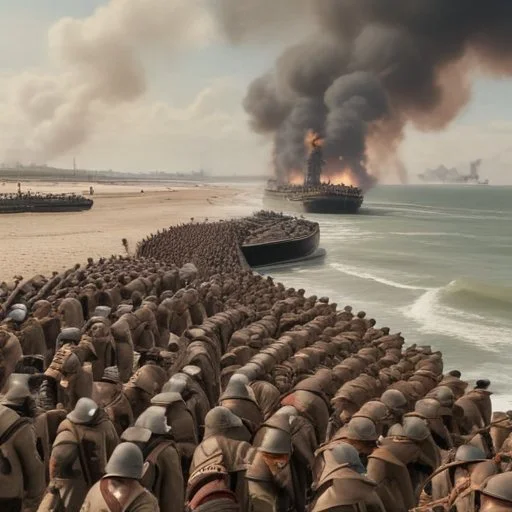
As the Nazi forces, led by Adolf Hitler, advanced rapidly through Western Europe, the British Expeditionary Force (BEF) and other Allied troops found themselves trapped in northern France, with their backs against the wall. The situation was dire, and the British high command knew they had to act fast to prevent a catastrophic defeat.
On May 26, 1940, Vice-Admiral Bertram Ramsay, the Flag Officer commanding the Dover Straits, was tasked with organizing a massive evacuation effort. The plan was to use a fleet of naval vessels, ferries, and even private boats to rescue the beleaguered soldiers from the beaches of Dunkirk.
The evacuation effort was a logistical nightmare. The port of Dunkirk was under constant bombardment by the German Luftwaffe, and the waters were treacherous, with shoals and sandbanks waiting to sink any vessel that strayed off course. Yet, against all odds, a motley fleet of 693 ships and boats, ranging from battleships to tiny fishing vessels, converged on the Dunkirk coast, determined to bring the soldiers home.
On May 27, 1940, the evacuation began in earnest. The beaches were a scene of chaos, with soldiers queuing patiently in long lines, waiting for their turn to board the waiting vessels. As the days passed, the rescue effort gained momentum, with more and more ships arriving to take on the stranded soldiers.
The bravery and selflessness of the sailors, soldiers, and civilians involved in the evacuation effort cannot be overstated. Many vessels made multiple trips to the Dunkirk coast, braving treacherous seas and withering German fire to rescue their comrades. The "Little Ships of Dunkirk," as they came to be known, became a symbol of British defiance and resilience in the face of overwhelming odds.
The successful evacuation of Dunkirk marked a crucial turning point in the war. Although the BEF had suffered a major defeat, the rescue of so many soldiers ensured that the British army remained intact, ready to regroup and rearm for the battles ahead. The morale boost to the British people was immense, and the Dunkirk spirit came to symbolize the nation's refusal to give in to the Nazi menace.
The Miracle of Dunkirk, as it has come to be known, continues to inspire generations with its tale of bravery, sacrifice, and determination. The Dunkirk evacuation serves as a powerful reminder of the importance of courage, teamwork, and ingenuity in the face of adversity, and its legacy will continue to endure long after the echoes of war have faded away.
As Winston Churchill, the British Prime Minister, so eloquently put it, "We shall fight on the beaches, we shall fight on the landing grounds, we shall fight in the fields and in the streets, we shall fight in the hills; we shall never surrender."
The Miracle of Dunkirk was not just a testament to British resilience, but also a masterclass in improvisation. With the German army closing in, Vice-Admiral Bertram Ramsay had to think on his feet to cobble together a fleet of vessels that could evacuate the stranded soldiers. The fact that he managed to assemble a motley crew of 693 ships and boats, ranging from battleships to tiny fishing vessels, is a tribute to his ingenuity and leadership.
One of the most remarkable aspects of the Dunkirk evacuation was the role played by civilian sailors and fishermen. Many of these vessels were requisitioned by the Royal Navy, but their civilian crews were instrumental in navigating the treacherous waters and avoiding German patrols. It was a true display of British pluck and determination.
Winston Churchill, the British Prime Minister, played a crucial role in rallying the British people during the Dunkirk crisis. His famous "We shall fight on the beaches" speech, delivered on June 4, 1940, is still remembered today for its defiant spirit and oratory flair. But Churchill was not just a skilled rhetorician – he was also a master strategist who recognized the importance of salvaging as many troops as possible from the Dunkirk debacle.
Churchill's leadership during the Dunkirk crisis was instrumental in boosting British morale and galvanizing the nation for the long and difficult fight ahead. His reputation as a statesman and a leader was cemented during those fateful days, and he went on to become one of the most iconic figures of the Second World War.
The Miracle of Dunkirk has had a lasting impact on British popular culture. The evacuation has been immortalized in films, books, and songs, and continues to be a source of national pride and inspiration. The phrase "Dunkirk spirit" has become synonymous with British resilience and determination in the face of adversity.
In recent years, the Dunkirk evacuation has been reimagined in Christopher Nolan's epic film Dunkirk, which brought the story to a new generation of audiences. The film's success is a testament to the enduring power of the Dunkirk narrative, and its ability to inspire and captivate people around the world.
The Dunkirk evacuation was a major political embarrassment for the Churchill government, but it also presented an opportunity for the British Prime Minister to reassert his leadership and galvanize the nation for the long haul. Churchill's decision to evacuate the BEF was widely criticized at the time, but in retrospect, it proved to be a masterstroke of strategic thinking.
The Dunkirk crisis also marked a turning point in British foreign policy, as Churchill began to pivot towards the United States and seek greater cooperation and support in the war effort. The evacuation may have been a military defeat, but it paved the way for a more robust and determined British response to the Nazi threat.
The Dunkirk evacuation took place against the backdrop of a rapidly shifting geopolitical landscape. The fall of France and the Low Countries had created a power vacuum in Western Europe, and the German army was poised to sweep across the continent.
In this context, the Dunkirk evacuation was a crucial act of resistance and defiance, as the British and their allies sought to stem the tide of German aggression and buy time to regroup and rearm. The evacuation may have been a tactical retreat, but it was also a strategic victory that helped to prevent a total German victory in the West.