


On July 10, 1943, the largest amphibious assault in history took place on the sun-kissed shores of Sicily, marking the beginning of Operation Husky, a decisive Allied campaign that would alter the course of World War II. This bold operation, orchestrated by General Dwight D. Eisenhower, brought together a formidable force of American, British, and Canadian troops to liberate the island from German and Italian occupation, paving the way for the eventual push into Italy.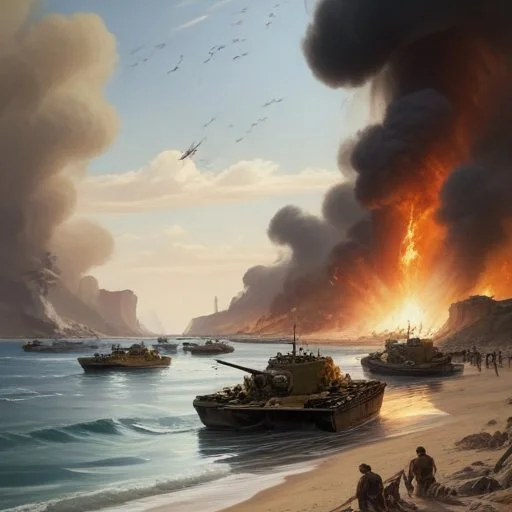
In the summer of 1943, the Allies were determined to gain a foothold in Axis-controlled Europe. With North Africa secured, Sicily became the next strategic target. The island's proximity to Italy made it an ideal launchpad for further operations, while its control would also disrupt Axis supply lines and communication.
July 10, 1943: The invasion force, comprising over 3,000 ships and 1,800 aircraft, sets sail for Sicily.
July 10-12, 1943: Allied troops land on the beaches of Sicily, encountering fierce resistance from German and Italian forces.
July 13-22, 1943: The Allies secure key cities and airfields, gradually pushing the Axis forces back.
August 17, 1943: The Allies capture the port city of Messina, marking the end of organized Axis resistance.
Operation Husky resulted in the capture of over 100,000 Axis prisoners, crippling the enemy's ability to respond to future Allied advances.
The invasion marked a significant shift in the balance of power, as the Allies gained a strategic foothold in Europe, paving the way for the eventual push into Italy and the heart of Germany.
The war ravaged the island, leaving behind a trail of destruction and displacement. Sicilian civilians paid a heavy price, with many forced to flee their homes or face the brutal consequences of war.
In the aftermath of the invasion, Allied troops worked to rebuild and restore order, earning the gratitude of the local population.
"The eyes of the world are upon you. The hopes and prayers of liberty-loving people everywhere march with you." - General Dwight D. Eisenhower, in a message to the Allied troops before the invasion
Operation Husky set the stage for the Allied invasion of Italy, which would follow in September 1943.
The success of the campaign boosted Allied morale, demonstrating the effectiveness of combined military operations and paving the way for future victories in Europe.
The heroes of Operation Husky were awarded numerous accolades, including the Purple Heart, the Bronze Star, and the Medal of Honor.
| Date | Event |
|---|---|
| July 10, 1943 | Invasion of Sicily begins |
| July 22, 1943 | Allies capture key cities and airfields |
| August 17, 1943 | Allies capture Messina, marking the end of organized Axis resistance |
Operation Husky remains one of the most significant military campaigns in history, a testament to the bravery, sacrifice, and strategic genius that paved the way for the Allied victory in World War II.
Operation Husky was not just a military campaign, but a complex logistical operation that required meticulous planning and coordination. The Allies had to transport thousands of troops, equipment, and supplies across the Mediterranean, all while maintaining secrecy and avoiding Axis detection. The invasion force was divided into two task forces, each with its own set of objectives and challenges. The Western Task Force, led by General Patton, was responsible for securing the western coast of Sicily, while the Eastern Task Force, led by General Montgomery, focused on capturing the eastern coast and the key city of Messina.

General Harold Alexander, a British Army officer, played a crucial role in the success of Operation Husky. As the 15th Army Group commander, Alexander was responsible for overseeing the overall strategy and tactics of the Allied forces in Sicily. His experience and leadership skills were instrumental in coordinating the efforts of the American, British, and Canadian troops, and in ensuring a unified response to the Axis forces.
The cultural impact of Operation Husky was significant, both during and after the war. The invasion brought about a massive influx of Allied troops, which led to a cultural exchange between the soldiers and the local Sicilian population. This exchange had a profound effect on the island's cuisine, music, and art. Additionally, the war effort led to an increase in American and British influence on Sicilian culture, shaping the island's identity and politics for decades to come.

The political implications of Operation Husky were far-reaching, with the campaign marking a significant shift in the balance of power in Europe. The Allies' success in Sicily boosted their morale and confidence, paving the way for further advances into Italy and eventually the heart of Germany. The campaign also led to increased pressure on Italy to surrender, which ultimately led to the country's capitulation in September 1943.
Operation Husky showcased the importance of technological innovation in modern warfare. The Allies' use of amphibious landing craft, such as the LST (Landing Ship, Tank) and the LCI (Landing Craft, Infantry), allowed them to transport troops and equipment efficiently and effectively. The campaign also saw the introduction of new communication technologies, including wireless radios and encoding machines, which enabled secure communication between commanders and troops.