


In the waning days of World War II, a beacon of hope pierced the darkness as American forces liberated the Santo Tomas Internment Camp from Japanese authority, freeing over 3,700 prisoners of war and civilian internees from the clutches of oppression.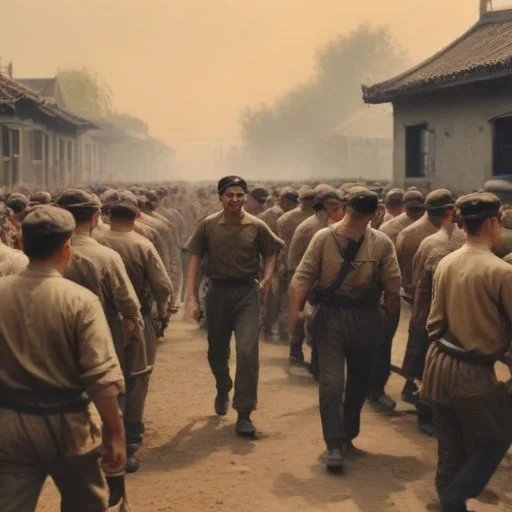
On that fateful day, the camp, once a prestigious university in Manila, Philippines, was transformed from a symbol of hopelessness to a testament of liberation. The prisoners, worn down by malnutrition, disease, and brutal treatment, finally tasted freedom after years of captivity.
Following the Japanese invasion of the Philippines in 1941, the Santo Tomas University campus was converted into an internment camp, housing a mix of American, British, and other Allied nationals, as well as Filipino civilians. The camp's population swelled as the war dragged on, leading to overcrowding, lack of sanitation, and scarcity of food and medicine.
Under the command of General Robert L. Eichelberger, the Allied forces launched a daring assault on the camp, breaching its walls and overpowering the Japanese guards. As the gates swung open, a wave of jubilation swept through the camp, with prisoners and internees alike embracing their long-awaited freedom.
Among the notable prisoners at Santo Tomas were Margaret Utinsky, a survivor of the Bataan Death March, and Ernest Stanley, a British diplomat who chronicled his experiences in the camp. These individuals, along with countless others, played a pivotal role in shedding light on the harsh realities of life within the internment camp.
The liberation of Santo Tomas Internment Camp served as a turning point in the war, marking a significant shift in the balance of power in favor of the Allies. The event also brought to light the atrocities committed by the Japanese occupation forces, leading to widespread outrage and condemnation.
The story of Santo Tomas has been immortalized in literature, film, and art, inspiring generations with its testament to human resilience and the unyielding pursuit of freedom. The camp's liberation continues to serve as a powerful symbol of hope and defiance in the face of oppression.
The prisoners and internees of Santo Tomas Internment Camp have left an indelible mark on history, their bravery and perseverance in the face of unimaginable hardship serving as a beacon of inspiration for generations to come.
As we reflect on this pivotal moment in history, we are reminded of the importance of standing against tyranny and fighting for the fundamental human right to freedom.
The liberation of Santo Tomas Internment Camp was not an isolated event, but rather part of a broader Allied campaign to retake the Philippines from Japanese occupation. In the months leading up to the liberation, American forces had been making steady gains against the Japanese, pushing them back on the island of Luzon. The Allies had already secured key victories at the Battle of Leyte Gulf and the Battle of Mindoro, and the liberation of Santo Tomas was a crucial step in securing the capital city of Manila.
The Japanese occupation of the Philippines had been brutal, with widespread atrocities committed against civilians and prisoners of war. The Santo Tomas Internment Camp was just one of several camps set up by the Japanese to detain Allied nationals and Filipino civilians. Conditions in the camp were harsh, with prisoners facing overcrowding, malnutrition, and disease.
The Allied forces' advance on Manila was slowed by the city's hastily constructed defenses, including pillboxes, barricades, and mines. However, American forces were able to break through these defenses, and on February 3, 1945, they reached the gates of Santo Tomas Internment Camp. The Japanese guards, realizing the futility of their situation, put up little resistance, and the camp was quickly secured by the Allies.

One of the most notable prisoners at Santo Tomas Internment Camp was Margaret Utinsky, a survivor of the infamous Bataan Death March. Utinsky, an American nurse, had been captured by the Japanese in 1942 and was forced to march through the jungles of Bataan with thousands of other prisoners. She was eventually interned at Santo Tomas, where she suffered from malnutrition and disease.
Despite the harsh conditions, Utinsky remained defiant, secretly keeping a diary of her experiences and documenting the atrocities committed by the Japanese. Her diary, which was later published, provides a detailed and harrowing account of life in the camp.
Utinsky's bravery and resilience in the face of unimaginable hardship have inspired generations, and her story is a testament to the strength and courage of those who were imprisoned at Santo Tomas.
The liberation of Santo Tomas Internment Camp has had a profound impact on Philippine culture, symbolizing the country's struggle for independence and freedom. The event has been commemorated in numerous films, books, and artworks, ensuring that the story of the camp and its prisoners is never forgotten.
In addition to its cultural significance, the liberation of Santo Tomas has also had a lasting impact on Philippine-Japanese relations. The event marked a turning point in the countries' complex and often contentious history, paving the way for greater cooperation and understanding in the post-war period.
The liberation of Santo Tomas Internment Camp took place against the backdrop of a rapidly shifting global geopolitical landscape. As the Allies pushed deep into Europe and the Pacific, the Japanese empire was beginning to collapse, and the Philippines was a crucial battleground in the war.
The Japanese occupation of the Philippines had been driven by a desire to secure the country's rich natural resources, including oil and minerals. However, the Allies' victory at Santo Tomas marked a significant blow to Japanese ambitions in the region, and paved the way for the eventual liberation of the Philippines and the defeat of Japan.
Among the many artifacts recovered from Santo Tomas Internment Camp were the diaries and letters of the prisoners, which provide a unique and intimate perspective on life in the camp. These documents, which include sketches, poetry, and other creative works, offer a glimpse into the daily struggles and triumphs of the prisoners.
One of the most significant artifacts recovered from the camp is the "Santo Tomas Times," a handmade newspaper produced by the prisoners. The paper, which was circulated secretly throughout the camp, included news, articles, and cartoons, and served as a vital source of information and entertainment for the prisoners.
These artifacts, which are now housed in museums and archives around the world, serve as a powerful reminder of the resilience and creativity of those who were imprisoned at Santo Tomas.