


The second day of the Battle of Edson's Ridge in the Guadalcanal Campaign is etched in the annals of history as a testament to the unwavering resolve of the U.S. Marines. On September 13, 1942, amidst the sweltering jungle terrain, a outnumbered Marine battalion, led by Colonel Merritt Edson, successfully repelled a series of brutal attacks by the Japanese forces, inflicting catastrophic losses on the enemy.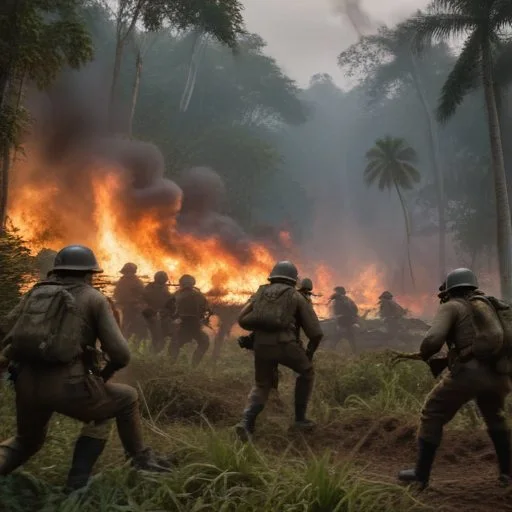
The Guadalcanal Campaign, which lasted from August 1942 to February 1943, was a pivotal battle in the Pacific Theater of World War II. The Japanese occupation of Guadalcanal, a strategic island in the Solomon Islands, threatened to cut off Allied supply lines and provide a launching point for further invasion. The U.S. Marines were tasked with capturing the Japanese-held airfield, later renamed Henderson Field, and securing the island.
In the early hours of September 13, the Japanese 35th Infantry Brigade, under the command of General Akasaki, launched a series of ferocious attacks on the Marine defenses, attempting to retake the airfield. The Japanese forces, bolstered by artillery and mortar fire, advanced up the slopes of Edson's Ridge, intent on overwhelming the Marine stronghold.
Colonel Edson's 1st Marine Raider Battalion, consisting of approximately 800 men, held their ground against the relentless Japanese onslaught. The Marines, dug in on the ridge, utilized their training and experience to devastating effect, repelling wave after wave of Japanese attacks. The U.S. forces exploited the Japanese tactics, using the enemy's own artillery fire against them, as the Marines expertly employed artillery spotting to direct their own firepower.
The Japanese forces suffered catastrophic losses, with estimates suggesting over 700 casualties, including many high-ranking officers. The Marines, although outnumbered, held their ground, but not without sustaining significant losses of their own, with over 100 killed and wounded.
The successful defense of Edson's Ridge marked a crucial turning point in the Guadalcanal Campaign. The Japanese, having failed to retake the airfield, began to withdraw from the island, effectively ceding control to the Allies. This hard-won victory bolstered Allied morale and paved the way for further successes in the Pacific Theater.
The bravery and tenacity displayed by the U.S. Marines during the Battle of Edson's Ridge have become legendary in the annals of military history. Colonel Edson's leadership and tactical genius, coupled with the unwavering resolve of his men, have inspired generations of soldiers and civilians alike. The Battle of Edson's Ridge serves as a testament to the indomitable spirit of the U.S. Marine Corps and their unwavering commitment to defending freedom and democracy.
The Guadalcanal Campaign was a pivotal moment in the Pacific Theater of World War II, and the Battle of Edson's Ridge was a crucial component of this campaign. The Japanese occupation of Guadalcanal threatened to cut off Allied supply lines and provide a launching point for further invasion, making it a strategic location that needed to be secured.
The battle was also significant because it marked a shift in the balance of power in the Pacific. The Japanese had been on the offensive since the start of the war, but the Allied victory at Edson's Ridge marked a turning point, as the Japanese began to withdraw from the island and the Allies gained the upper hand.
The battle was fought in harsh conditions, with both sides suffering from the jungle environment. The Marines had to contend with sweltering heat, dense foliage, and treacherous terrain, while the Japanese had to navigate the same challenges while facing a determined and well-trained enemy.
The outcome of the battle was far from certain, and the Marines' victory was a testament to their training, leadership, and determination.
Colonel Merritt Edson was a seasoned military leader who played a crucial role in the Battle of Edson's Ridge. Edson was a veteran of the Banana Wars and had served in Haiti and Nicaragua before being assigned to the 1st Marine Raider Battalion.
Edson's leadership during the battle was instrumental in the Marines' victory. He expertly directed his troops, using his knowledge of the terrain to outmaneuver the Japanese and exploit their weaknesses.
Edson was known for his courage and tactical genius, and his men revered him for his leadership and bravery. He was awarded the Medal of Honor for his actions during the battle, and his legacy has endured as a symbol of Marine Corps excellence.
The Battle of Edson's Ridge has had a lasting impact on American culture, symbolizing the bravery and sacrifice of the U.S. Marines. The battle has been immortalized in literature, film, and art, inspiring generations of Americans.
The battle has also been mythologized, with stories of the Marines' heroism and sacrifice becoming part of the Marine Corps' folklore. The battle has inspired countless works of fiction, including novels, films, and television shows.
The battle has also had a profound impact on American identity, serving as a symbol of American strength and resilience in the face of adversity. The battle has become an integral part of American cultural heritage, symbolizing the nation's values and ideals.

The Battle of Edson's Ridge was a critical moment in the Pacific Theater of World War II, with far-reaching consequences for the outcome of the war. The battle marked a turning point in the Guadalcanal Campaign, as the Japanese began to withdraw from the island and the Allies gained the upper hand.
The battle was also significant because it marked a shift in the balance of power in the Pacific. The Japanese had been on the offensive since the start of the war, but the Allied victory at Edson's Ridge marked a turning point, as the Japanese began to adopt a more defensive strategy.
The battle had significant implications for the war effort, as the Allies gained a strategic foothold in the Pacific and began to push the Japanese back. The battle was a crucial step towards the ultimate defeat of Japan and the Allied victory in World War II.
The Battle of Edson's Ridge was fought in the context of the larger Guadalcanal Campaign, which was itself part of the Pacific Theater of World War II. The battle was a key component of the Allied strategy to secure the Solomon Islands and deny the Japanese a foothold in the region.
The battle was also influenced by the broader geopolitical context of the war. The Japanese occupation of Guadalcanal threatened to cut off Allied supply lines and provide a launching point for further invasion, making it a strategic location that needed to be secured.
The battle was fought in a region of great strategic importance, with the Solomon Islands serving as a gateway to the Pacific. The outcome of the battle had far-reaching consequences for the war effort, as the Allies sought to gain the upper hand in the Pacific.