


The Kanalkampf, a series of aerial attacks on British maritime convoys, marked the starting point of the epic Battle of Britain, a clash that would decide the fate of Western Europe during World War II.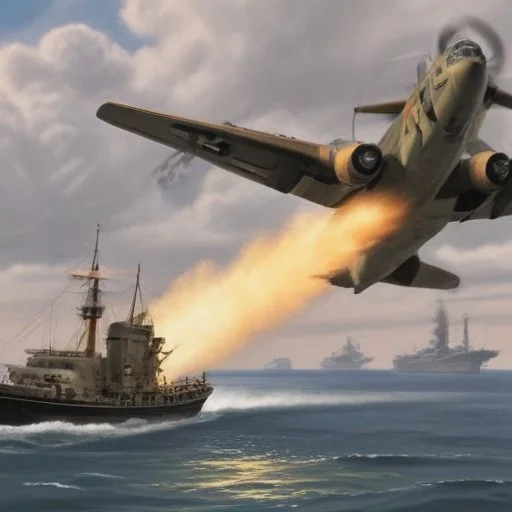
Six days before Adolf Hitler issued his Directive 16, outlining the plan for Operation Sea Lion, the German air force, the Luftwaffe, launched a relentless campaign to cripple the British Navy's supply lines, paving the way for the invasion of Britain.
In the summer of 1940, Germany had already conquered much of Europe, and Britain stood as the last bastion of resistance against the Nazi war machine. The British Navy, with its impressive fleet, remained a significant obstacle to Hitler's plans for invasion.
The Luftwaffe, led by Hermann Göring, was tasked with gaining air superiority over the Royal Air Force (RAF) to clear the way for the German army's invasion. The Kanalkampf was designed to weaken the British Navy's ability to respond to an invasion by targeting its supply lines.
The Kanalkampf attacks resulted in significant losses for the British Navy, with many merchant ships sunk or damaged. However, the British responded swiftly, mobilizing its air defense systems and adapting its tactics to counter the German aerial threat.
The failure of the Kanalkampf attacks to achieve the desired level of destruction ultimately led to the cancellation of Operation Sea Lion, saving Britain from invasion.
One British sailor, John Smith, recalled the terror of being on board a convoy ship during a Kanalkampf attack: "The noise was deafening, the explosions rocked the ship, and I thought it was all over for us. But we fought back, and our gunners managed to take down several German planes."
The bravery and resilience of sailors like John Smith, as well as the pilots and ground crew of the RAF, played a crucial role in thwarting the German plans.
The Kanalkampf attacks served as a catalyst for the British people to rally behind their country and its armed forces. Winston Churchill's famous speeches, including his "We shall fight on the beaches" address, galvanized the nation, inspiring ordinary citizens to contribute to the war effort.
The Battle of Britain, which ensued after the Kanalkampf attacks, became a symbol of British grit and determination, paving the way for the Allied victory in World War II.
The Kanalkampf, a little-known yet pivotal episode in World War II, reminds us of the bravery, sacrifice, and strategic genius that ultimately led to the defeat of Nazi Germany.
Hermann Göring, one of the highest-ranking officials in the Nazi Party, played a crucial role in the Kanalkampf attacks. As the Commander-in-Chief of the Luftwaffe, he was responsible for executing the aerial campaign against British maritime convoys.
Göring's leadership style was marked by a mix of strategic brilliance and personal arrogance. He was known for his flamboyant personality, often clashing with other top Nazi officials, including Adolf Hitler.
Despite his flaws, Göring was a skilled military strategist, and his experience in World War I made him a valuable asset to the Luftwaffe. However, his overconfidence in the German air force's capabilities ultimately contributed to the failure of the Kanalkampf attacks.
The Kanalkampf attacks took place against the backdrop of Germany's rapid expansion across Europe. By the summer of 1940, Nazi Germany had already conquered Poland, Denmark, Norway, Belgium, the Netherlands, and France.
The British Isles remained the last stronghold of resistance against Nazi Germany, and the Kanalkampf was a crucial step in Hitler's plans to invade Britain.
The German occupation of France and the Low Countries provided a strategic advantage, allowing the Luftwaffe to launch sorties from nearby airbases and gaining a foothold on the European continent.
The Kanalkampf marks a significant turning point in the development of air warfare tactics and technology. The German Luftwaffe employed its Stuka dive bombers, which were highly effective in sinking ships, but extremely vulnerable to British fighter aircraft.
In response to the German tactics, the British developed new countermeasures, including the use of radar-directed fighter intercepts and anti-aircraft artillery. These innovations ultimately helped to neutralize the German aerial threat.
The Kanalkampf also spurred the development of more advanced aircraft designs, such as the British Spitfire and the German Messerschmitt Bf 109, which would go on to play crucial roles in the Battle of Britain.
A crucial factor in the British response to the Kanalkampf was the development of a network of radar stations, known as the "Chain Home." These stations used radio waves to detect and track incoming German aircraft, providing early warnings to British fighter pilots.
The Chain Home system, developed by British scientist Robert Watson-Watt, was a game-changer in the Battle of Britain. It allowed British commanders to deploy their limited fighter resources more effectively, and ultimately helped to turn the tide of the battle in their favor.
The radar stations were heavily guarded secrets, with even the British pilots unaware of their exact mechanisms. The success of the Chain Home system remains one of the most significant unsung heroes of the Battle of Britain.
The Kanalkampf attacks had significant economic implications for Britain, as the loss of merchant ships and cargo disrupted the country's vital supply lines.
The British economy, already strained by the demands of wartime mobilization, suffered greatly from the loss of imports and the diversion of resources to defend against the German aerial threat.
Despite these challenges, the British government responded with a series of economic measures, including rationing, price controls, and increased production, to mitigate the impact of the Kanalkampf attacks. The resilience of the British economy played a crucial role in the country's ability to withstand the German onslaught.