


On a fateful day in February 1942, President Franklin D. Roosevelt signed Executive Order 9066, a decision that would forever mar the United States' reputation as a beacon of freedom and democracy. This executive order paved the way for the forced relocation of over 120,000 Japanese Americans to internment camps, stripping them of their basic human rights and dignity.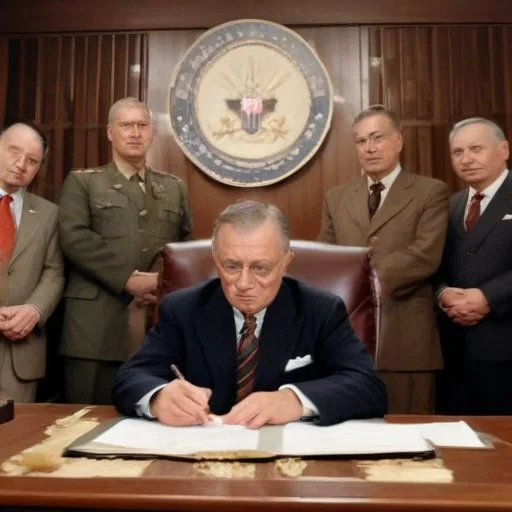
The attack on Pearl Harbor in December 1941 had sent shockwaves across the United States, plunging the nation into a state of panic and xenophobia. Anti-Japanese sentiment was rampant, fueled by wartime hysteria and racist stereotypes. The U.S. government, yielding to public pressure, began to view Japanese Americans as potential fifth columnists, suspecting them of disloyalty and espionage.
Executive Order 9066 authorized the military to designate "military areas" and evacuate anyone deemed a threat to national security. This blanket suspicion fell squarely on the shoulders of Japanese Americans, who were forcibly removed from their homes, businesses, and communities. The relocation process was chaotic and brutal, with families separated, and property confiscated or sold at pennies on the dollar.
Internment camps, euphemistically called "relocation centers," sprouted across the American heartland. Conditions in these camps were Spartan, with tar-paper barracks, barbed wire fencing, and meager rations. The once-thriving Japanese American community was now fragmented, demoralized, and humiliated.
The internment of Japanese Americans sent shockwaves through the cultural and social fabric of the United States. It exposed the nation's deep-seated prejudices and biases, revealing a darker side of American democracy.
The experience of internment also had a profound impact on the Japanese American community. Many internees lost their businesses, homes, and savings, leading to a sense of displacement and dislocation. The trauma of internment would take decades to heal, leaving behind a legacy of shame and regret.
The internment of Japanese Americans during World War II remains one of the most egregious violations of civil rights in American history. It led to a fundamental re-examination of the country's values, prompting a renewed commitment to human rights and social justice.
The Civil Liberties Act of 1988, which provided reparations and apologies to Japanese American internees, served as a belated acknowledgment of the government's mistake. The legacy of Executive Order 9066 continues to serve as a cautionary tale, reminding Americans of the dangers of xenophobia, racism, and the abuse of power.
The resilience and courage of Japanese Americans in the face of adversity inspired a generation of civil rights activists. The internment experience galvanized the community to fight for social justice, leading to the formation of organizations like the Japanese American Citizens League and the Asian Law Caucus.
Stories of internees like Fred Korematsu, who continued to fight for his rights even after the war, have become beacons of hope and inspiration. His bravery in the face of overwhelming odds has inspired countless Americans to stand up for justice and equality.
The legacy of Executive Order 9066 serves as a painful reminder of the dangers of fear, prejudice, and the erosion of civil liberties. As Americans, we must confront our past and learn from the mistakes of our ancestors, ensuring that such a tragedy never occurs again.
In the words of Fred Korematsu, "If you have the feeling of vengeance, or hatred, or anger, it will eat you away, and it will hurt you, and it will make you sick." It is only through reflecting on our past, and working towards a more just and equitable society, that we can truly begin to heal the wounds of history.
The Japanese attack on Pearl Harbor sent shockwaves beyond the United States, resonating throughout the geopolitical landscape of World War II. The assault not only drew America into the conflict but also altered the balance of power in the Pacific, as the US began to challenge Japan's expanding empire.
In the months leading up to the attack, Japan had been making aggressive moves in Southeast Asia, invading territories and securing strategic resources. The US, along with other Western powers, had responded with economic sanctions, freezing Japanese assets and imposing an oil embargo. This tense standoff created an atmosphere of mutual hostility, which ultimately culminated in the surprise attack on Pearl Harbor.
The subsequent US declaration of war against Japan, followed by Germany and Italy's declarations of war against the US, cemented the global nature of the conflict. The war would eventually engulf multiple continents, involving dozens of nations and claiming millions of lives.
Fred Korematsu, a Japanese American welder from California, became an unlikely hero in the fight against Executive Order 9066. Born in 1919, Korematsu grew up in Oakland, California, and was 23 years old when the US entered World War II.
Refusing to comply with the evacuation order, Korematsu underwent plastic surgery to alter his appearance and changed his name to "Caleb Perry" in an attempt to avoid detection. However, he was eventually arrested and convicted of violating the order.
Korematsu's case, Korematsu v. United States, made its way to the Supreme Court, which in 1944, infamously ruled in favor of the government, citing "military necessity" as justification for the internment. This ruling would later be widely criticized as a grave injustice.
The forced relocation of Japanese Americans during World War II has drawn comparisons to the treatment of other minority groups throughout history. One such parallel can be drawn with the experience of Native Americans, who were forcibly relocated from their ancestral lands to reservations throughout the 19th century.
In both cases, the US government justified the actions as necessary for national security or "civilization." However, both instances involved the wholesale violation of human rights, the erasure of cultural identity, and the exploitation of native resources.
These comparisons serve as stark reminders of the dangers of xenophobia, racism, and the abuse of power, highlighting the need for vigilance in defending the rights of minority communities.

The internment of Japanese Americans had a profound impact on American culture, exposing the hypocrisy of the nation's claimed values of freedom and democracy. The event sparked a national conversation about racism, xenophobia, and the limits of executive power.
In the decades that followed, the internment experience inspired a generation of activists, artists, and writers to explore themes of identity, belonging, and social justice. Works like Jeanne Wakatsuki Houston's Farewell to Manzanar and Mine Okubo's Citizen 13660 provided powerful testimonials to the internment experience, humanizing the statistics and challenging the dominant narrative.
Today, the legacy of Executive Order 9066 continues to inform American cultural discourse, serving as a cautionary tale about the dangers of fear-mongering and the importance of protecting civil liberties.
The forced relocation and internment of Japanese Americans resulted in devastating economic consequences for the community. Many families lost their homes, businesses, and life savings, with an estimated $400 million in property losses (approximately $6 billion in today's dollars).
The government's failure to provide adequate compensation for confiscated property or lost income exacerbated the economic hardship, leaving many Japanese Americans in a state of financial insecurity for years to come.
The Civil Liberties Act of 1988, which provided reparations to surviving internees, was a belated acknowledgment of the government's responsibility for the economic devastation inflicted upon Japanese Americans.