


In the waning days of World War II, a pivotal moment in history unfolded along the banks of the River Elbe, as United States and Soviet reconnaissance troops converged in the German towns of Torgau and Strehla. This chance meeting, later commemorated as Elbe Day, dealt a decisive blow to the beleaguered Wehrmacht, cleaving the Nazi war machine in two and sealing the fate of the Third Reich.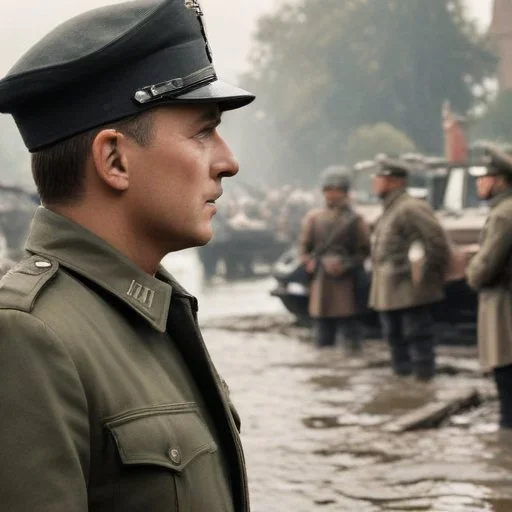
As the Allies closed in on Germany from both east and west, the stage was set for a dramatic confrontation. The Soviet Union, driven by the unyielding determination of Stalin, had been pushing deep into Eastern Europe, while the United States and its Western allies had been making steady gains in the west. The Wehrmacht, once the vaunted pride of the German military, was now a shadow of its former self, battered and bruised by the relentless onslaught.
On April 25, 1945, the vanguard of the Soviet 5th Guards Army, led by General Aleksei Radzievsky, and the reconnaissance elements of the American 69th Infantry Division, under the command of General Emil F. Reinhardt, made contact near the river Elbe. The initial encounter was marked by a mixture of caution and curiosity, as the two former allies – bound together by a shared enemy, but divided by ideology and suspicion – tentatively explored the unexpected meeting.
The convergence of the Soviet and American forces at the Elbe had far-reaching consequences. The Wehrmacht, already reeling from the dual pincer movement, was now effectively cleaved in two, rendering it incapable of mounting a coherent defense. The stranglehold on Berlin tightened, paving the way for the Soviet capture of the city on May 2, 1945. The final collapse of Nazi Germany was now all but inevitable.
In the aftermath of Elbe Day, the Soviet Union and the United States engaged in a series of symbolic gestures, exchanging gifts and toasts as a token of their shared victory. The meeting at the Elbe also served as a poignant reminder of the complex web of alliances that had shaped the course of the war. As the world looked toward the uncertain future, Elbe Day stood as a testament to the power of cooperation in the face of a common enemy.
For the soldiers who participated in this historic encounter, the memories of Elbe Day would remain etched in their minds forever. General Reinhardt, in his memoirs, would later recount the sense of wonder and trepidation that accompanied the meeting, as the two armies, once separated by an ocean and a continent, came face to face on the banks of the Elbe.
As the world commemorates the anniversary of Elbe Day, we are reminded of the transformative power of cooperation and the unbreakable bonds forged in the crucible of war. In a conflict that claimed millions of lives and left scars that would take generations to heal, this chance meeting at the River Elbe stands as a defiant testament to the human spirit – a beacon of hope that illuminates the darkest recesses of history.
In modern-day Germany, the towns of Torgau and Strehla have become sacred sites of remembrance, attracting visitors from around the world who come to pay homage to the bravery and sacrifice that defined Elbe Day. As we walk the banks of the Elbe, we are reminded of the enduring legacy of this fateful encounter – a powerful symbol of the human capacity for cooperation and compassion in the face of adversity.
The journey to Elbe Day was a perilous one, marked by bloodshed, sacrifice, and unwavering determination. As the Allies pushed deeper into Germany, they encountered fierce resistance from a desperate Wehrmacht. The Soviet Union's advance was accompanied by the thunderous rumble of artillery, while the United States Army's methodical approach was characterized by meticulous planning and execution.
As the two armies converged on the Elbe, the stakes grew higher. The fate of Nazi Germany hung in the balance, and the world held its breath in anticipation of the encounter that would seal its fate.
General Aleksei Radzievsky, commander of the Soviet 5th Guards Army, was a seasoned veteran of the Eastern Front. His unyielding determination and strategic brilliance played a crucial role in the Soviet Union's advance into Germany. Radzievsky's leadership was marked by a keen understanding of the battlefield, earning him the respect and admiration of his troops.
As the Soviet forces approached the Elbe, Radzievsky's experience and expertise proved invaluable, guiding his men through treacherous terrain and against a fiercely resistant enemy.
The Soviet 5th Guards Army and the US 69th Infantry Division, though differing in approach and ideology, shared a common goal: the defeat of Nazi Germany. The Soviet Army's brutal efficiency was tempered by the US Army's meticulous planning, highlighting the distinct approaches of the two Allied powers.
While the Soviet Union's military might was built on sheer numbers and firepower, the United States relied on precision and strategic maneuvering. This contrast in approaches would ultimately prove decisive in the campaign to capture Berlin.
Historians have long debated the significance of Elbe Day, with some arguing it marked the beginning of the end of World War II. However, a closer examination of the event reveals a more complex narrative, one that underscores the intricate web of alliances and rivalries that shaped the war's final stages.
By recontextualizing Elbe Day within the broader framework of the war, historians can better understand the event's far-reaching consequences and its enduring impact on international relations.
The convergence of the Soviet and American armies on the Elbe River occurred against the backdrop of a rapidly shifting geopolitical landscape. As the war drew to a close, the Allies' relationship with the Soviet Union was fraying, and the specter of the Cold War loomed large.
The meeting at the Elbe, though a symbol of cooperation, also underscored the deep-seated tensions between East and West, foreshadowing the ideological struggle that would define the post-war era.