


The Atlantic Charter, a historic agreement signed by World War II leaders Winston Churchill and Franklin D. Roosevelt, stands as a testament to the unwavering resolve of two great nations united against a common enemy. This pivotal document, crafted in the midst of global turmoil, outlined the Allied powers' shared vision for a post-war world, one built on the principles of freedom, cooperation, and collective security.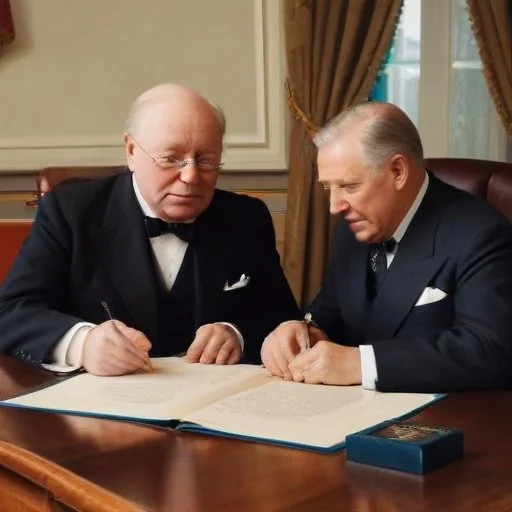
In August 1941, the HMS Prince of Wales, a British battleship, anchored off the coast of Newfoundland, Canada. On board, Churchill and Roosevelt, two of the most iconic leaders of the 20th century, converged for a clandestine meeting. The war was raging, and the stakes were high. The fate of democracy, freedom, and world order hung precariously in the balance.
The Atlantic Charter, a document born from this meeting, consisted of eight points that articulated the Allied powers' vision for the post-war world. At its core, the Charter advocated for:
The Atlantic Charter's far-reaching implications cannot be overstated. This document laid the groundwork for the United Nations, fostering an era of international cooperation and collective security. The Charter's principles have continued to shape global politics, influencing the development of human rights, economic cooperation, and international law.
The partnership between Churchill and Roosevelt was forged in the heat of war. Their friendship, rooted in mutual respect and trust, proved instrumental in shaping the Allied war effort. Through their collaboration, they drafted the Atlantic Charter, injecting hope and unity into the hearts of those fighting against tyranny.
In the darkest moments of World War II, the Atlantic Charter shone like a beacon, illuminating a path towards a brighter future. As Churchill so eloquently phrased it, "The Atlantic Charter is a statement of the ideal which we are fighting for, and of the methods by which we propose to attain it."
Today, the Atlantic Charter's message of cooperation, freedom, and collective security remains as relevant as ever. As we navigate the complexities of our globalized world, we would do well to recall the wisdom and courage of Churchill and Roosevelt, who dared to envision a better tomorrow during humanity's darkest hour.
The Atlantic Charter was forged in the midst of a global crisis, as the Axis powers continued to expand their territorial control. The war had already ravaged Europe, and the United States was still reeling from the surprise attack on Pearl Harbor. In this precarious environment, the meeting between Churchill and Roosevelt took on a sense of urgency, as the two leaders sought to galvanize the Allied effort and articulate a shared vision for the post-war world.
The geopolitical context of the time was marked by a power vacuum, with the collapse of the OLD international order and the rise of totalitarian regimes. The Charter's emphasis on collective security and cooperation was a direct response to the aggressive expansion of the Axis powers, and it paved the way for the creation of new international institutions that could maintain peace and stability.

Winston Churchill, the iconic British Prime Minister, was known for his unwavering resolve and unshakeable optimism. Despite facing a series of military setbacks, Churchill remained committed to the Allied cause, and his oratory skills inspired a nation to persevere through its darkest hour.
Roosevelt, on the other hand, was a master strategist, adept at navigating the complexities of international politics. His leadership style was marked by a strong sense of pragmatism, as he sought to balance the competing interests of various nations and ideologies.
The Atlantic Charter's impact on international relations was profound, as it established the principle of collective security and cooperation as a cornerstone of post-war diplomacy. The Charter's emphasis on self-determination and democracy resonated with people around the world, and it helped to galvanize the Allied effort against the Axis powers.
The Charter also marked a significant shift in the balance of power, as the United States emerged as a global leader and the United Kingdom began to cede its dominance. This new dynamic would have far-reaching implications for international relations in the decades that followed.
The Atlantic Charter's cultural impact was felt far beyond the realm of international politics. The Charter's emphasis on freedom, democracy, and cooperation resonated with people from all walks of life, inspiring a sense of hope and optimism in the face of adversity.
The Charter also influenced the development of modern art, literature, and music, as creatives responded to the idealism and vision articulated by Churchill and Roosevelt. From the Jazz Age to Abstract Expressionism, the Charter's message of freedom and cooperation inspired a generation of artists and writers.
The Atlantic Charter's economic impact was significant, as it paved the way for the Bretton Woods system and the establishment of the International Monetary Fund and the World Bank. The Charter's emphasis on free trade and economic cooperation helped to spur post-war economic growth, and it laid the foundation for the modern global economy.
The Charter also had a profound impact on the development of international trade, as it established the principle of non-discrimination and the reduction of trade barriers. This, in turn, helped to spur economic growth and prosperity in the decades that followed.