


In the autumn of 1914, the Western Front of World War I witnessed a frantic series of battles that would reshape the course of the war and forever etch the phrase "trench warfare" into the annals of history. The Race to the Sea, a hasty and chaotic scramble for position, marked the end of the war of maneuver and the beginning of a four-year stalemate that would claim millions of lives.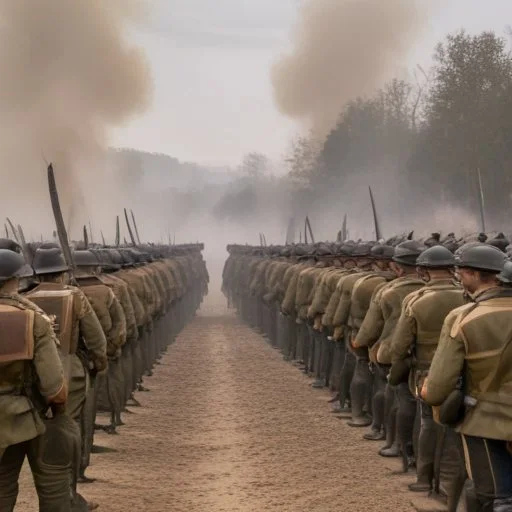
The German army, led by Erich von Falkenhayn, had been pushing westward, hoping to outflank the Allied forces and capture the French ports, thereby crippling their ability to receive supplies and reinforcements. Meanwhile, the French, under the command of Joseph Joffre, and the British Expeditionary Force, led by John French, were racing to respond to the German advance, determined to protect their territories and prevent a German breakthrough.
The Race to the Sea began in earnest on September 5, 1914, with the Battle of the Frontiers, a series of brutal clashes in northern France and Belgium. The Germans, driven by their Schlieffen Plan, sought to outmaneuver the Allies by rapidly advancing on both flanks. The Allies, however, refused to yield, and the battle raged on for several days, leaving behind a trail of devastation and carnage.
Despite their initial successes, both sides soon realized that the war of maneuver was doomed to fail. The advent of machine guns, barbed wire, and trenches rendered rapid advances impossible, and the war degenerated into a stalemate. The Race to the Sea had exhausted both armies, and the Western Front settled into a pattern of attrition, with each side dug in for the long haul.
The Race to the Sea marked the beginning of a new era in warfare – the era of trench warfare. The trenches, those damp, filthy, and cramped ditches, would become the iconic symbol of World War I, a testament to the futility of human conflict. The soldiers, trapped in a cycle of mud, blood, and boredom, would fight for every inch of ground, often sacrificing their lives for mere yards of territory.
The Race to the Sea and the ensuing trench warfare left an indelible mark on the world. It destroyed a generation of young men, ravaged the countryside, and forever changed the face of warfare. As the world reflects on the centennial of this cataclysmic event, we are reminded of the enduring lessons of the Great War: the price of pride, the futility of conflict, and the importance of peace.
Erich von Falkenhayn, the Chief of the German General Staff, was the mastermind behind the German war effort during the Race to the Sea. A seasoned military strategist, Falkenhayn was determined to outmaneuver the Allies and capture the French ports. His calculations, however, did not account for the tenacity of the Allied forces, and the war soon degenerated into a stalemate.
Falkenhayn's leadership style was marked by caution and meticulous planning, often to the frustration of his more impulsive colleagues. Despite his failures during the Race to the Sea, Falkenhayn remained a respected figure in German military circles, eventually becoming the Minister of War.

The trenches of World War I have become an enduring symbol of the futility of war, a testament to the destructive power of human conflict. The trenches, with their mud, blood, and boredom, have inspired countless works of literature, art, and music, forever etching the experience of trench warfare into the cultural consciousness.
The war poets, such as Wilfred Owen and Siegfried Sassoon, drew inspiration from their experiences in the trenches, crafting powerful anti-war poetry that continues to resonate with audiences today. The trenches have also been immortalized in films, such as All Quiet on the Western Front, and in numerous museum exhibitions, serving as a poignant reminder of the devastating consequences of war.
The Race to the Sea marked a significant shift in the political landscape of Europe, as the war of maneuver gave way to a war of attrition. The stalemate on the Western Front led to increased tensions between the Allied powers, particularly between France and Britain, as they struggled to coordinate their efforts.
The failure of the Schlieffen Plan, combined with the heavy casualties suffered during the Race to the Sea, led to a crisis of confidence in the German High Command. The subsequent replacement of Helmuth von Moltke with Erich von Falkenhayn marked a significant shift in German military strategy, as Falkenhayn opted for a more cautious approach.
The Race to the Sea took place against the backdrop of a rapidly shifting geopolitical landscape. The decline of the Ottoman Empire, the rise of nationalism in the Balkans, and the complex system of alliances in Europe had created a volatile powder keg, waiting to be ignited.
The German push into France and Belgium was driven, in part, by a desire to secure strategic resources and territory. The resulting clash of empires would redraw the map of Europe, setting the stage for the tumultuous decades that followed.
Historians have long debated the significance of the Race to the Sea, with some viewing it as a crucial turning point in the war, while others see it as a mere sideshow to the greater conflict.
Revisionist historians, such as Fritz Fischer, have argued that the Race to the Sea was a deliberate attempt by Germany to annex French territory, while others, like John Terraine, have portrayed it as a series of desperate measures to prevent a French breakthrough.