


On a momentous day in January 1997, Yasser Arafat, the Palestinian leader, made a long-awaited return to Hebron, a city he had not set foot in for over 30 years. The occasion was a major milestone: the handover of the last Israel-controlled West Bank city to Palestinian control, marking a significant step towards Palestinian autonomy and a potential precursor to statehood.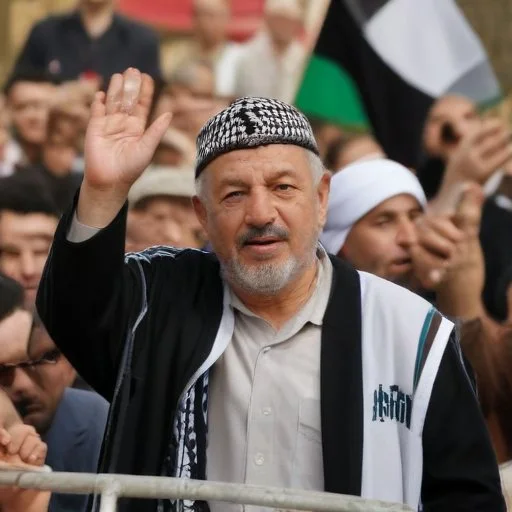
Hebron, a city in the southern West Bank, is a place of great historical and emotional significance for Palestinians. It is home to the Cave of the Patriarchs, a sacred site revered by both Jews and Muslims, and has been a flashpoint for conflict and tension between Israelis and Palestinians for decades.
Arafat's return to Hebron was not just a political statement; it was an emotional homecoming for a man who had dedicated his life to the Palestinian cause. As he emerged from his helicopter, surrounded by throngs of jubilant Palestinians, the atmosphere was electric.
The crowds that gathered to welcome Arafat were a testament to the sense of hope and excitement that filled the air. Palestinians of all ages waved flags and chanted slogans, their faces beaming with pride and joy. It was a moment of pure elation, a sense of triumph over decades of occupation and struggle.
Arafat, resplendent in his trademark keffiyeh and olive green fatigues, was visibly moved by the reception. He waved and smiled, shaking hands and embracing well-wishers, basking in the adoration of the crowd.
The handover of Hebron marked a significant turning point in the Israeli-Palestinian conflict. It was the first time since 1967 that Palestinians had control over a major West Bank city, and it paved the way for further autonomy and self-governance.
The agreement, brokered by the United States and signed in January 1997, was the culmination of years of negotiation and diplomacy. It was a hard-won victory for the Palestinians, and Arafat's return to Hebron was the perfect symbol of that triumph.
Yasser Arafat, the charismatic leader of the Palestine Liberation Organization (PLO), was the driving force behind the Palestinian struggle for independence. His return to Hebron was a personal vindication, a testament to his unwavering commitment to the Palestinian cause.
Other key players involved in the negotiations included Israeli Prime Minister Benjamin Netanyahu, US Secretary of State Madeleine Albright, and Palestinian negotiator Saeb Erekat. Their collective efforts helped to bring about a new era of cooperation and dialogue between Israelis and Palestinians.
Arafat's return to Hebron marked a significant shift in the balance of power in the region. It paved the way for further Palestinian autonomy and set a precedent for future negotiations and agreements.
The event also had a profound impact on the Palestinian psyche, symbolizing a sense of hope and renewal after decades of occupation and struggle. It was a powerful reminder that, despite the many challenges and setbacks, the Palestinian people remained united and determined in their quest for independence.
In the words of Arafat himself, "Today, we take a major step towards the realization of our dream, the establishment of a free and independent Palestinian state."
The return of Yasser Arafat to Hebron was a momentous occasion, one that will be etched in the memories of Palestinians and Israelis alike for generations to come. It was a testament to the power of perseverance and determination, and a reminder that, even in the darkest of times, hope and freedom can prevail.
Hebron has been a city of great historical significance for thousands of years, with a rich cultural heritage that spans multiple civilizations. From the ancient Israelites to the Ottoman Empire, Hebron has been a coveted prize for many empires, each leaving their mark on the city.
The city's strategic location in the southern West Bank has made it a crucial trade route between the Mediterranean coast and the Arabian Peninsula. This has led to a unique blend of cultures, with Hebron becoming a melting pot of Arab, Jewish, and Christian traditions.
Arafat's return to Hebron was not only a symbolic gesture of Palestinian autonomy but also a recognition of the city's historical importance in the region.

Yasser Arafat was a man of many contradictions, a complex figure who embodied the Palestinian struggle for independence. From his early days as a guerrilla fighter to his later years as a statesman, Arafat's life was a testament to his unwavering commitment to the Palestinian cause.
Arafat's leadership style was often described as charismatic and authoritarian, with a unique ability to inspire loyalty among his followers. However, his critics accused him of being autocratic and prone to making decisions without consulting his advisors.
Despite his flaws, Arafat remained a unifying figure for the Palestinian people, and his return to Hebron was a triumphant moment in his long and tumultuous career.
Arafat's return to Hebron marked a cultural revival of sorts, with the city experiencing a resurgence of Palestinian nationalism. The event was seen as a symbol of hope and renewal, inspiring a new generation of Palestinians to reclaim their cultural heritage.
The city's historic Old Town, with its narrow streets and ancient buildings, became a hub of cultural activity, with Palestinian artists, musicians, and writers converging on the city to celebrate the occasion.
The event also led to a renewed interest in Palestinian folklore, with traditional music, dance, and crafts experiencing a resurgence in popularity.

The Israeli occupation of the West Bank, including Hebron, had created a complex geopolitical landscape, with multiple stakeholders vying for control. The 1993 Oslo Accords had established a framework for Palestinian autonomy, but the reality on the ground was far more complicated.
The Israeli military maintained a significant presence in the region, and Jewish settlers had established several settlements in and around Hebron, leading to tensions with the Palestinian population.
Arafat's return to Hebron was a calculated move, designed to assert Palestinian control over the city and pave the way for further autonomy and eventually, statehood.
The handover of Hebron to Palestinian control marked a significant milestone in the journey towards Palestinian autonomy and eventual statehood. The event was seen as a major victory for the Palestinian leadership, providing a much-needed boost to their negotiating position.
The agreement also paved the way for further negotiations, including the development of a Palestinian security apparatus and the establishment of a Palestinian economy.
However, the road to statehood remained fraught with challenges, including the thorny issue of Jerusalem, settlements, and borders.