


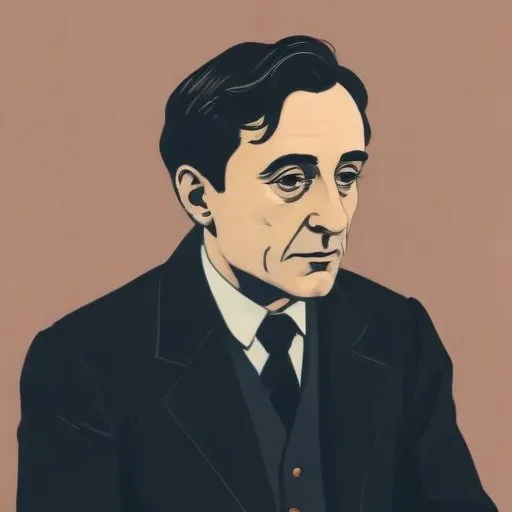
A prominent logical positivist, he championed the idea that only verifiable statements are meaningful, and his book "Language, Truth, and Logic" remains a seminal work in 20th-century philosophy.
Sir Alfred Jules Freddie Ayer, aka A.J. Ayer, was a renowned English philosopher celebrated for his ardent promotion of logical positivism, a philosophical movement that emphasizes the use of logic and evidence in understanding the world. His influential works, particularly Language, Truth, and Logic (1936) and The Problem of Knowledge (1956), continue to shape the landscape of philosophical inquiry.
Ayer was born on October 29, 1910, in St. John's Wood, London, to Jules Louis Cyprien Ayer and Reine née Citroen, a wealthy family with roots in continental Europe. He was educated at Ascham St. Vincent's School and later at Eton College, where he distinguished himself as a Kings Scholar and demonstrated a keen interest in intellectual pursuits and sports.
Ayer's philosophical endeavors were largely influenced by his studies at the University of Vienna, where he delved into the ideas of logical positivism. He believed that philosophy should focus on clarifying the meaning of sentences and statements, rather than exploring metaphysical or ontological questions. This perspective is reflected in his seminal work, Language, Truth, and Logic, which argues that many traditional philosophical problems stem from linguistic confusions.
Ayer's academic journey took him from Christ Church, Oxford, where he lectured on philosophy from 1933 to 1940, to the University College London, where he served as the Grote Professor of the Philosophy of Mind and Logic from 1946 to 1959. He later returned to Oxford as the Wykeham Professor of Logic at New College. His notable works include:
Ayer's philosophical ideas have had a significant impact on modern society. His advocacy of humanism, logic, and reason has influenced various fields, including science, politics, and education. As the second president of the British Humanist Association (now known as Humanists UK), he championed the causes of secularism and human rights.
Ayer's life was marked by several notable events, including his service as a Special Operations Executive and MI6 agent during World War II. He was knighted in 1970 for his contributions to philosophy and education. Ayer was also known for his witty humor and charismatic personality, which earned him a reputation as a lively and engaging conversationalist.
Ayer's views on homosexuality, which he supported, sparked controversy during his presidency of the Homosexual Law Reform Society. His comment, "As a notorious heterosexual, I could never be accused of feathering my own nest," reflects his commitment to social justice and his willingness to challenge prevailing attitudes.
Sir Alfred Jules Freddie Ayer's philosophical legacy continues to inspire and influence scholars, thinkers, and educators. His emphasis on logical positivism, humanism, and reason has shaped the development of philosophy, science, and critical thinking. As a champion of intellectual inquiry and social progress, Ayer's impact will be felt for generations to come.
Born in 1872
A renowned thinker who made significant contributions to mathematics, philosophy, and social commentary, known for his influential writings on logic, ethics, and politics. He's a prominent figure in shaping modern intellectual thought.
Born in 1889
A philosopher who challenged traditional philosophy by emphasizing the importance of language and its limits, and is famous for his philosophical ideas on logic, reality, and the nature of meaning.
Born in 1909
A Latvian-English historian and philosopher who explored the intersection of philosophy, history, and politics, and is renowned for his work on the Enlightenment, liberty, and the nature of humanity.
Born in 1900
A philosopher who challenged traditional views on the mind-body problem, proposing a more holistic approach to understanding human behavior and consciousness. He's known for his concept of "category mistake."
96 Years Old
Iconic actor of stage and screen, best known for his beloved portrayal of Gomez Addams in the classic TV series "The Addams Family".
Born in 1916
A prominent philosopher and logician, known for his work on philosophical logic, ethics, and the philosophy of religion, making significant contributions to the development of analytic philosophy.
