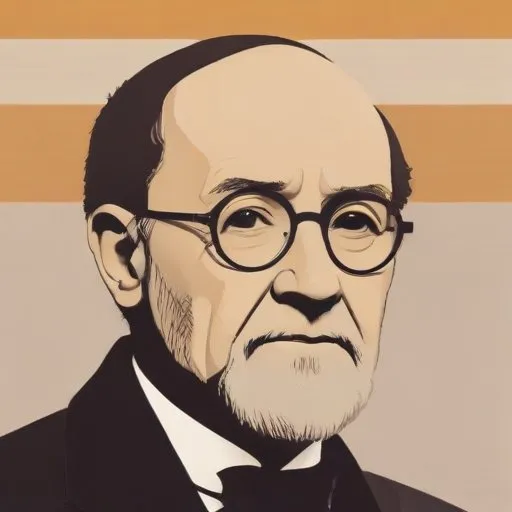
Gilbert Ryle: The Philosopher Who Dispelled the "Ghost in the Machine"
A Critique of Cartesian Dualism
Gilbert Ryle, a British philosopher, is renowned for his relentless critique of Cartesian dualism, a philosophical framework that posits the existence of a non-physical mind or soul that interacts with the physical body. Ryle's work, particularly his iconic book "The Concept of Mind" (1949), has had a profound impact on the development of philosophy of mind, challenging the dominance of dualism and paving the way for alternative perspectives.
A Life Steeped in Philosophy
Born on August 19, 1900, in Brighton, England, Ryle was exposed to philosophy from an early age. His father, Reginald John Ryle, a doctor with philosophical interests, fostered a love for learning in his children, providing them with an extensive library. This environment encouraged Ryle to explore the works of prominent philosophers, including
Bernard Bolzano,
Franz Brentano,
Alexius Meinong,
Edmund Husserl, and Martin Heidegger.
Philosophical Contributions
Ryle's philosophical contributions are characterized by his critique of Cartesian dualism, which he saw as perpetuating a false dichotomy between the mind and body. He argued that this dichotomy led to a flawed understanding of human behavior, neglecting the intricacies of human experience. Ryle's work aimed to dissolve this dichotomy, instead emphasizing the importance of understanding human behavior in terms of observable actions and social contexts.
Ordinary Language Philosophy
Ryle was a key figure in the ordinary language philosophy movement, which emphasized the importance of everyday language and experience in understanding philosophical concepts. This approach was influenced by
Ludwig Wittgenstein's later philosophy, which Ryle admired. Ryle's work in this area focused on the concept of "category mistakes," where philosophers mistakenly assign properties or qualities to the wrong category, leading to philosophical confusions.
Influence on Modern Society
Ryle's philosophy has had a profound impact on various fields, including psychology, sociology, and cognitive science. His critique of dualism has influenced the development of behaviorism and functionalism, which emphasize the importance of understanding human behavior in terms of observable actions and functions rather than inner mental states.
Quotes and Memorable Sayings
* "The general trend of this book will undoubtedly, and harmlessly, be stigmatised as behaviourist." (From "The Concept of Mind")
* "It is not a matter of 'what we perceive' but rather of 'how we perceive'." (ibid.)
Personal Milestones and Key Life Events
Ryle was a professor of philosophy at Oxford University from 1945 to 1968, where he taught and influenced many prominent philosophers. He was also a fellow of Magdalen College, Oxford, and served as the editor of the philosophical journal "Mind."
Historical Context and Legacy
Ryle's work must be understood within the context of the philosophical landscape of the mid-20th century. His critique of dualism was a response to the dominant Cartesian and idealist philosophies of the time. Ryle's influence can be seen in the development of subsequent philosophical movements, including functionalism, eliminativism, and embodied cognition.
Comparative Analysis with Contemporaries
Ryle's work can be compared to that of other influential philosophers of his time, such as Wittgenstein,
Bertrand Russell, and A.J. Ayer. While sharing similarities with these thinkers, Ryle's unique approach and emphasis on ordinary language philosophy set him apart.
Career Highlights and Major Works
*
The Concept of Mind (1949)
* "Systematically Misleading Expressions" (1932)
* "Philosophical Arguments" (1945)
Trivia and Fun Facts
* Ryle's family has a long history of notable figures, including his ancestor John Ryle, a silk merchant and friend of
John Wesley.
* Ryle's brother, John Alfred Ryle, was a head of the family and a notable figure in his own right.
Final Thoughts
Gilbert Ryle's philosophical contributions continue to influence contemporary debates in philosophy of mind and cognitive science. His relentless critique of Cartesian dualism has paved the way for alternative perspectives, shaping our understanding of human behavior and experience. As a philosopher, Ryle's work serves as a testament to the power of critical thinking and the importance of challenging dominant ideologies.