


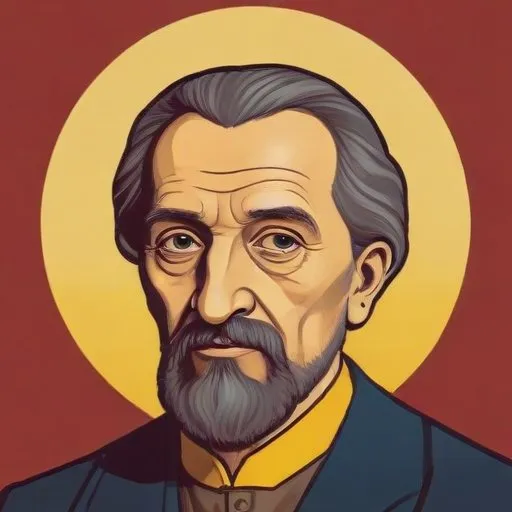
Developed a theory of objects that can be thought of but do not exist, and explored the concept of "non-being" in philosophy. His work influenced the development of philosophical logic and semantics.
Known for his groundbreaking contributions to ontology and theory of objects, Alexius Meinong was an Austrian philosopher who left an indelible mark on the world of philosophy. His unique approach to understanding reality, which deviated from traditional views, earned him a special place in the annals of philosophical history.
Meinong was born on July 17, 1853, in Lemberg, Austria-Hungary (now Lviv, Ukraine), to Anton von Meinong, a high-ranking officer who was granted the hereditary title of Ritter in 1851. Meinong's educational journey began at the Akademisches Gymnasium in Vienna, where he studied from 1868 to 1870. He then enrolled at the University of Vienna law school, where he was drawn to Carl Menger's lectures on economics.
It was during the winter term of 1874-1875 that Meinong began to focus on history and philosophy. He became a pupil of Franz Brentano, a prominent philosopher who had recently joined the faculty. Under Brentano's guidance, Meinong developed his philosophical ideas, which would later parallel those of Edmund Husserl, another notable philosopher who was also a student of Brentano.
In 1882, Meinong became a professor at the University of Graz, where he later became the chair of the philosophy department. During his tenure, he founded the Graz Psychological Institute in 1894 and the Graz School of experimental psychology. He supervised the doctorates of prominent philosophers, including Christian von Ehrenfels, founder of Gestalt psychology, and Adalbert Meingast.
Meinong's magnum opus is his theory of objects, which posits that objects can exist independently of human perception or experience. He argued that objects can be real, even if they do not exist in reality. This concept, known as "Meinong's jungle," has been influential in the development of modern ontology.
Meinong's philosophical contributions have had a significant impact on modern philosophy. His ideas on ontology and theory of objects have influenced philosophers such as Bertrand Russell and Gottlob Frege. His work has also had a profound impact on the development of Gestalt psychology and the philosophy of mind.
Alexius Meinong passed away on November 27, 1920, leaving behind a rich legacy of philosophical inquiry and discovery. His work continues to inspire philosophers, psychologists, and scholars across the world, and his ideas remain a vital part of ongoing debates in ontology, epistemology, and philosophy of mind.
Born in 1838
A founder of act psychology, known for introducing the concept of intentionality, which holds that mental states are always directed towards objects or aspects of the environment. This idea has had a significant impact on the development of modern philosophy of mind.
Born in 1859
A pioneer of phenomenology, this mathematician and philosopher developed a rigorous method to study conscious experience, seeking to understand how we perceive and interpret the world around us.
Born in 1859
Developed the concept of Gestalt psychology, which emphasizes that the whole is more than the sum of its parts, and is known for his work on the nature of perception and consciousness.
Born in 1848
Developed a formal system of logic and introduced modern mathematical notation, laying the groundwork for modern logic, mathematics, and computer science.
