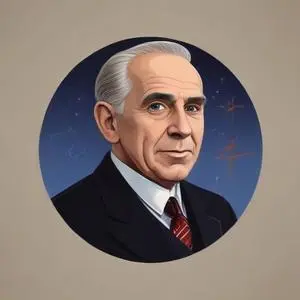
Aage Bohr: The Nobel Prize-Winning Physicist
The Connection between Collective Motion and Particle Motion
Aage Bohr, a renowned Danish nuclear physicist, shared the Nobel Prize in Physics in 1975 with
Ben Roy Mottelson and
James Rainwater for his groundbreaking discovery of the connection between collective motion and particle motion in atomic nuclei. This pioneering work led to the development of a detailed theory on the structure of the atomic nucleus, which was in close agreement with experimental results.
Early Life and Education
Born on June 19, 1922, in Copenhagen, Bohr was the fourth of six sons of the esteemed physicist
Niels Bohr and his wife Margrethe. Growing up in an environment surrounded by prominent physicists, including Hans Kramers,
Oskar Klein,
Yoshio Nishina,
Wolfgang Pauli, and
Werner Heisenberg, Bohr was exposed to the world of physics from a young age.
The Family Legacy
As the son of Niels Bohr, Aage Bohr became part of a unique group of father-son duos who have both won the Nobel Prize. His father, Niels Bohr, was awarded the Nobel Prize in Physics in 1922, making them one of the six pairs of fathers and sons to achieve this feat, and one of the four pairs to do so in the field of Physics.
The Road to Discovery
Starting from James Rainwater's concept of an irregularly shaped liquid drop model of the nucleus, Bohr and Mottelson developed a detailed theory that explained the connection between collective motion and particle motion in atomic nuclei. This work built upon Bohr's graduate research, which focused on the theoretical study of nuclear reactions.
Career Highlights
- Shared the Nobel Prize in Physics in 1975 with Ben Roy Mottelson and James Rainwater
- Developed the theory of the structure of the atomic nucleus based on the connection between collective motion and particle motion
- Made significant contributions to the understanding of nuclear reactions and atomic nuclei
Influence on Modern Society
Aage Bohr's work has had a profound impact on our understanding of the atomic nucleus, paving the way for advancements in nuclear physics and its applications in medicine, energy, and technology.
Personal Milestones
- Born on June 19, 1922, in Copenhagen
- Graduated from the University of Copenhagen with a degree in Physics
- Awarded the Nobel Prize in Physics in 1975
- Passed away on September 8, 2009
Legacy
Aage Bohr's groundbreaking work has left a lasting legacy in the field of nuclear physics, inspiring future generations of physicists and scientists. His contributions to our understanding of the atomic nucleus continue to shape the course of scientific discovery and innovation.
FAQ
What was Aage Bohrs contribution to nuclear physics?
Aage Bohr made significant contributions to our understanding of nuclear physics, particularly in the area of nuclear reactions. His work with his father, Niels Bohr, led to the development of the liquid drop model of the atomic nucleus.
How did Aage Bohrs work lead to the Nobel Prize?
Aage Bohrs work with Ben Mottelson on the structure of atomic nuclei led to the development of the collective model, which was recognized with the Nobel Prize in Physics in 1975.
What was Aage Bohrs role in the discovery of the nuclear shell model?
Aage Bohrs work with Ben Mottelson led to the development of the nuclear shell model, which describes the structure of atomic nuclei. This discovery revolutionized our understanding of nuclear physics and paved the way for new research in the field.
How did Aage Bohrs collaboration with Ben Mottelson shape his career?
Aage Bohrs collaboration with Ben Mottelson was a fruitful and influential partnership that shaped his career and led to significant breakthroughs in nuclear physics.
What is Aage Bohrs legacy in the field of physics?
Aage Bohrs legacy is that of a pioneering physicist who made fundamental contributions to our understanding of nuclear physics. His work continues to influence research in the field and inspires new generations of physicists.