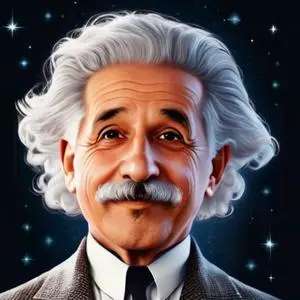
Albert Einstein: The Brilliant Physicist Who Revolutionized Our Understanding of the Universe
The Father of Relativity
Albert Einstein is widely regarded as one of the most influential scientists of the 20th century, best known for his groundbreaking theory of relativity, which transformed our understanding of space, time, and gravity. His mass-energy equivalence formula, E=mc², has become an iconic symbol of scientific innovation and genius.
Early Life and Education
Born on March 14, 1879, in Ulm, Kingdom of Württemberg, German Empire, Einstein grew up in a middle-class Jewish family. His curiosity and passion for learning were evident from an early age, and he was largely self-taught in physics and mathematics. In 1895, he moved to Switzerland, where he completed his schooling and later enrolled in the Swiss Federal Polytechnic University, graduating in 1900 with a degree in physics.
Theoretical Breakthroughs
Einstein's most significant contribution to science was his development of the theory of relativity, which consists of the special theory of relativity (1905) and the general theory of relativity (1915). These theories challenged the long-held notion of absolute time and space, introducing concepts like time dilation, length contraction, and gravitational redshift. His work also laid the foundation for quantum mechanics and had a profound impact on the development of modern physics.
Awards and Honors
Einstein's outstanding contributions to science were recognized with numerous awards and honors, including the 1921 Nobel Prize in Physics for his explanation of the photoelectric effect. He was also awarded the Copley Medal in 1925 by the Royal Society for his outstanding contributions to science.
Influence on Modern Society
Einstein's work has far-reaching implications for various fields, including astronomy, engineering, and philosophy. His theory of relativity has led to breakthroughs in GPS technology, nuclear power, and space exploration. His influence extends beyond science, inspiring new ways of thinking and problem-solving in fields like art, literature, and politics.
Personal Life and Relationships
Einstein's personal life was marked by simplicity, humility, and a deep love for music and sailing. He married Mileva Marić in 1903, and they had two sons, Hans Albert and Eduard. The couple divorced in 1919, and Einstein married Elsa Löwenthal in 1919.
Philosophical Contributions and Beliefs
Einstein's philosophical outlook was deeply rooted in his scientific worldview. He believed in the power of human imagination and the importance of challenging established knowledge. He was a strong advocate for peace, civil rights, and the importance of education.
Legacy and Impact
Einstein's legacy extends far beyond his scientific contributions. He remains an iconic figure, symbolizing the power of human ingenuity and creativity. His work continues to inspire new generations of scientists, thinkers, and innovators.
Fun Facts and Trivia
- Einstein's brain was stolen after his death and was later found to have some unique features, including a higher-than-average number of glial cells, which may have contributed to his exceptional cognitive abilities.
- He was an avid sailor and enjoyed playing the violin in his spare time.
- Einstein's famous equation, E=mc², was not widely recognized until the 1940s, when it became a symbol of the atomic age.
Conclusion
Albert Einstein's remarkable life and work continue to inspire and fascinate people around the world. His groundbreaking theories, philosophical contributions, and personal story have cemented his place as one of the most influential figures in modern history. As we continue to explore the mysteries of the universe, Einstein's legacy reminds us of the power of human curiosity, creativity, and determination.
FAQ
What is Albert Einsteins most famous theory?
Albert Einsteins most famous theory is the Theory of Relativity, which revolutionized our understanding of space and time. It consists of the Special Theory of Relativity and the General Theory of Relativity, which introduced the famous equation E=mc².
What was Albert Einsteins contribution to quantum mechanics?
Albert Einsteins work on the photoelectric effect led to the development of quantum mechanics. He proposed that light is composed of particles, now called photons, which challenged the traditional understanding of light as a wave.
Did Albert Einstein have any notable awards or honors?
Yes, Albert Einstein was awarded the Nobel Prize in Physics in 1921 for his explanation of the photoelectric effect. He also received the Copley Medal in 1925 and was named Time Magazines Person of the Century in 1999.
What was Albert Einsteins early life like?
Albert Einstein was born in 1879 in Ulm, Kingdom of Württemberg, German Empire. He grew up in a middle-class Jewish family and was an average student in school. However, he was fascinated by science and mathematics, which led him to become one of the most influential scientists of the 20th century.
Did Albert Einstein have any notable friends or colleagues?
Yes, Albert Einstein had many notable friends and colleagues, including Max Planck, Niels Bohr, and Erwin Schrödinger. He was also friends with philosophers such as Bertrand Russell and was a strong advocate for pacifism and civil rights.